


_1680206850.jpg)
Public Opening at Locust Projects' New Little River home on March 3, with Rafael Domenech's manipulated photo scrims of Miami (Photo by Irene Sperber)
Standing in the middle of Locust Projects, Miami's successful long running art incubator, my arms are enthusiastically splayed out starfish style in their spacious brand new Little River digs.
Slipped over each arm are two finished lamps which a dozen workshopping elves helped assemble on Feb. 22, readying to hang over naked bulbs affixed from the gallery ceiling. Those of us who signed on for an evening of lamp building (part of LP's Social Factory program) constructed shades from templates made by artist Rafael Domenech, our guide to “enlightenment” that evening, and chosen for Locust Projects inaugural exhibition. A public opening loomed on Friday, March 3.
This is the sort of synergistic activity we have come to expect from Locust Projects in conjunction with the community to complement communication both socially and creatively.
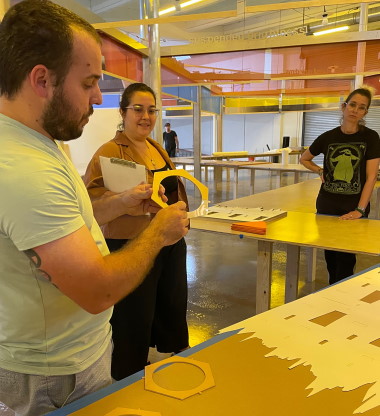
Artist Rafael Domenech explains how to assemble lamps while Locust Project's Laurie Rojas, Program and Grants Consultant, looks on. (Photo by Irene Sperber)
Domenech is an interdisciplinary Cuban-American artist known for his pavilions, installations and public programs. He splits his time between New York and Miami; ergo, is familiar with this area's gestalte. He's been collecting a photographic archive of Miami for some time...reappropriating this archive, distorting the photos digitally, then printing them on screen-like retractable scrims to create variations of the space. Snippets of poems hover over the scrims.
Irene Sperber: "How did you imagine the first new Locust Projects installation, which ultimately was titled 'assembling beneath a desire for sabotage'?"
Rafael Domenech: “...I don’t do prefabricated exhibits...part of it comes from the studio, a lot is fabricated on site. I use local fabricators or a team in the space. I lived here (Miami, full time) 2011 to late 2017. I consider myself from here. I have a lot of ties in the community and heavily invested in the well-being of the eco-system. (Locust Projects) is a space that attempts to create a new set of rules for the artist to make... it places the responsibility on the artist. You are the one in charge of doing as much as you want and to push yourself as much as you want.”
Referring to the lamp building workshop: “It’s about being together and making things together. You’re participating in the show, you are making an object to be part of the show until the end of June.”
Being in Locust the new space as it came into shape had the controlled chaotic excitement of new beginnings...renewed energy lighting the way to a transformation. As forward as Locust Projects has always been, the Little River venue is double in size (8,000 sq. ft) from the previous Miami Avenue site, a suggestion of grander things to come. Everyone here is cranked up on possibilities in this repurposed dry cleaning factory. They are thinking a similar Locust Projects vibe for the future space with a bent toward resembling MOMA PS1 in Queens for parties and events, able to include access to an adjacent outdoor courtyard.
I caught up with Executive Director Lorie Mertes, and by “caught up” I mean that in every sense of the word. The challenge of moving a successful art venue from one place to another is a task that comes with heavy lifting for Miami’s longest-running alternative art space.
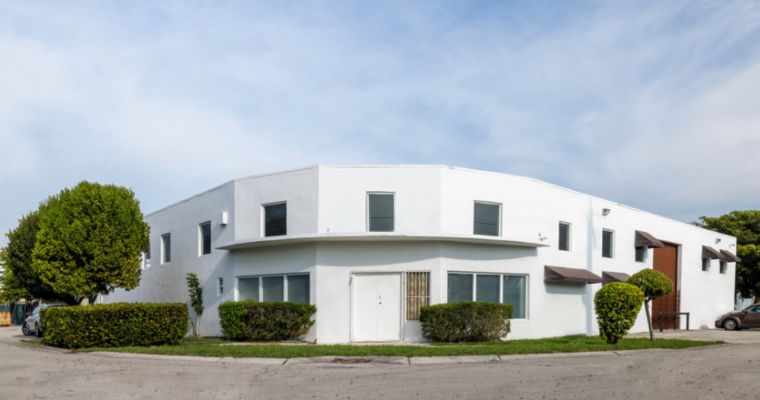
Exterior of Locust Projects in Little River. (photo by Pedro Wazzan)
Irene Sperber: “The cavernous main area of your new “home” is impressive. This is going to change what you show...what’s on the front burner?”
Lorie Mertes: “Interesting challenge, right? You've absolutely put the nail on the head, it's definitely going to change. You want to stay true to providing opportunities to work on a large scale, artists of all career stages, to push their practice and to experiment. Choosing Rafa (Rafael Domenech for first exhibitor) was very intentional; it gave us the chance to move into the space and get to know it. ...It’s the intention that we would eventually build out gallery spaces where artists can control sound and light and all the things they want to do to create those immersive installations that we're known for. I really love working with artists...and the process of seeing art come to life. We want to respond to the needs of artists...it was artists who founded us...the ones who put forth that mission to provide a large scale space that they can’t afford on their own in their own studios, for example. Or maybe that the galleries and more traditional spaces, museums, can't support because of the experimental nature.”
IS: "What happens after Rafael’s installation leaves in late June?”
LM: “We're going to be doing gatherings to get feedback from people within Rafa's space as places to build conversations about the future. Every summer we welcome teams through an open call for local start builders to take over the main gallery and use whatever materials we have leftover from past shows...Rafa offered to let them reuse, recycle, repurpose (material from his show) as they see fit. And so those materials will be taken down and reconfigured by our lab kids. By the time we roll into the fall season and do the construction of this booth...we’re going to at least start one project room space and then have a smaller open main gallery not as big as it is currently.”
IS: “So the way you had the larger space for a main exhibition and a smaller show in the back room at the old place on Miami Avenue will continue?"
LM: “We do want to maintain the balance between a project room, which is a smaller condition space, like we had in the old, but a little bigger than what it was, then maintaining a main gallery so that there's always a balance between an artist from Miami and one not from Miami. That's been going on since the beginning in 1998-99. We want to maintain those opportunities for building community...and both supporting artists at all career stages local, national and internationally.”
IS: “What will the near future bring? You've been incorporating the community and projects by the use of workshops, lectures, live events...is there anything else on the docket for future shock?"
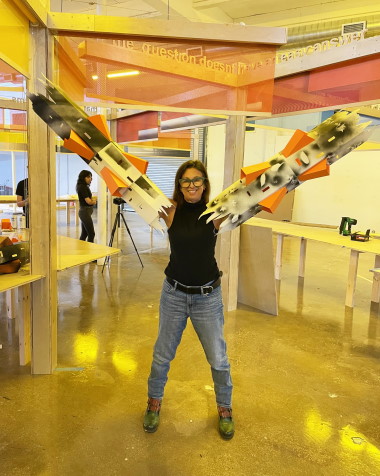
Irene Sperber with lamps... the writer personally spray painted the one on right arm. (Photo by Nina Worth)
LM: “We’re going to be doing an open call very soon...for the lab MFA...this is the normal timing for current MFA students to have an opportunity to be in residence over the summer. That usually gets selected by May. And then our next open call for the new main gallery/ project rooms will also be up in the next two months or so.” For submission info: www.locustprojects.org/for-artists/submissions/
Mertes hinted at several engaging thoughts to add to the community atmosphere, not yet in the “tell-all” category, but I have no doubt we will be happily utilizing the ideas. Mertes was previously director of public programs at the National Museum of Women in the Arts in Washington, D.C, from 1994 to 2006, she served as curator of the Miami Art Museum (aka Pérez Art Museum Miami) receiving the Dade Cultural Alliance’s 2006 Unsung Hero Award for her unswerving dedication to our cultural community. A native of South Florida, Mertes began here managing the Jason Rubell Gallery in the early 1990s.
Locust Projects is a non-profit, which was created in1998 by three artists Westen Charles, COOPER and Elizabeth Withstandley as a place for contemporary artists to create “site specific works outside of the commercial gallery system.”
LM: “We want to have a space people feel like it's their place to come and hang, be, and be seen. We (Miami) need more spaces to gather and build community.... whether it's artists doing curated listening or screening sessions ...combining both visual arts and sound.”
IS: “Miami arts neighborhoods are changing at such a rapid pace...the developers run right in when it starts to take off and the arts get priced out. How do you see that playing out going forward?”
LM: “We truly are still a pioneer city that's being reimagined and imagined, with every new influx of people and ideas. And while I do think it's tough on our arts community, I think there's a resiliency... we might have to keep circling around. The commitment that our local government has to the arts community is super strong. I think arts organizations are thriving, and we’re building a really powerful foundation for a thriving community. I hope we can (also) see building better infrastructure around a higher level education in the arts. That's one of the things we don't have, like Philadelphia has five or six art and design schools. What happens is those students come out and they transform the city.”
IS: “Did I miss any important points on Locust Projects agenda?”
LM: “One of the things that’s so core about what we do is also provide resources. We have free pro bono legal services for artists of all disciplines in our community. Also Wavemaker Grants, a small grant meant to be community based, not traditional exhibition space projects. Artists kick off an idea (with Wavemaker) and then apply for an Oolite or Knight grant for example.” (see more info on their web site www.locustprojects.org/ )
In the coming year, Locust Projects will add a Digital Innovation Lab funded by the John S. and James L. Knight Foundation, where artists can use new technologies to experiment and create. Eyes forward...watch this space.
Join Locust Projects and Oolite Arts for a conversation with Dominic Molon, curator of contemporary art, at the Museum of Art Rhode Island School of Design, Wednesday, April 26 from 7 to 8 p.m. at the Little Haiti Cultural Complex, 212 NE 59th Terrace, Miami.
"Rafael Domench: assembling beneath a desire for sabotage" through June 24 at Locust Projects, 297 N.E. 6th St., Miami. Hours 11 a.m. to 5 p.m., Wednesday through Saturday. locustprojects.org.