



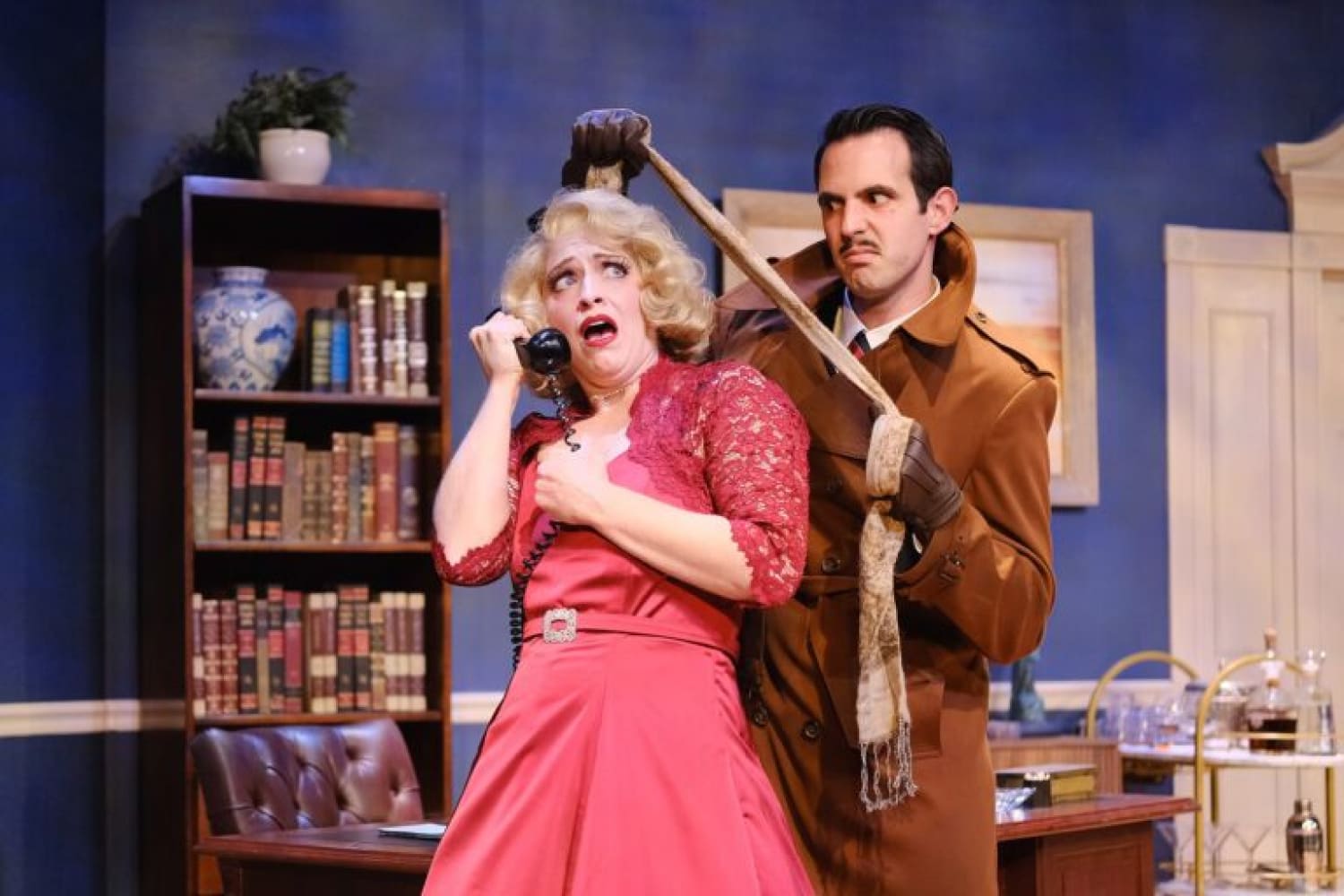
Daniel Llaca as Lesgate has Mallory Newbrough as Margot in a bind. (Photo by Javier Franceschi)
Actors' Playhouse dials up suspense, intrigue, and playfulness in its riveting professional production of "Dial M for Murder," which runs through Sunday, June 7 in Coral Gables. The production, which runs in the Miracle Theatre's intimate upstairs space, lasts about two hours and 15 minutes, including an intermission.
Jeffrey Hatcher's lean adaptation of Frederick Knott's 1952 stage thriller begins enticingly enough to immediately grab our interest, appealing to our darker instincts. "So, how would you murder me?" British socialite Margot asks her girlfriend, Maxine. "How would you like to be murdered?" Maxine responds. "What are my choices?" Margot retorts.
"Dial M for Murder" is not a traditional murder mystery; we know the identity of the villain from the outset. Instead, it functions as a suspense thriller in which we remain riveted, hoping the authorities catch the culprit.
One way Hatcher's adaptation differs from Knott's original is that instead of the lover character being Max Hadley, it is Maxine Hadley. She and Margot are lesbian lovers during a time (the 1950s, rather than the original play's 1920s) when such a relationship would not have been easy to maintain. The same-sex relationship raises the stakes even further than Knott's original or Alfred Hitchcock's film noir adaptation.
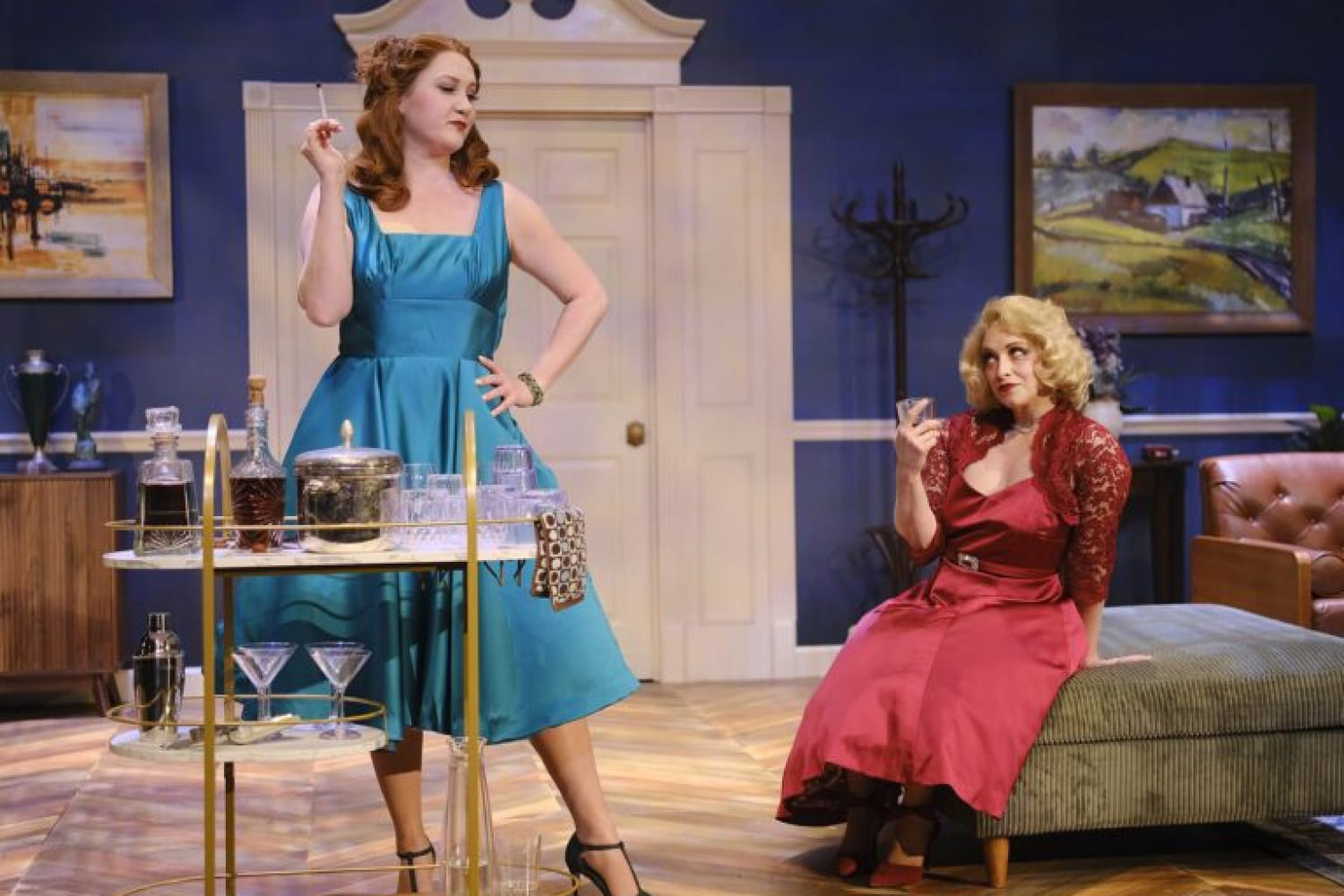
Lindsey Corey as Maxine and Mallory Newbrough as Margot. (Photo by Javier Franceschi)
Even with these changes, the plot is essentially the same. Tony Wendice, a former writer, suspects his wealthy wife, Margot, is having an affair. Fearing that Margot will leave him for her lover, Maxine, and take access to her fortune with her, Tony schemes to hire someone to kill his wife.
Under Actors' Playhouse Artistic Director David Arisco's astute direction, the timing is impeccable, the movement feels deliberate, and the pacing is finely calibrated. In a smart directorial choice, Arisco places Maxine and Margot in close proximity, so that their heads are almost touching. The staging creates an intimate tension that hints at a deeper attraction between the two women. A suspenseful play such as "Dial M for Murder" must maintain clear momentum, and the action never comes close to lagging.
Expect the unexpected. The play also contains red herrings—deliberately false clues designed to mislead the audience. While the story may misdirect viewers, we are also given information that other characters do not know, which heightens the suspense.
The production employs suspenseful music to enhance the sense of danger and mystery. For instance, as suspenseful music plays, Tony hurries to hide or plant evidence, glancing up periodically to make sure Margot is not present.
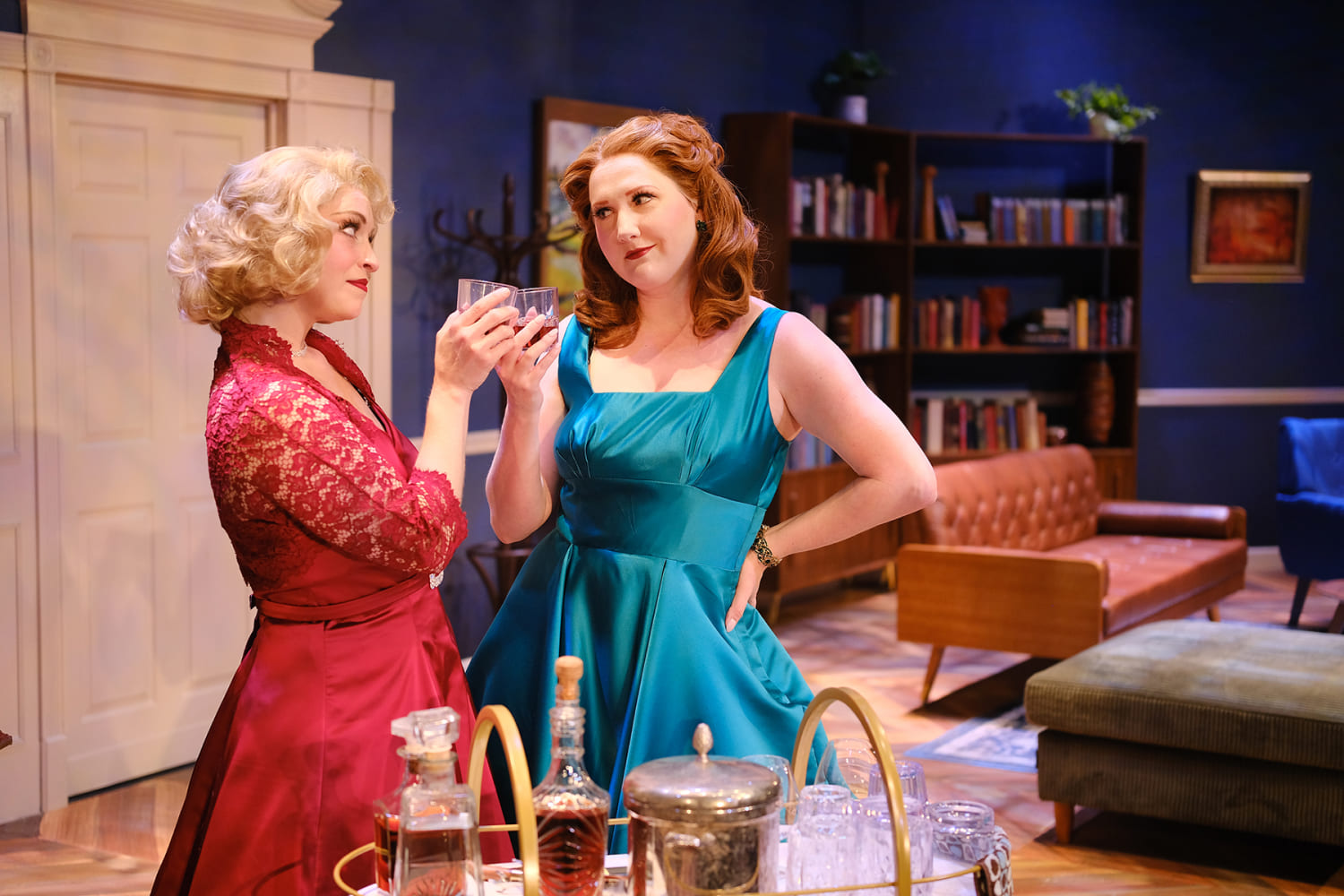
Mallory Newbrough as Margot and Lindsey Corey as Maxine in Actors' Playhouse "Dial M for Murder." (Photo by Javier Franceschi)
In another scene, which takes place mostly in darkness, a voice on a radio discusses the difference between a thriller and a mystery as the hired killer, Lesgate, wary and careful, surreptitiously enters the space. With cat-like speed, he sneaks up behind Margot and strangles her with what resembles an object. Horrified, Margot emits a sound that combines screaming and crying.
The performances are uniformly strong, with the actors, wearing costume designer Ellis Tillman's period outfits, utilizing a winning combination of naturalism and unforced intensity to bring their characters to life.
At the beginning, Ben Sandomir, with leading-man good looks, captures Tony's charm, which masks the character's true intentions. But when Margot and others are not looking, he turns serious and walks with purpose, a clear signal that Tony is intent on following through with his plan to do away with her. At times, he is cat-like in his quickness, rushing in and out of the scene before anyone can catch up to him. He alternates between quick glances to ensure no one is watching and swiftly planting evidence.
As Lesgate, Daniel Llaca deftly conveys the character's shadiness from the outset. With his dark eyebrows lowered in deadly intent and his eyes burning with malevolence, Llaca fully commits to Lesgate's sinister objective. Early on, he admires a representation of himself, noting that he looks murderous, a clever bit of foreshadowing that underscores the character's trajectory. He is as quick as Tony in action. When he attempts to murder Margot, he appears seemingly out of nowhere, and before we know it, he is choking her. The physical struggle between them feels real, thanks in part to fight director Lee Soroko's guidance.
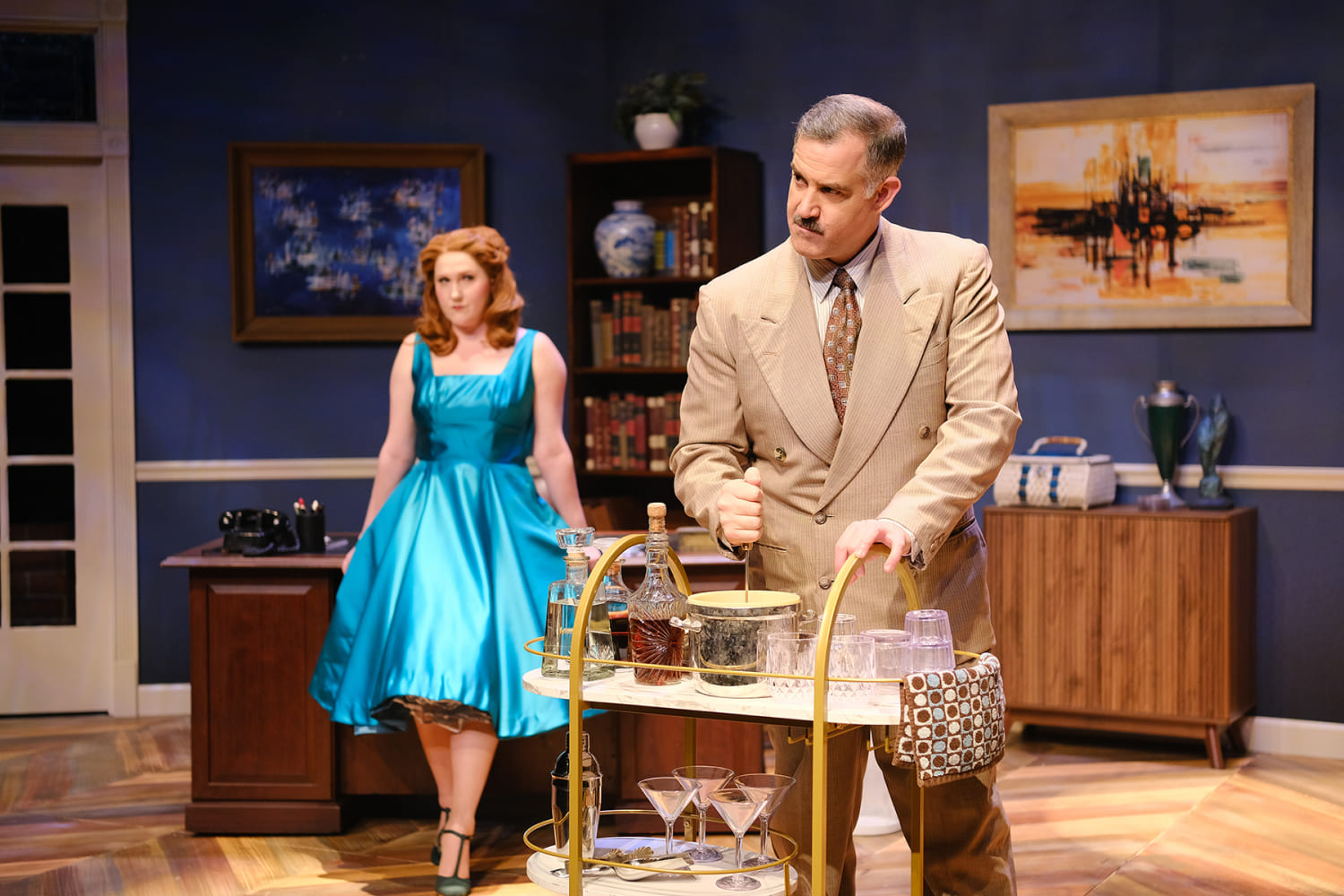
Lindsey Corey as Maxine and Ben Sandomir as Tony Wendice. (Photo by Javier Franceschi)
Mallory Newbrough lends Margot a cultured air without making her seem like a snob. Instead, Newbrough's Margot is a well-spoken, polished socialite who appears entirely unsuspecting. Her calm persona shifts suddenly and seamlessly into panic as she shrieks and begs for her life when Lesgate attempts to strangle her. Without ever forcing the moment, Newbrough also nails Margot's emotional intensity, conveying a woman who is deeply hurt and unafraid to express her anguish.
Newbrough shares strong chemistry with Lindsey Corey, who delivers a multifaceted performance as Maxine Hadley. With a self-assured posture and a clear, sharp tone of voice, Corey is as successful at conveying Hadley's intelligence as she is at capturing her playfulness during intimate scenes between the two women. Hadley is an American crime novelist, and Corey makes her enthusiasm for such stories—and her desire to uncover the truth—clear throughout. While Corey's Hadley speaks with a distinctly American cadence, the actors playing the English characters maintain consistently believable British accents.
Stephen G. Anthony injects the inspector with a formal, business-like demeanor. His voice, while authoritative and at times accusatory, is devoid of even the slightest sentimentality. Throughout, he maintains a serious tone and expression, making it clear that he has a job to do and is not about to let anyone sidetrack him.
The actors perform on K. April Soroko's elegant set, which is realistic and rich with carefully chosen details. These include a comfortable-looking couch, a dark-patterned rug, a multi-level tray for drinks, chandeliers, artwork on the walls, plants, neatly ordered shelves of books, and decorative pieces such as a vase and flowerpot. Clearly, well-to-do people live here. While the set is spacious, the presence of only a couple of transparent windows creates a subtle sense of claustrophobia. Parts of the set are dark, with hues such as brown and deep blue, while white furniture provides contrast, suggesting danger lurking beneath the elegance.
Lighting designer Eric Nelson illuminates the set with mostly bright, realistic lighting, tinged with just a shade of pink to suggest danger lurking beneath the surface. Nelson's lighting is not the only source of illumination in the production. At the beginning and the end, a character lights a cigarette in the dark, creating a noirish effect that emphasizes mystery, danger, and romance.
For the most part, this production satisfies our appetite for suspenseful fare and justice by deftly presenting a dynamic, high-stakes story that hurtles toward a heart-stopping conclusion. However, the ending is ultimately less than satisfying, as it concludes without a strong final visual moment of resolution.
IF YOU GO
WHAT: Actors' Playhouse's "Dial M for Murder."
WHERE: Miracle Theatre, 280 Miracle Mile in Coral Gables
WHEN: Performances are 8 p.m. Wednesday, Thursday, Friday, and Saturday; 3 p.m. Sunday. Through June 7.
TICKETS: $50, $70, $80, and $95.
INFORMATION: Call (305) 444-9293 or visit www.actorsplayhouse.org.