

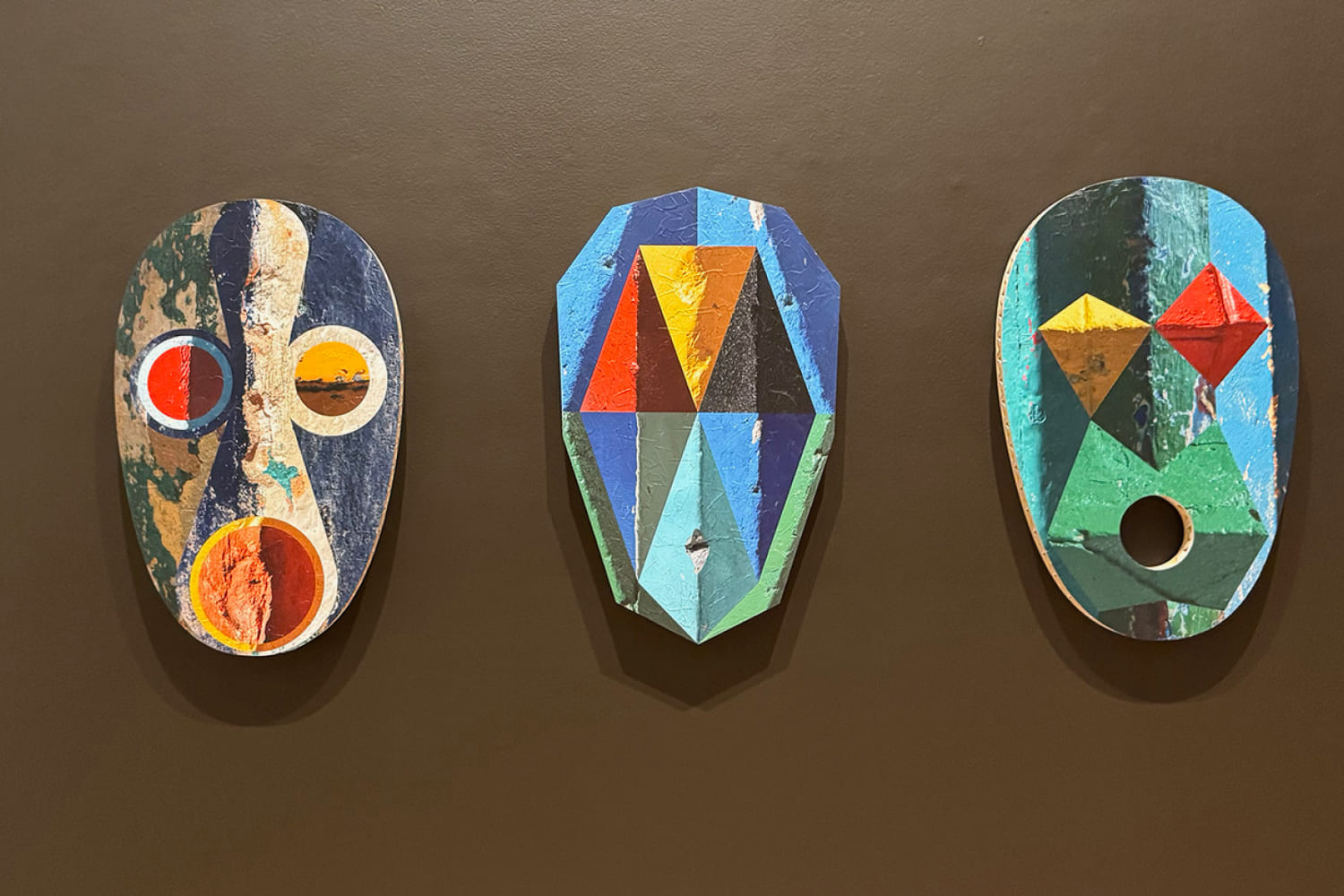
Alexandre Arrechea, (Ink on Wood), Cantor, Truth and Lies, Sound of Seas (photo by Irene Sperber)
Walk into the generous open galleries of University of Miami's Lowe Art Museum with its serenely lit walls and halls for a summer respite. With so much content and so many empty intellectual calories swirling around daily, here is the chance to change that up.
These two new exhibitions are worth any trip through traffic and discordant street effluvia. Clear an afternoon for visit between now and when the show closes on Saturday, Sept. 12.
Combined, both landmark exhibitions at the Lowe Art Museum at the University of Miami represent 200 Years of Afro-Cuban Art (1822 - 2022). Harvard University's organizers chose the Lowe Museum for only the second showing of the exhibition "El Pasado Mio/My Own Past," previously shown in Cambridge, Mass.
A group kept in the shadows of the art world, the Cuban artists in "El Pasado Mio/My Own Past" are all of African descent, and many of them are finally rescued from obscurity. How is it possible to form intelligent and comprehensive ideas, avoiding a skewed notion of the world and our place in it, if all people are not represented in the full story? The Lowe fills in many knowledge gaps – 11 female Cuban artists of African descent are included in "El Pasado Mio/My Own Past," who have never been exhibited together before.
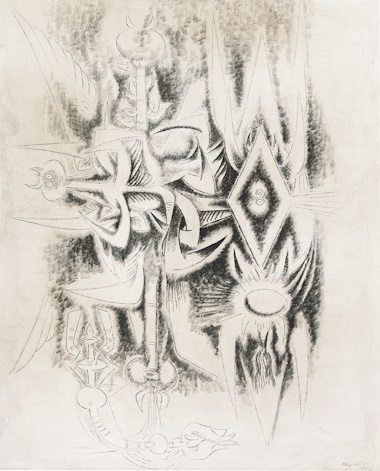
Wifredo Lam, Au Defaut du Jour (Photo by Lowe Art Museum)
These two special exhibits complete a “don't miss" moment: "El PasadoMio/My Own Past: Afrodescendant Contributions to Cuban Art," and "Afrocubanismo: Highlights from the Ramón and Nercys Cernuda Collection" are both curated by Alejandro de la Fuente, Ph.D., and the Director of Harvard's Afro-Latin American Research Institute.
In speaking about the Afrocubanismo works in the Cernuda Collection, Fuentes notes that “Afrocubanismo was a transformative moment, producing some of the most beautiful pieces of visual art in Cuban art history. An exhibition like this, one that centers that particular moment in time, has never been done."
Tola Porter, art historian and museum educator at the Lowe Museum, guided our group through the extensive offerings. With an impressive block of knowledge, Porter dusted off years of Cuban art history, revealing how relevant the past can be. We traversed the Lowe's pleasant spaces, organized through eras, as three Vangardia movements rolled on: the 20s, '30s through '40s, and '40s to '50s..
A variety of spiritual practices are identified here: Yoruba, Santoria, and Abakua, were demonized during the socialist eras. Yoruba is a religion with West African origins, Santería, an Afro-Cuban religion, and Abakuá, a Cuban all-male secret society from Nigeria but separate from the Yoruba tradition. The religions were not necessarily exclusive for the purview of the male gender, however.
Artist Wifredo Lam (1902-1982), of African and Chinese descent with a Cuban mother of Congolese and Spanish background, had been influenced by Picasso. Lam, exposed to many cultural upheavals in his life, became one of the more revered Cuban artists of Modernism. He had a commanding godmother who was a powerful priestess, influencing Lam with her visual language and Santeria. Lam's work comes up in several eras on these walls.
The two exhibitions cover, among many, works from a contemporary movement termed Los Carpinteros (1992-2003) blending architecture, design, and sculpture. A large piece by Alexandre Arrechea hangs in the Lowe Museum permanently. Known for his murals on the Underline in Miami and twenty-blocks of large sculptures on Park Avenue (NYC), Arrechea addresses power, hierarchy, surveillance, control, prohibition, and subjugation in his work.
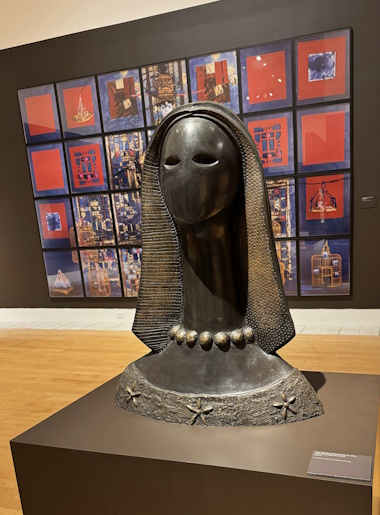
(background) Maria Magdalene Compos Pons, Finding Balance, (foreground) Juan Roberto Diago Durruthy, Niña Feliz (photo by Irene Sperber)
Many of the earlier Afro-Cuban artists represented here had minimal exposure in their time, some ended up becoming obscured from the canon of Cuban art history. A book by de la Fuente, is titled “My Own Past, Afrodescendants Contributions to Cuban Art," a comprehensive tome available in the gallery to scan during your visit. It is written along with Cary Aileen Garcia Yero and published by the Cambridge University Press if you want to dive deeper into this fascinating subject.
Several artists depicted here taught or studied at Havana's Academia Nacional de Bellas Artes San Alejandro, the oldest and most prestigious fine arts school in Cuba, not to mention all of Latin America.
I could see a variety of influence in both directions as we walked from gallery to gallery; visual references to Diego Rivera, Picasso, Degas, the surrealists, even the Florida Highwaymen (a movement of 26 African American artists 1950- 1980). You will find yourself connecting the dots of impact and historic significance.
Grupo Antillano apparently was an overlooked art movement between 1978 and 1983, supporting African practices in Cuban culture: modern, surreal, and abstract styles stand out.
Cuba is the largest country in the Caribbean. A participant in and of copious universal changes, it's been ruled in the past by Spain and the U.S. as well as a brief British occupation, creating a multi-cultural heritage heavily augmented by approximately 800,000 enslaved Africans brought mainly from West Africa, close to twice as many as the United States, between 1808 and 1820 during the sugar and coffee boom. A variety of situations and the melding of cultures fueled personal upheaval that conveyed profound depth of creativity to these islands.
“Afrocubanismo: Highlights from the Ramón and Nercys Cernuda Collection" will complete your day at the Lowe. The Cernudas are instrumental in creating a solid global gravitas around Miami as an art hub. Jill Deupi, Ph.D., the Lowe Art Museum's Beaux Arts Executive Director and Chief Curator explained, “our companion exhibition explores the complexities and contradictions of Afro-Cuban culture which played a vital and persistent role in Cuban Modernism."
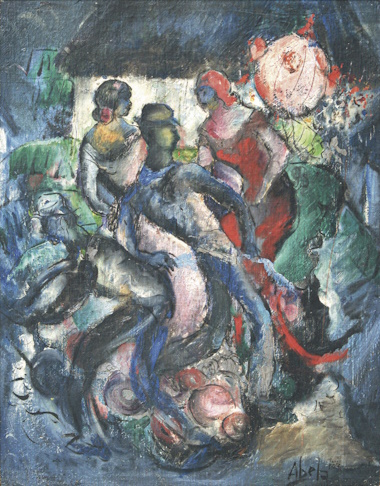
Eduardo Abela, Party at the Batey
The artists in this selection are more well-known than in the other exhibition. Eleven female artists in the Cernuda Collection shed light on another previously restricted group of Cuban artists.
Afrocubanismo was a cultural movement encompassing visual arts, literature and music from 1930 to1940 that came to prominence during Cuba's first Vanguardia wave. Many of these artists visited Paris in the 1920s where they were influenced by the Parisian fascination with sub-Saharan African art of that time.
One more thing: don't miss the Archival Room in the Lowe Museum, which gives an added degree of depth to the Afro-Cuban art heritage via journals, images, books, and letters.
Visiting these shows will be a rewarding afternoon well spent, cracking open doors of information, some you know, some you don't. My visit stays within me as I continue pondering the artists, their experiences, growth and significance both for the past and future.
Deupi underscored that “The Lowe is honored to present "El PasadoMio/My Own Past: Afrodescendant Contributions to Cuban Art," which not only contextualizes these lost voices but also brings them into dialogue with contemporary artists, and artists from the Cuban Vanguardia that are featured in the companion exhibition from the Cernuda Collection."
Clarity and diversity are the key to all things. Start with the Lowe Museum this summer.
If you are new to the Lowe Museum experience, let me answer your first question: Yes, there is easy parking. A proper parking garage is located across from the museum area off Stanford Drive. It's down a short driveway so keep an eye out for it.
- Lowe Art Museum, University of Miami, 1301 Stanford Drive, Miami
- Hours are 10 a.m. to 4 p.m. Wednesday through Saturday. Closed Sunday through Tuesday. Exhibition through Saturday, Sept.12.
Note: Check in regularly with Lowe's web site to identify upcoming programming at https://www.lowe.miami.edu/