

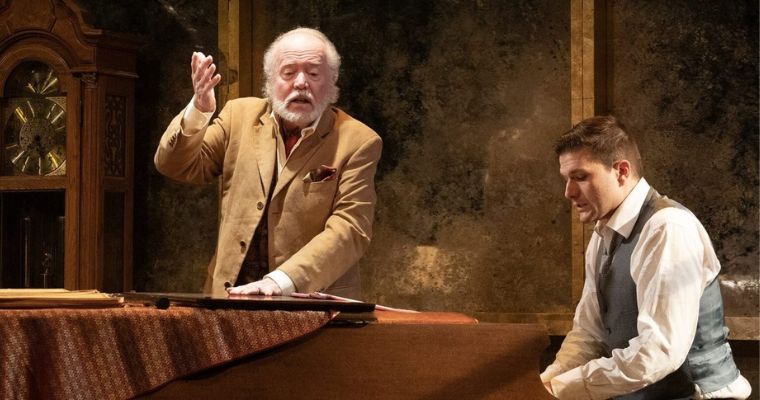
Professor Mashkan (Keith Baker) and Stephen Hoffman (Teddy Warren) appear in a scene from GableStage's production of "Old Wicked Songs" through Sunday, Feb. 4 at the theater at the Biltmore Hotel in Coral Gables. (Photo by Magnus Stark)
Music’s power to move us and bring us together is evident in the touching, eloquent, and comic play, “Old Wicked Songs,” a 1996 Pulitzer Prize finalist now playing at GableStage in Coral Gables.
The timely and timeless two-hour production, which includes a 15-minute intermission, is the Miami premiere of Jon Marans’ popular play with music. It runs through Sunday, Feb. 4.
GableStage’s production of the two-hander, which Marans based loosely on his experiences studying in Vienna, features strong performances by versatile actors Keith Baker and Teddy Warren. Their director is Marans, who guides the actors sensitively and with attention to detail. Meanwhile, other behind-the-scenes theater artists do their part to bring 1986 Vienna, Austria to vivid life.
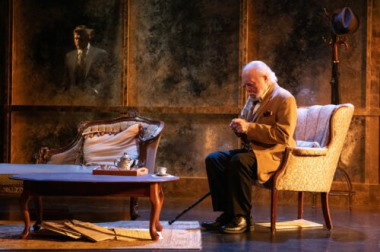
Professor Mashkan (Keith Baker) spends time alone as Stephen Hoffman (Teddy Warren) appears outside in Jon Marrens "Old Wicked Songs" at GableStage. (Photo by Magnus Stark)
It is rare in productions of “Old Wicked Songs” for both performers to not only act but play the piano. Usually, a special type of piano makes it appear as though both performers are playing. But in GableStage’s production, Baker and Warren not only disappear into their characters’ skin, they prove to be highly-accomplished pianists. In addition, they sing, in German no less, with clarity, vocal control, and deft expression.
South Florida theatergoers are fortunate to have the chance to experience these tour-de-force performances. Certainly, GableStage scored a coup by its casting since the actors playing piano as part of their characterizations lend the production an impressive authenticity. (Just a note: The production could have benefitted from subtitles when the characters speak and sing in German.)
“Old Wicked Songs” takes place in a rehearsal studio at a Viennese university, where middle-aged Professor Josef Mashkan teaches voice.
One day, 25-year-old former American piano prodigy Stephen Hoffman arrives at the studio. He thinks it belongs to a piano professor with whom he plans to study. However, Mashkan tells Hoffman that in order to study piano accompaniment, he must first learn how to sing, so that he can understand how singers feel. Hoffman reluctantly agrees to study with Mashkan, hoping that it won’t be long before he can begin piano studies.
You might say the two men form an odd couple. After all, Mashkan is a mercurial, Viennese older man who speaks like an anti-Semite. Contrastingly, Hoffman is a Jewish, arrogant, and opinionated younger American. But after the two begin working together, they grow comfortable enough to spill their secrets. In addition, they realize that despite their differences, they share more in common than they thought.
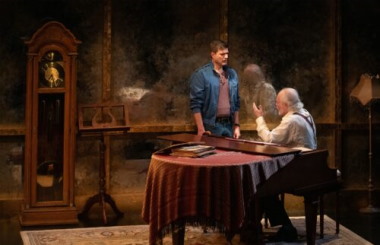
Teddy Warren as Stephen Hoffman and Keith Baker as Professor Mashkan in "Old Wicked Songs." (Photo by Magnus Stark)
True, “Old Wicked Songs” is formulaic. At first glance, it may seem like just another play about an odd couple overcoming their differences by embracing what they have in common. But what sets Marans’ play apart from other similar works is the playwright's inventive use of music. For instance, the moods and subject matter of the songs mirror the characters’ feelings and emotions.
Mashkan teaches Hoffman to sing by having him study and perform German composer and pianist Robert Schumann’s (1810-1856) famous song cycle, “Dichterliebe (A Poet’s Love).” While Schumann composed the music (a haunting combination of sadness and joy), German poet and writer Heinrich Heine (1797-1856) wrote the heartfelt lyrics for the cycle’s 16 songs.
“Dichterliebe (A Poet’s Love)” tells the story of a young man rejected in love. He comes to terms with his loss through reconciliation and forgiveness.
In one of the “Dichterliebe’s” songs, “Im Wunderschonene Monat Mai,” (“In the Wondrous Month of May”), a man talks about his love for a woman. “In the wondrous month of May, when all the birds were singing, then it was I confessed to her my longing and desire,” so goes the poem.
While the man in the poem experiences longing and desire during a season of new beginnings, Hoffman longs to once again play the piano after at least a year’s absence from the instrument. In fact, Marans’ text suggests Hoffman is in a “relationship” with the professor’s piano.
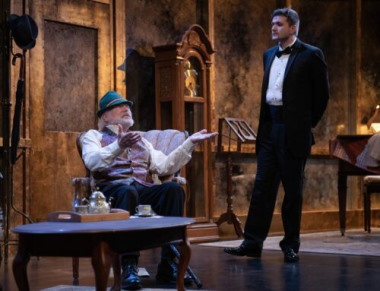
Professor Mashkan (seated) speaks to Stephen Hoffman (Teddy Warren) after he returns from a night at the opera. (Photo courtesy of Magnus Stark)
“You almost tried to rape my piano!” the eccentric professor tells Hoffman. “She must be flirted with, not pounced on. Caress her keys. Let her know she is safe in your arms. Once that is established, then you can be wild and passionate.”
Speaking of passion, Hoffman’s time in Vienna rekindles his pride for his Judaism. The play’s setting of 1986 is the year that former U.N. Secretary-General Kurt Waldheim successfully ran for the chancellorship of Austria despite his Nazi past. Mashkan’s Anti-Semitic remarks, coupled with Waldheim’s candidacy, prompts Hoffman to don a yarmulke (skull cap).
“It’s time Vienna saw some Jews who were proud of their heritage,” Hoffman says.
“Old Wicked Songs” explores themes such as art, history, and identity. More specifically, the play seems to ask whether it is better to hide one’s identity or celebrate it. It is an especially timely question to ponder, with Anti-Semitism raging in the world – not only through words but violence.
With Anti-Semitism erupting seemingly everywhere, this is an apt time to stage plays with Jewish themes. So, credit not just GableStage, but other theater companies in South Florida and elsewhere, for deciding to stage pieces centering on themes relevant to Judaism.
“Old Wicked Songs” deals with, among other things, the Holocaust. Specifically, Hoffman visits the Dachau concentration camp, one of the first built by Nazi Germany and the longest running one. When Hoffman arrives at the site, he is shocked to discover “how beautiful” Dachau has been “fixed up.”
“Most of the buildings - gone. Those that were left - whitewashed. The grass - so green. A stream near the side of the camp had a quaint little bridge. If I hadn’t known better, I’d never suspect these few acres of land had been crowded with thousand(s) of emaciated, tortured bodies,” Hoffman says.
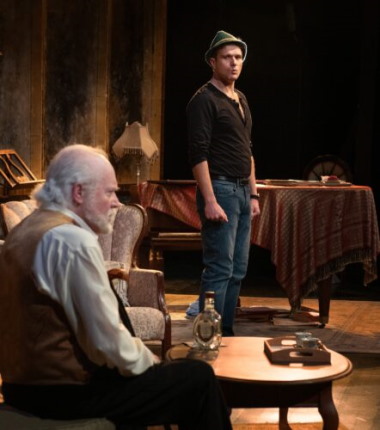
Professor Mashkan (Keith Baker) contemplates something as Stephen Hoffman (Teddy Warren) looks on, sporting a Tyrolean hat. (Photo by Magnus Stark)
Through such passages, without preaching, the playwright highlights the theme of keeping history, even if it’s a horrific past, alive. “Never forget,” Marans seems to say without using those words.
“I knew nothing that went on there,” a woman tells Hoffman while he is on his way to the former concentration camp.
And when Hoffman asks Mashkan whether he thinks Waldheim is a Nazi, the professor responds, “It’s 1986, who cares?”
Speaking of the professor, one of the play’s surprises involves him, but we won’t reveal it.
We will say that Baker shines as the unpredictable professor, although his accent does not sound convincing.
With wide dark eyes peering out from behind dark glasses, the grey-haired performer imbues the character with a wry wit and speaks German as though it’s his native language. In addition, Baker lends Mashkan a polished air that befits someone as educated as he is. But Baker’s Mashkan can also be stern, irritable, angry, and unpredictable. As a matter of fact, he sometimes shakes with anger. Also, Baker emphasizes his character’s vulnerability. At one point, with wide, horrified eyes, Mashkan makes you feel for the man.
Opposite Baker, the dark-haired, dark-eyed Warren, his arms at times folded, endows Hoffman with intense impatience and irritability. Clearly, he does not wish to be in Mashkan’s studio. But at least once, noticeable joy escapes Warren’s voice, such as after he plays the professor’s piano.
Warren makes Hoffman’s transition from an awkward, uptight, and unpolished young man to a calmer, more content, enthusiastic, and caring person. The transformation happens gradually, almost unnoticeably, which is a credit to Warren. He also possesses a strong, pleasant, and expressive singing voice, and speaks German with seeming ease.
The actors, clad in Gema Valdes’s striking and appropriate costumes, perform on scenic designer Frank J. Oliva’s impressively natural-looking, spacious set. With items such as pre-World War I furniture, the set depicting the studio carries a historic, worn, yet tasteful aura. Other items such as a gramophone and an antique clock further enhance the historical character of the setting. Speaking of the clock, it is perpetually set at 5:35. While that time’s significance is unclear, the fact that it never moves provides rich symbolism; Vienna is unwilling to move on from its shameful past. The clock’s hands are “stuck, as always,” Hoffman says. “It looks like both hands have drooped just about as low as possible, without the energy or strength of character to pull themselves back up.”
Also, behind the scenes, Tony Galaska’s dimmed lighting provides an elegant ambiance as music plays, whether live from the piano or recorded music. At times, recorded music takes over for the live music, filling the performance and audience space with a glorious sound.
The song “Sunrise, Sunset” from “Fiddler on the Roof” includes lyrics that note that life is “laden with happiness and tears.”
Also, sadness and joy are emotions that we sense from songs that comprise the Dichterliebe. Sadness and joy are at “the core of truly beautiful music. Just as it is the core of drama. Of life,” the professor says.
So true.
"Old Wicked Songs" runs through Sunday, Feb. 4 at GableStage in the Biltmore Hotel, 1200 Anastasia Ave. in Coral Gables. Performance times are 2 and 7 p.m. Wednesday, 8 p.m. Thursday-Saturday, 2 p.m. Sunday (an additional 2 p.m. matinee on Saturday, Feb. 3). A streaming version is available during regular performances from Jan. 19-Feb. 4. Tickets are $40, $45, $50, $55, $60, and $65, all with an additional $10 service fee. Discounts are available for students, teachers, artists, military, and groups. A streaming ticket costs $30. For more information, call (305) 445-1119 or go to www.gablestage.org.
NOTE: A conversation with Gerard Schwarz, artistic and music director of the Palm Beach Symphony and professor of music at the Frost School of Music, in honor of Holocaust Remembrance Day, will follow the 2 p.m. matinee on Sunday, Jan. 28. Go to gablestage.org/events for details.