


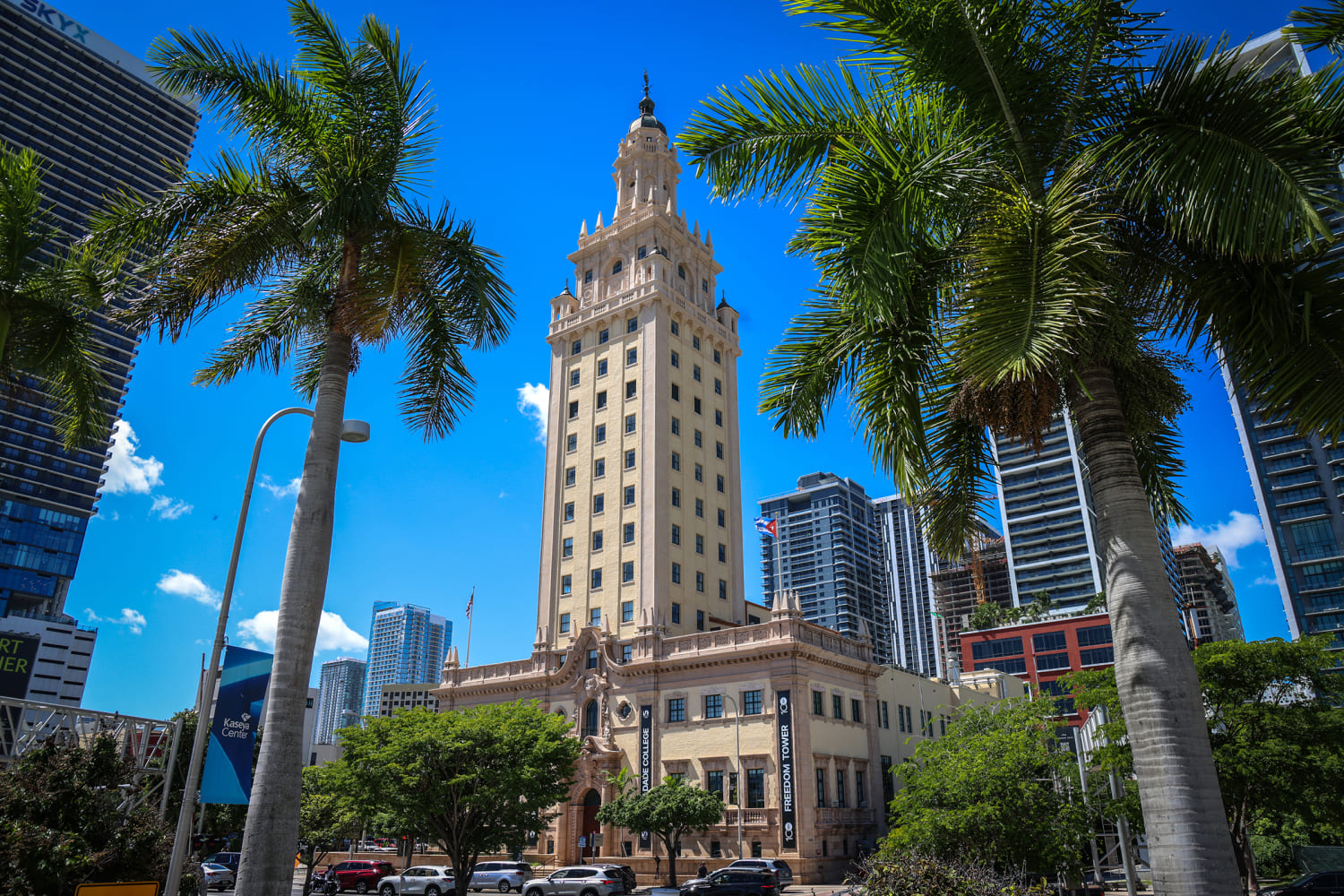
"Odyssey" is a second exhibition at the Freedom Tower since its reopening after a million dollar restoration. (Photo by Giorgio Viera)
Walking up to the elegant entrance of downtown Miami’s one hundred year old Freedom Tower, my mind was distracted by the usual urban detritus of daily life. A noisy, construction-laden cacophony quickly gave way to ambience of the past as the 1925 Mediterranean Revival architecture focused in on who we were then to become who we are now.
Freedom Tower was donated to Miami Dade College (MDC) in 2005. Now, MDC utilizes the building’s historic significance by incorporating the Museum of Art and Design (MOAD), the Cuban Legacy Gallery, the Kislak Center, and the Exile Experience.
Running through Sunday, May 10, the latest exhibition marks the second presented since the Freedom Tower reopened after its latest handsome two-year restoration.
For the latest show, “Odyssey,” MOAD chose to exhibit two equally strong complementary Cuban artists: Painter Carlos Alfonzo (1950 - 1991) and collagrapher Belkins Ayón (1967 - 1999.)
Alfonzo had a previous solo exhibition here in 1999, underlining the circumstances of change that time ultimately served up. I couldn’t help but think of current myriad upheavals as differing ideals and power clashes weigh heavily on populations around the world.
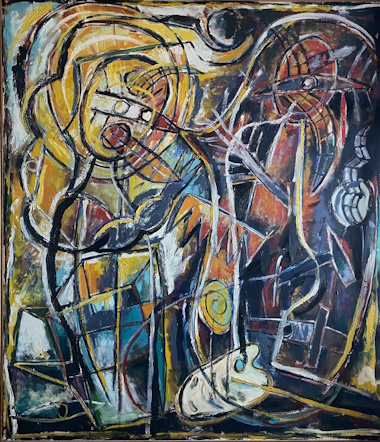
Carlos Alonzo, 'Artist and the Genie." Oil on canvas,1987. On loan from Craig Robins Collection.
Alonzo’s work possesses a colorful frenetic energy with an undercurrent of darkness that exudes chaos and personal distress.
Born in Havana, he studied at the University of Havana before needing to leave for the U.S. in 1980. The Cuban-American painter came here during the Mariel Boatlift, an emigration of around 125,000 Cubans happening between April and November of 1980. His work reflects this upheaval in his maturation.
The two chosen artists’ work is interwoven on the walls of this smaller gallery, causing your eye to strobe between the two quite different treatments. Belkins Ayón (1967 – 1999) heavily leans on strong symbolism in her large pieces, which insists on a deeper look as to meaning.
She was a Cuban printmaker using a technique I was previously unfamiliar with called Collagraphy: a printmaking process of materials adhered to a rigid substrate creating a plate.
Quite taken with her work, I spent time peering into complicated and often disturbing black and white images, in an attempt to figure out exactly how she achieved successfully morphing techniques. Many of the symbols are based on Abakuá, a secret, all-male Afro-Cuban society founded in 1836.
Several ghost-white figures show up; oblong heads and hollow, almond-shaped eyes are unsettling, compelling viewers to want more of the story she is telling.
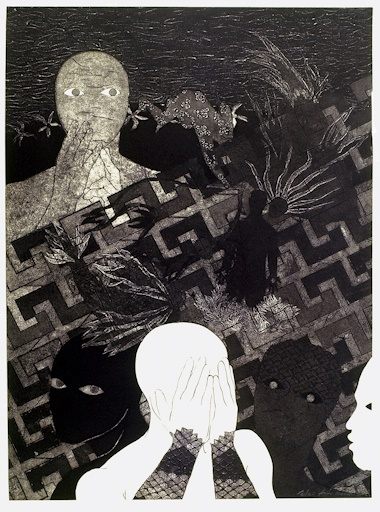
Belkis Ayon, "Sin titulo," "Figura blanca abajo tapandose la cara/Labertinto de grecas." Collagraph, done in 1996. On loan from Carmen Corrales. (Image courtesy of the Belkis Ayon Estate and David Castillo)
Just as I thought I had her processes figured out, I noted another visual clue that made me question further. Information is generously added next to the images to beckon the viewer to enter the artist’s inner realm. The visions have stayed with me.
Noted in Miami’s galleries over the last several years, I see a renewed interest in Afro-Cuban spirituality, for one. The symbolism can be very complex, often disturbing. Dark, deep. Alonzo’s work draws from the symbolic nature of Afro-Cuban Santería.
Traversing the halls of the Freedom Tower, I was struck by how many switchbacks this tiny spit of turf has seen even in the several decades I have lived under the heat of its sun.
I spoke with MOAD curator Amy Galpin regarding how MOAD chose these two artists to exhibit for January through May this year.
Galpin told me she immersed herself in the scholarship on Ayón, and in the case of both artists, she focused on their own words which are emphasized in the exhibition labels.
"In terms of Alfonzo, close proximity to the archives at the Cuban Heritage Collection at the University of Miami and the Vasari Project at the Miami Dade Public Libraries allowed me to hold brochures and cards from past exhibitions," said Galpin, "and to read the artist's correspondence."
"I felt emotional thinking about the artist's resilience."
I inquired of how MOAD intends to build on the foundation that the first two exhibitions created in this newly renovated museum. Galpin explains the histories that echo in the Freedom Tower reinforce the power of storytelling and the ways in which the past shapes the present.
“Our exhibitions do the same. We hope people leave impacted by their visit. That they learn new things and that our shared humanity becomes amplified,” she says.
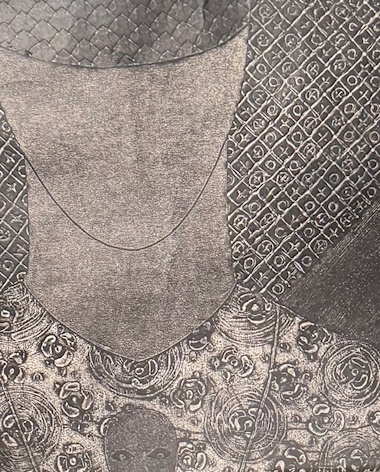
Close up of a collagraph by Belkis Ayon. (Image by Irene Sperber to show artist's process.)
According to Galpin, both Alfonzo and Ayón were shaped by their lived experiences and various aspects of history, art history, and myths.
“They were singular artists who developed recognizable bodies of work. Their art mines complex spiritualities and alludes to persistent struggle.”
Galpin lined up a plan in choosing artists going forward.
“Future exhibitions will reference history, invite reflection, and encourage reconsideration of the present.”
Huge shiny megastructures now erupt from the oolitic limestone base, obscuring shadows of past lives. Native Tequestas once traversed the Miami River in hand-made canoes where we now slurp exotic frozen drinks while lounging on bigger and bigger yachts. Uprooted Cubans once agonized in long lines in Freedom Tower as they were processed in an unfamiliar, unknown world they were about to inhabit.
The Freedom Tower (256 ft tall) was originally the highest building in Miami. I now struggle from my Miami Beach condo across the bay to pick it out from the giant wall of buildings strung across the eastern edge of Miami. In contrast, Miami’s current tallest building, the Panorama Tower in Brickell, stands a whooping 868 feet tall.
Our own lives and thoughts are formed by where we started and experiences encountered along the way. If we don’t know our history, or the history of our environment, how do we know where or who we are now? Refresh your research at the Freedom Tower. It fills in a lot of blanks, especially if Miami is not your home turf. Lives are tangled and re-tangled in our quest for understanding, survival and power.
IF YOU GO
WHAT: Museum of Art and Design presents "Belkis Ayón and Carlos Alfonzo: Odyssey”
WHEN: Through Sunday, May 10
WHERE: MOED on the second floor of the Freedom Tower, 600 Biscayne Boulevard, Miami.
ADMISSION: $18 general admission, MOAD Exhibition free with admission
INFO: moadmdc.org