



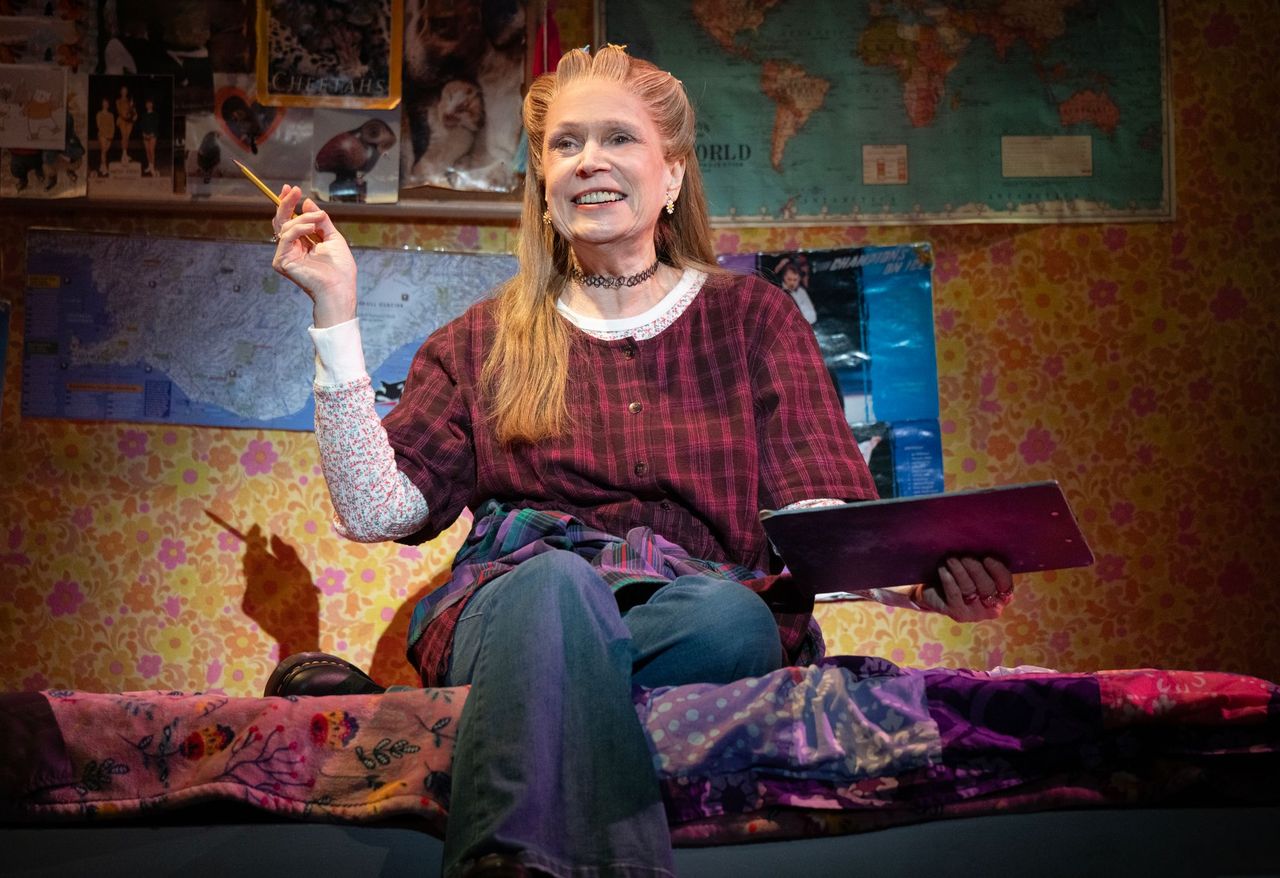
Ann Morrison playing Kimberly Levaco during the National Tour of "Kimberly Akimbo," at the Broward Center for Performing Arts showing until Sunday, April 12.(Photo by Joan Marcus)
The opening song of the Broadway musical “Kimberly Akimbo” is one of those quirky numbers as teenagers skate on stage singing, easily giving the impression that the next few hours will be nothing more than a gimmicky coming of age story. But as the musical unfolds, it reveals something far more grounded and affecting.
Created by Jeanine Tesori (music) and David Lindsay-Abaire (book and lyrics), the production tells the story of Kimberly Levaco, a teenage girl with a rare condition that causes her to age rapidly, forcing her to confront adulthood earlier than anyone should. She is faced with navigating high school life with her condition, a new crush and an interesting family dynamic all while possibly committing a felony.
With a runtime of 2 hours and 25 minutes including one intermission, the national touring production is running at the Broward Center for the Performing Arts through Sunday, April 12.
Set just before the early 2000s somewhere in Bergen County, New Jersey, the story and casting has a uniqueness to it that is unmissable. Sixteen year old Kimberly is in the body of a 70-year-old, played by Ann Morrison, and through her refined understanding of acting and vocal technique, Morrison channels her teen-aged self in a way that feels believable.
Her opening number, “Make a Wish,” does more than showcase her vocal ability, it establishes Kimberly’s inner world. Revealing her desires, frustrations and hopes it sets the emotional tone for what follows. It also signals one of the musical’s strengths: its score functions as an extension of the narrative. Rather than pausing the story, each number actively engages the plot, with lyrics that reveal character motivations and move the plot forward, serving as a form of dialogue in themselves.
Between Kimberly, her parents, her aunt and the supporting cast of high school peers, each character showcases a distinct and relatable identity that allows the audience to connect with the story on multiple levels. Whether that's the telling of her mother's narcissistic tendencies, her father's functioning alcoholism, or her friends' seemingly normal high school struggles, or crazy aunt Debra and her wild history. Kimberly’s condition, while central to the plot, is more like a lens rather than the entire focus, as storylines unfold alongside her character.
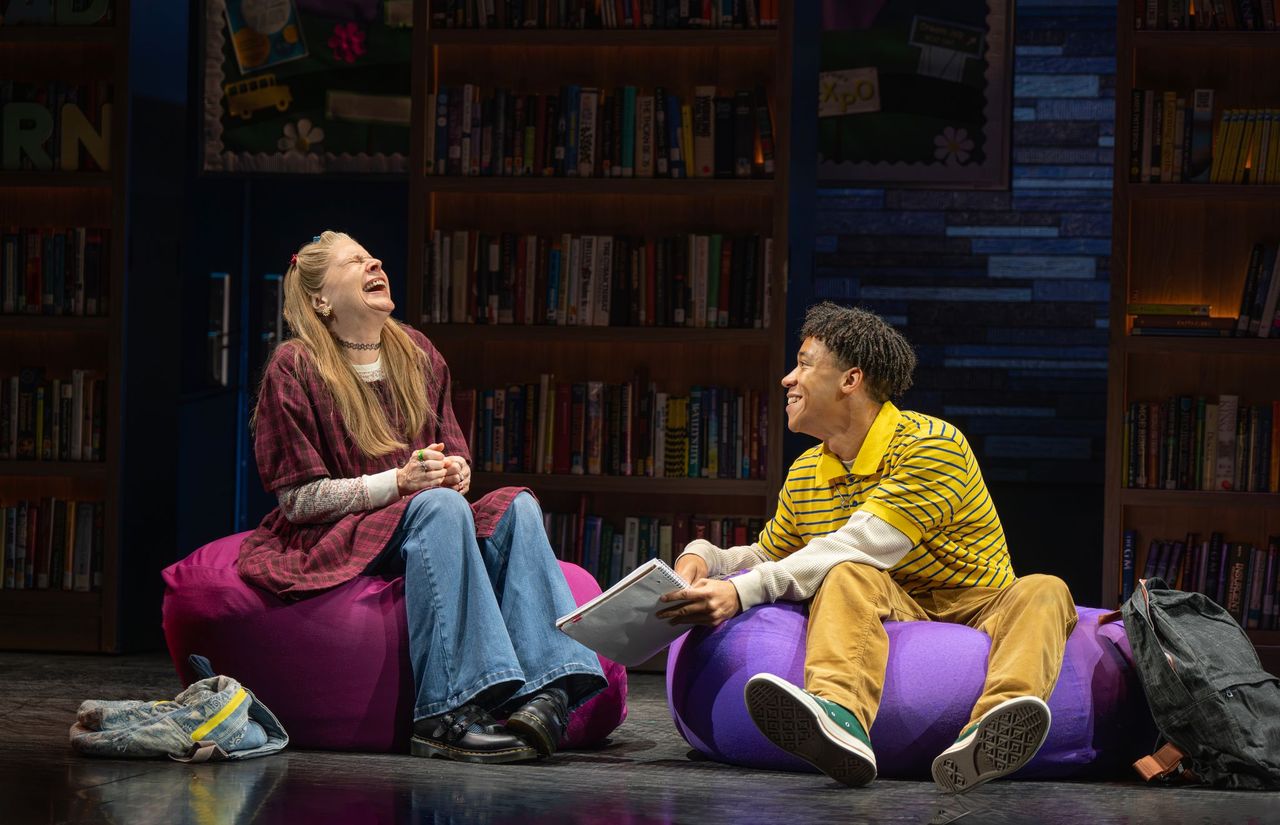
Ann Morrison playing Kimberly Levaco, and Marcus Phillips, playing Seth, during the National Tour of "Kimberly Akimbo," at the Broward Center for Performing Arts.(Photo by Joan Marcus)
The show’s crude humor and occasional vulgar language help create the comic appeal, particularly through Kimberly’s aunt Debra, played by Emily Koch. Koch takes on the role of the overbearing, chaotic aunt, a character shaped by a long history of questionable decisions. Her irreverence, along with her sharp commentary, make her stand out as a source of comic relief. Koch has the ability to balance the emotional side of the story with well-timed humor and the occasional breaking of the fourth wall.
Kimberly’s high school friends, Delia (Gabby Beredo), Teresa (Skye Alyssa Friedman), Martin (Understudy, Regene Seven Odon), Aaron (Max Santopietro), also ground the story in everyday teenage experience. Through their interactions and conflicts there is a layer of relatability, showing that despite Kimberly’s unusual circumstances, the social dynamics and struggles of adolescence remain universal.
The ensemble, that are framed like a Greek Chorus, yet with each character having their own personal struggles, also serve as a supporting chorus for the score. In this production, there is something a bit uneven. There are moments in some of the musical numbers where some voices projected with more confidence and control than other times during the show.
And then there’s Kim's crush Seth, played by Marcus Phillips, who at first might feel like a Scooby-doo type sidekick—one of those quirky, slightly exaggerated characters more common in movies than real life. Yet Phillips gives Seth a depth, embodying beyond just the awkward teenage boy often recognizable in high school students. His backstory, a loss of a parent, emotional distance at home, the pressure to overachieve academically, adds more to what could have been a purely comic and love interest role. Seth’s character, like the rest of the ensemble, helps the balance of comedy and poignancy in “Kimberly Akimbo,” proving that every character contributes meaningfully to the narrative’s heart.
Another element of “Kimberly Akimbo” is the recurring video diary created for a new baby on the way. First introduced in a musical moment featuring Pattie—Kimberly’s mother, played by Laura Woyasz—the device initially comes across as comedic and slightly performative, showing Pattie’s self-centered and image conscious personality in her track “Hello Darling.”
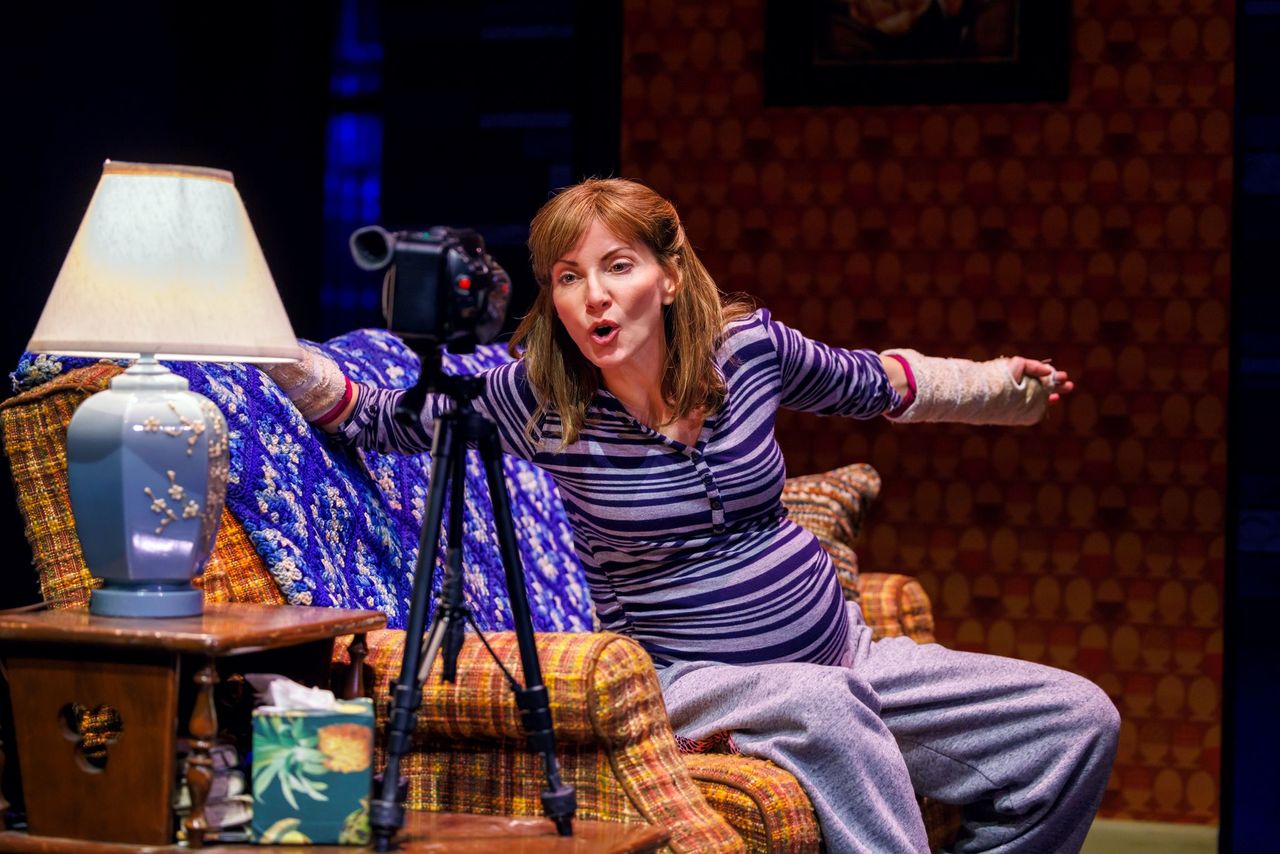
Kimberly's mother, Pattie, played by Laura Woyasz during her musical number "Hello Darling," at the Broward Center for Performing Arts. (Photo by Patrick Gray)
As the show progresses, these video diaries take on a deeper narrative function. What begins as a seemingly superficial gesture moves into a storytelling tool, offering an insight into each character’s internal world. Through these recordings, Pattie’s narcissism become more pronounced, while also showing her need for validation. Kimberly’s father Buddy, played by understudy Benjamin Camenzuli, is often quite passive and battling alcoholic, but uses the format during his number “Hello Baby,” to express emotions about Kimberly and his own life that he struggles to communicate directly.
Most importantly, the diaries allow Kimberly to articulate her thoughts in a space where she feels more seen and heard. In contrast to the chaos of her home life, the recording during “Hello Sister,” shows her taking control of her own life while she has it and self-determination that completes a circular emotional arc from the beginning of the show, where her dreams and wishes are first introduced.
Scenic design by David Zinn, and lighting design by Jeanette Oi-Suk Yew are noteworthy as the scenes change flawlessly with the lighting—also creating moods from highs to lows. Sets are moved in and out by the actors keeping step like a dance routine, helping the transitions feel fully integrated into the rhythm of the show rather than separate. The live orchestrations by John Clancy create an intimate feeling and add to an already impressive score.
This story and production has a little bit of something for everyone between the funny dialogue, the relatable themes or relatively catchy songs. Despite the quirky characters and unique storyline of "Kimberly Akimbo," it ultimately centers on the wants and needs of a young girl, as she begins to truly live them out, mirroring the nature of life itself. At the end, time no longer simply passes her by, instead she takes control of it in the ways she can.
IF YOU GO
WHAT: National Tour of "Kimberly Akimbo"
WHERE: 201 SW 5th Ave, Fort Lauderdale, Au-Rene Theater at The Broward Center for the Performing Arts
WHEN: 8 p.m. on Friday, April 10; 2 p.m. and 8 p.m. on Saturday, April 11; 1 p.m. and 6:30 p.m. on Sunday, April 12
TICKETS: $17.70 to $231.58
INFORMATION: browardcenter.org/kimberlyakimbo