


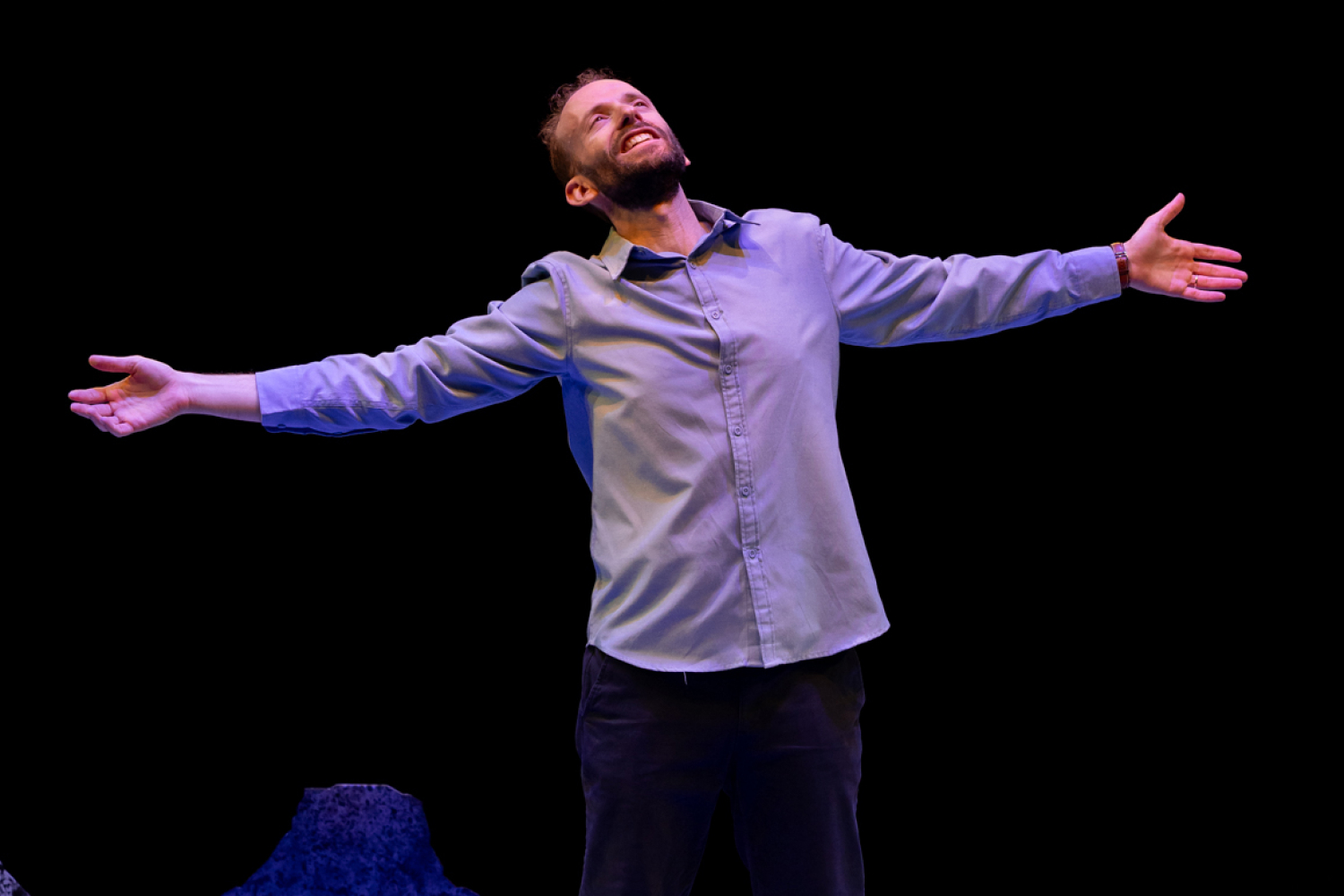
David Rosenberg stars in "Moses" by Michele Lowe making is Florida premiere at Zoetic Stage through Sunday, May 17 at the Adrienne Arsht Center. (Photo by Morgan Sophia Photography)
A fire gutted his home, killing his wife and five children. Yet, in the end, no blaze could extinguish this modern-day Moses's spirit, dream, or enduring love for his family.
Zoetic Stage's heartfelt and believable professional production of Michele Lowe's intense, one-performer play, "Moses," presents a protagonist who, unlike the Biblical figure, ultimately reaches his own promised land. Along the way, however, he faces crucibles that test his faith and resilience.
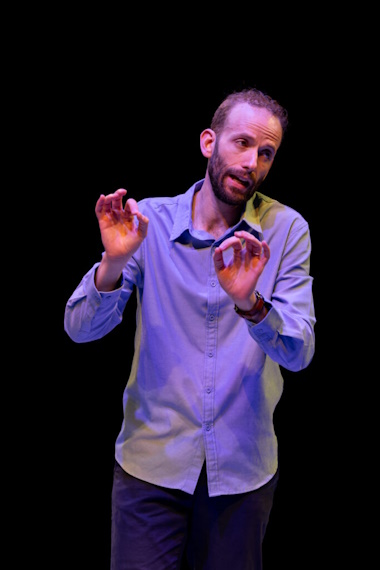
David Rosenberg stars in "Moses," a heart-wrenching story of faith, remorse and the unbreakable human spirit.(Photo by Morgan Sophia Photography)
The 90-minute, intermission-less production, running through Sunday, May 17 in the Adrienne Arsht Center's intimate Carnival Studio Theater, invites audiences to consider faith, belief, and personal struggle while also reflecting on the human spirit's endurance.
Playwright and performer David Rosenberg, a Miami native whose play "Wicked Child" Zoetic produced in January 2024, stars as Moses and serves as the play's narrator. Rosenberg delivers a tour-de-force performance with genuine emotion, naturalism, and a flair for storytelling, while also portraying with humanity multiple characters Moses meets on his journey.
"'Moses" follows a Bronx hardware store employee's seven-year journey through grief and isolation after a fire kills his family and destroys his home. The story traces his crisis of faith, his move to Massachusetts, and his gradual reconciliation with loss as he finds a new sense of purpose and continues pursuing his dream.
The piece includes dreamlike or surreal moments, and the script blurs the line between fantasy and reality. "Did he talk to his family? His father? Nobody remembers," the narrator says at one point. One can expect such lapses in memory from someone who has endured unfathomable tragedy.
The playwright does not always make clear what is real and what Moses may be imagining or dreaming in his fragile state. For example, did he really punch an insurance adjuster so hard that he dislodged the man's two front teeth? You wonder whether this actually happened, especially since no consequences follow this violent act. Elsewhere, Lowe writes, "Is this a dream or is this happening? You tell me."
Answers from audience members may vary, but we can all agree that our world merges with the play's reality when the narrator pauses to consult a rabbi in the audience. In a bit of meta theater, as part of the narrative, rabbis observe the action with the understanding that, during the performance, Rosenberg will ask them questions pertaining to Jewish law and custom. It can be difficult to take in some of those tough questions-such as how one gathers remains for burial after a fire, or whether someone with tattoos is eligible for burial in a Jewish cemetery.
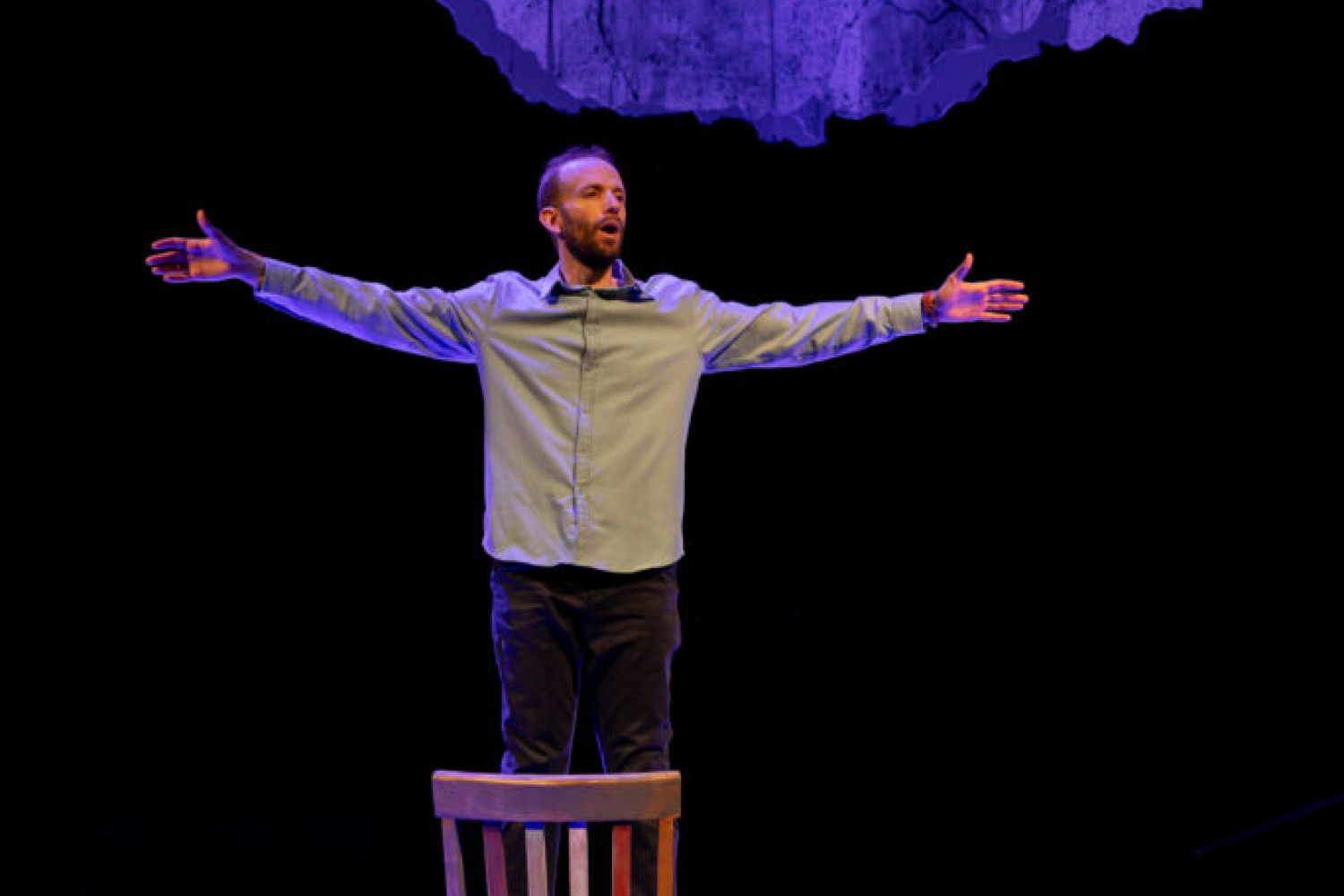
David Rosenberg has the task of taking the audience on a journey in one man's struggle to reconcile profound grief with the possibility that his story isn't yet complete. (Photo by Morgan Sophia Photography)
"'Moses" explores themes such as grief and loss, resilience and survival, crisis of faith, memory and trauma, as well as healing and rebuilding. While the subject matter is dark, Lowe balances it with moments of humor and lightness to keep the piece accessible. Generally, the tone remains engaging and respectful. Lowe has gained a reputation for creating emotionally charged, character-driven plays that blend sharp comedy with deep drama, often exploring the intricacies of love, loss, and human connection,
While the production is largely strong, it assumes audiences understand terms such as "yarmulke" (a skullcap worn by Jewish people to signify reverence) without providing a reference guide in the program. Additionally, the projection screen, which shows images such as flames and snow (projection designer Steve Covey), is positioned high enough that audience members may need to look up and could miss some details.
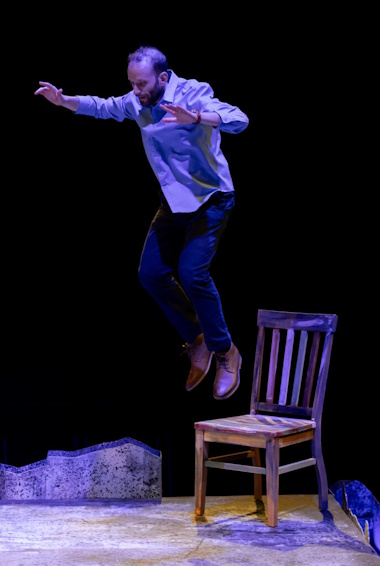
David Rosenberg wrote "Wicked Child," which Zoetic Stage presented in 2024 and now he stars in "Moses." (Photo by Morgan Sophia Photography)
Zoetic Artistic Director Stuart Meltzer directs with an eye for detail, and the action moves fluidly throughout. Movement feels purposeful, and the tone is consistently appropriate to each scene. Meltzer stages the production "in the round," meaning audiences sit on all sides of the stage. This configuration occasionally results in the performer's back facing some patrons. To their credit, Meltzer and Rosenberg ensure that, for the most part, the performance remains clearly visible and audible from all angles.
While the set pieces and props are minimal, the production makes effective use of what is available. For instance, when Moses reaches a high floor in a building, Rosenberg stands atop a chair, which is one of the production's only set pieces and props.
Scenic designer Nikolas Serrano has created a mostly barren, rectangular-shaped playing space. It includes a dark-colored ground coated with something white, perhaps snow or chalk. The outer edges of the space suggest uneven roads or paths with peaks and valleys.
Before the show starts, the stage is empty except for a chair positioned at an angle, facing one corner. Two additional chairs appear before the final curtain. Above the stage is a map-like, four-sided structure that functions as a projection surface, displaying fire and snow effects.
The uneven terrain could suggest the topsy-turvy existence survivors of trauma experience, with emotional highs and lows. The sparse stage may also reflect Moses' isolation and focuses attention on character and narrative.
While he questions God and even yells at the Almighty-evoking Tevye from "Fiddler on the Roof"-this modern-day Moses works hard and remains spirited. Lowe describes him as a "nothing" and a "nobody" who wears brown pants and a brown-and-white shirt. Rosenberg embodies an ordinary "everyman" presence. He carries a pleasant, unassuming demeanor and remains mostly mild-mannered, though emotionally expressive. At one point, he looks upward and yells at God. Despite his anguish, he doesn't break down completely. Instead, he conveys a quieter, sustained suffering.
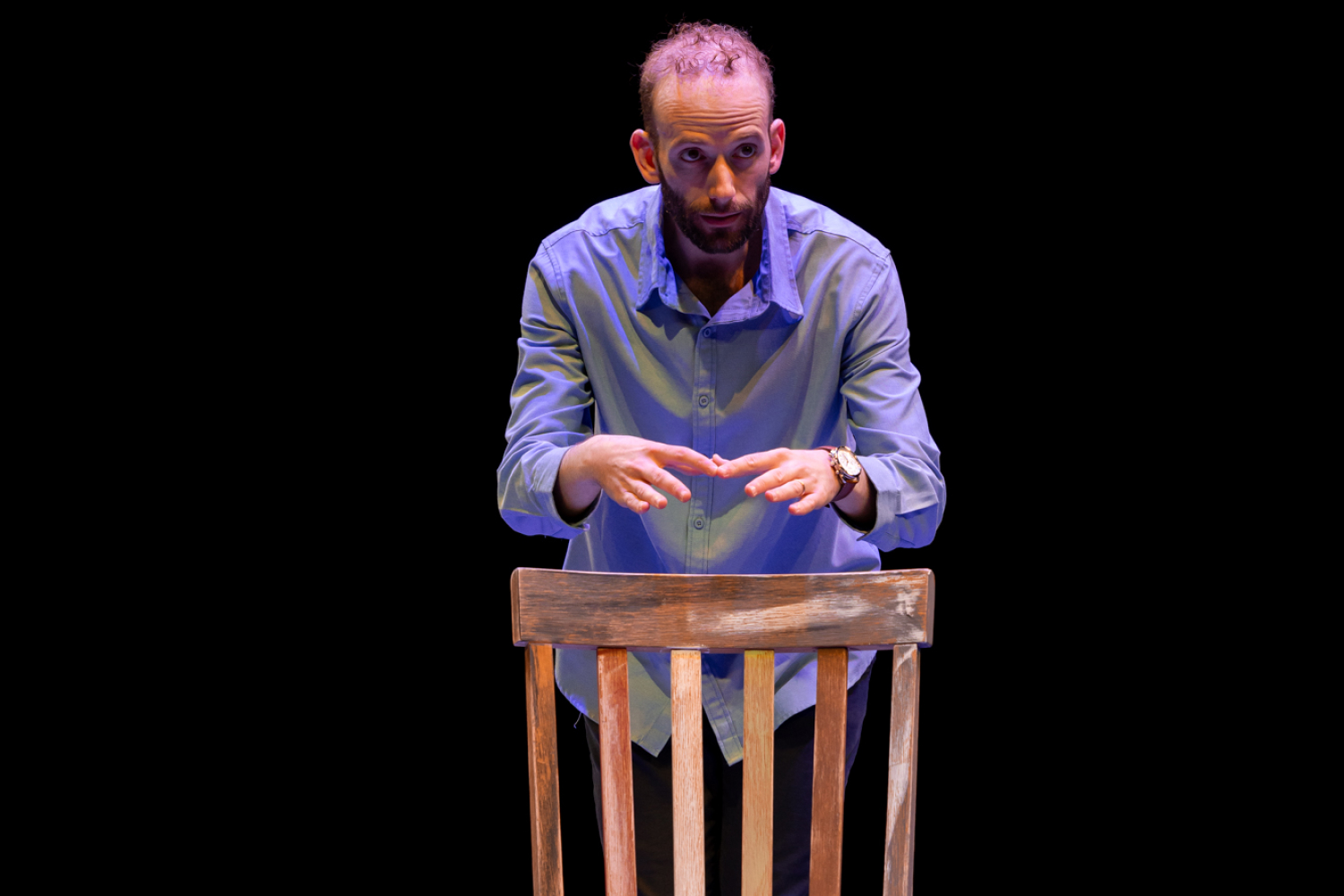
The gripping one-person play by Michele Lowe follows the journey of a man who, after losing everyone and everything he cherishes in a single night, makes a desperate bargain with God: 'You forget about me, and I'll forget about you?'(Photo by Morgan Sophia Photography)
Rosenberg seamlessly transitions between characters through shifts in posture and voice, portraying figures ranging from an elderly woman to a cemetery worker.
A clarinetist, Orin Jacobs, underscores the action with a score that evokes history, struggle, and tradition, recalling "Fiddler on the Roof."
Meltzer keeps the pacing fluid and ensures Rosenberg's movement is purposeful and varied. The director handles lighthearted and dramatic moments with equal care.
Lighting designer Becky Montero appropriately uses mostly naturalistic lighting, with brighter illumination suggesting snowfall.
In a touch of irony, it is a cemetery office worker who ultimately helps Moses recognize that his dream remains alive. Visiting the graves of his wife and children, he worries that he "did nothing for them." But when Moses bares his chest, the moment resonates deeply, revealing how he has carried his loved ones with him all along.
The production ends on a hopeful note, with the sun emerging. It is a fitting conclusion to Zoetic Stage's moving production, which ultimately reaffirms the enduring power of storytelling, faith, and human resilience.
IF YOU GO
WHAT: Zoetic Stage's production of "Moses" by Michele Lowe.
WHEN: Through Sunday, May 17. Show times are 7:30 p.m. Wednesday-Saturday; and 2:30 p.m. Saturday and Sunday.
WHERE: The Adrienne Arsht Center's Carnival Studio Theater, 1300 Biscayne Blvd. in Miami.
TICKETS: $66.69-$72.54
INFO: (305) 949-6722 or visit www.arshtcenter.org or www.zoeticstage.com.