



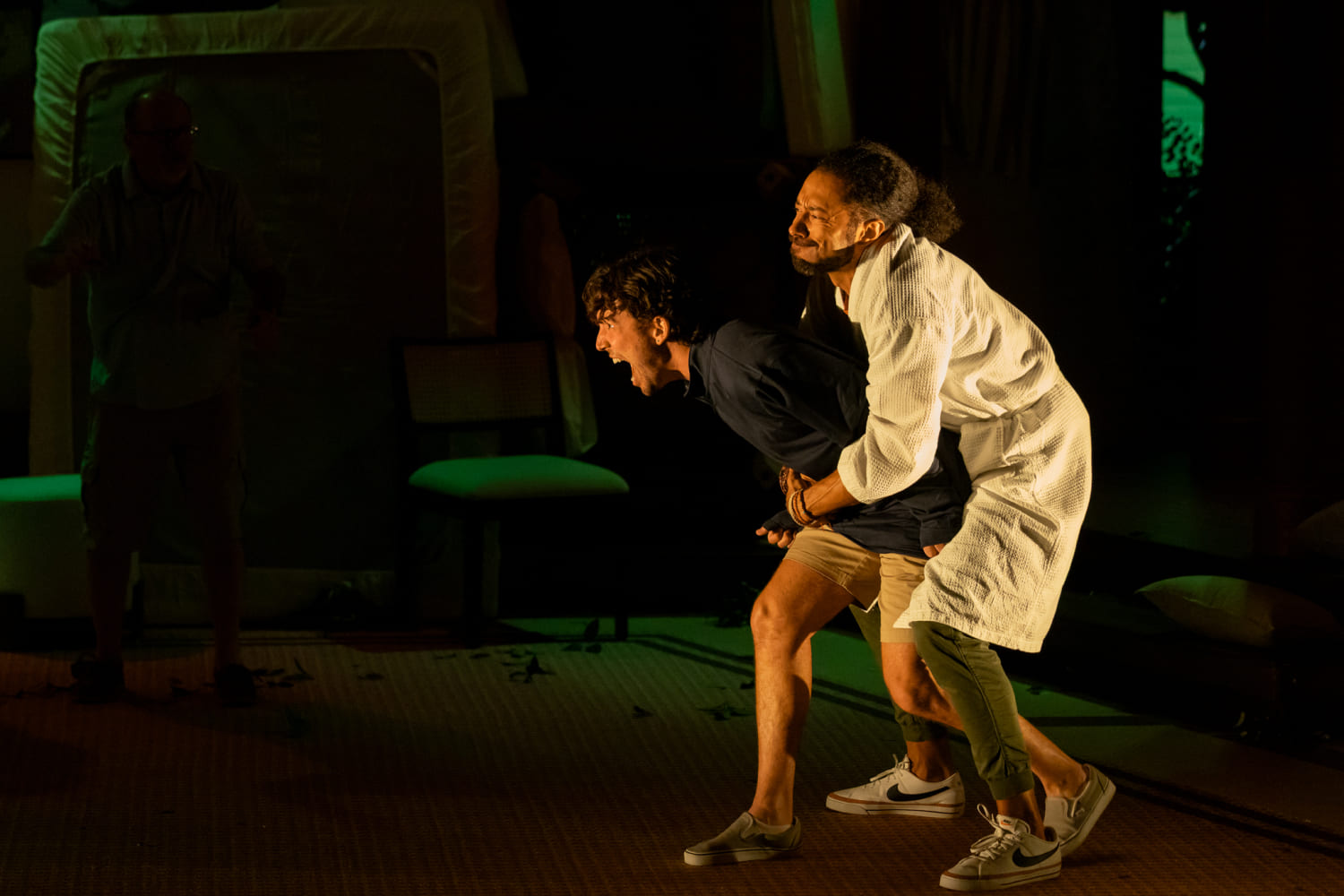
Coby Getzug as Aaron and William DeMerrit as Zephyr. (Photos by Morgan Sophia Photography)
When you enter the Colony Theatre, seagulls and ocean waves gently rolling ashore can be heard as a clear blue sky stretches in the distance. At first glance, the serene setting suggests calm, but it soon becomes a pressure-filled space as two storms converge on one Jewish family.
Circumstances trap the Rosenbergs in a space that feels inviting but is about to become their cell during a moment of reckoning. Family members must sit with discomfort and uncertainty, their lives hanging in the balance, as they have an uncomfortable discussion with embattled relatives.
This is the setup for S. Asher Gelman's "The Zionists: A Family Storm," an intense, funny, and thought-provoking drama receiving a riveting world premiere production through Sunday, May 10 at the Colony Theatre in Miami Beach.
The production, a collaboration between Miami New Drama (MIND) and Midnight Theatricals, runs about two hours, including intermission. The piece is part of MIND's Y6K Project, a partnership-driven effort with Wasserman Projects to commission and produce new theatrical works that explore Jewish narratives, history, and modern identity.
The play takes place over a weekend in late 2024 at a luxury Caribbean resort in Turks and Caicos (designed handsomely by scenic designer Adam Koch), where the Rosenbergs gather to reunite as a family and attempt to heal past divisions.
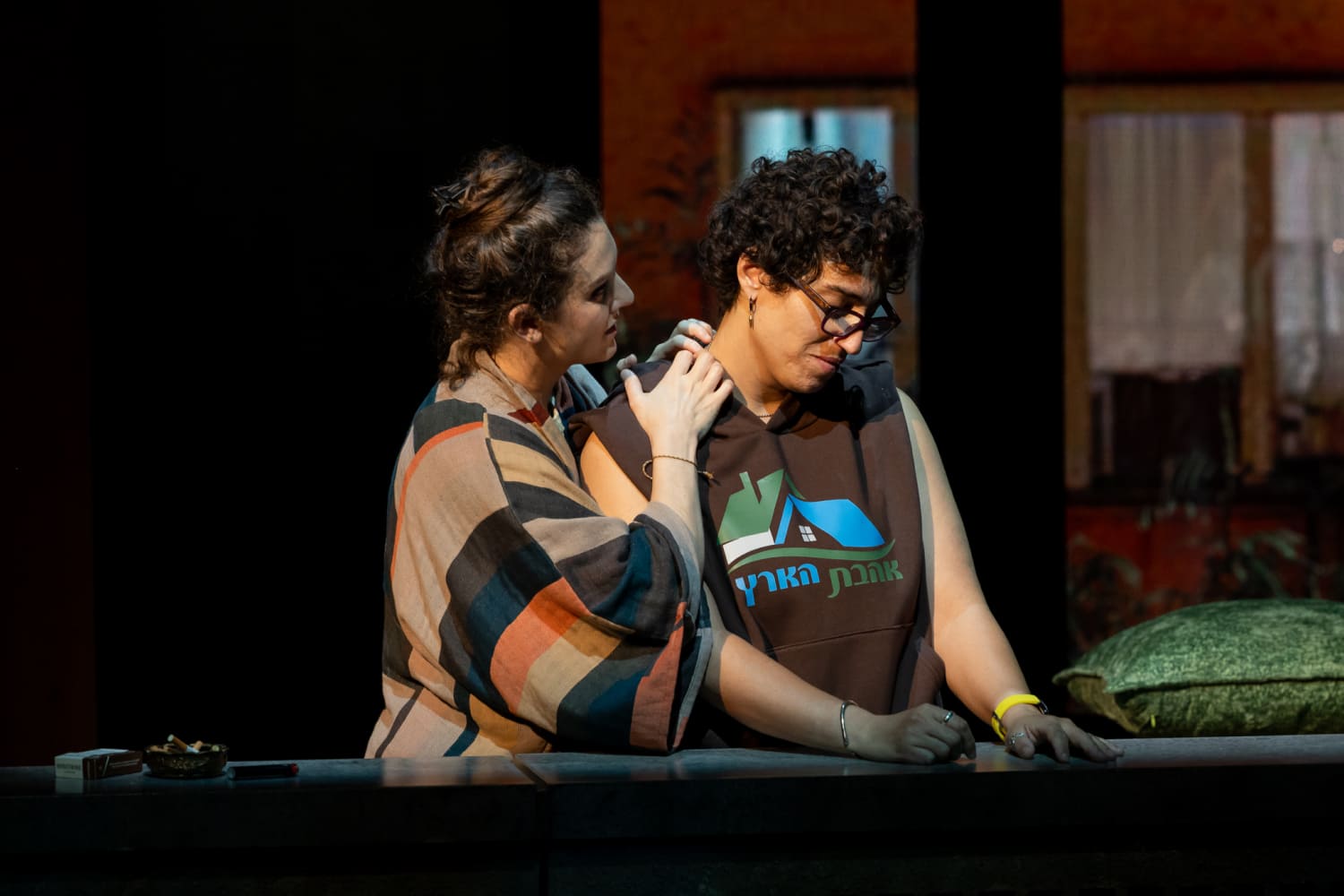
Dani Stoller as Bex and Shira Alon as Dana. (Photos by Morgan Sophia Photography)
At first, the atmosphere is pleasant and largely cordial. But as time progresses, the embattled relatives are forced to confront deep-seated tensions over identity, faith, and geopolitical beliefs, sparking increasingly intense confrontations and shattering family bonds. As the "storm" within the family intensifies, the weather outside deteriorates into a powerful hurricane that traps the group, knocks out power, and leaves the Rosenbergs wondering whether they will survive. Thanks to strong projections and video design by Bryce Cutler, and sound design by Andy Cohen and Salomon Lerner, the rain, wind, thunder, and lightning seem authentic enough to suggest the real thing.
Before the intensity of the tempest outside matches the turmoil inside, a sense of calm settles over the space. Family members arrive, hug each other, and joke. For instance, we learn that Mitchell, the family patriarch, cannot hear well and uses a hearing aid that does not always work, leading him to mishear words as similar-sounding ones. The audience laughs, as Mitchell (Avi Hoffman) acts in a way that feels familiar, like someone we know. He also breaks into songs from musical theater when a word or phrase triggers a memory of a particular show. Another running joke is his constant supply of Werther's candies.
While the atmosphere is lighthearted for a time, it turns serious when the family lights candles and recites a Jewish prayer for the approaching Sabbath (Shabbat in Hebrew). Under Chloe Treat's direction, the cast imbues such moments with reverence, including family matriarch Ruth's (Joanna Glushak) fervent recitation of a blessing in Hebrew.
Ruth is a strong-willed, caring woman of social standing who is involved in different causes and makes her presence felt. We instantly feel her commanding presence through her booming voice as the play begins. She speaks loudly to her husband because she knows his hearing aid is probably not working, and she can be controlling and dramatic. For instance, to prevent family members from going outside during the growing storm, she temporarily positions herself in front of the door, blocking their access. Of course, she can't stay there forever, and it's not long before wind blows the doors open.
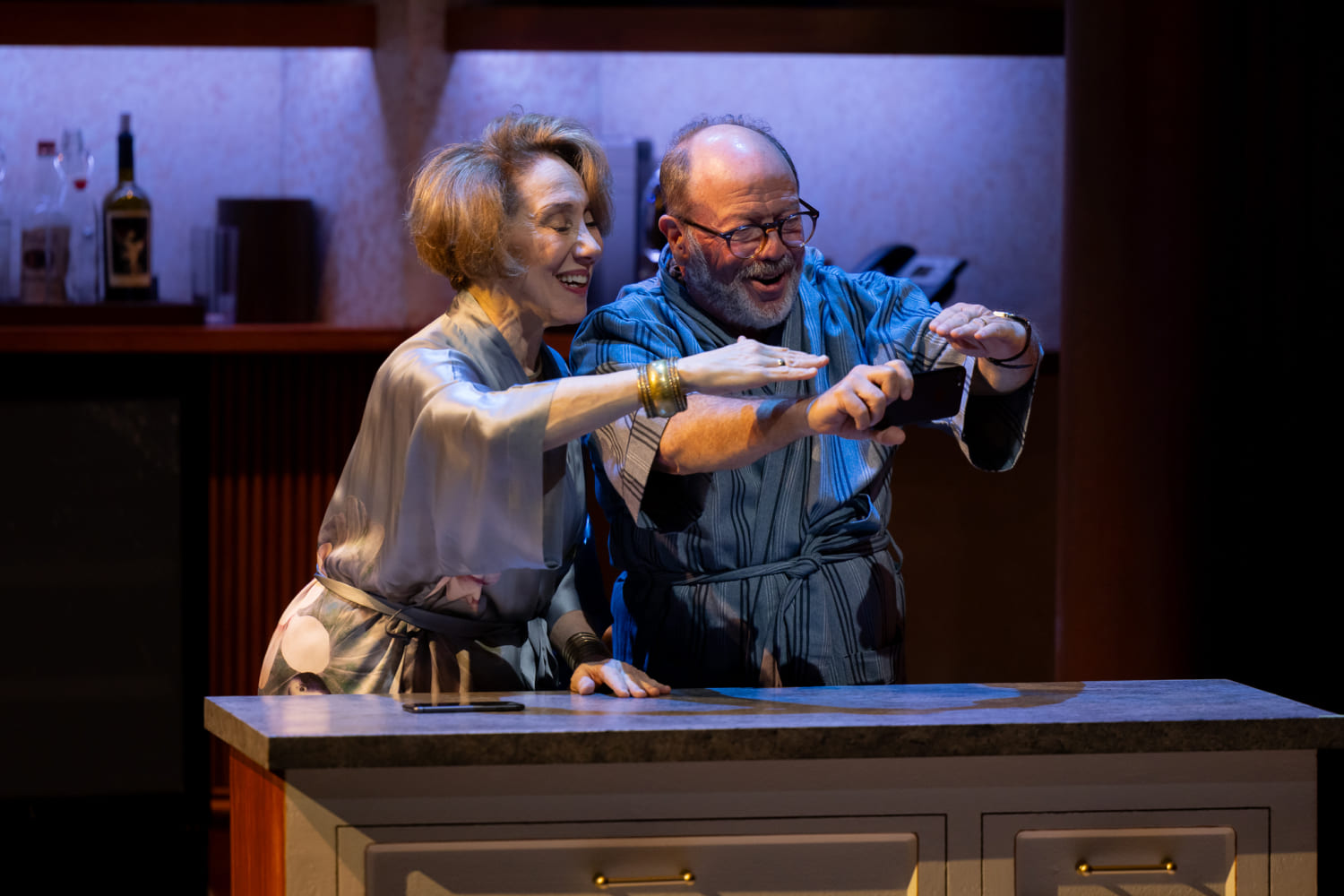
Joanna Glushak as Ruth and Avi Hoffman as Mitchell (Photos by Morgan Sophia Photography)
As the weather outside worsens, the temperature inside heats up as divisions become apparent within the family. Ruth and Mitchell's oldest son, David (Gregg Weiner), is an expectant father and Zionist whose protective instincts manifest as righteous anger, especially toward his younger brother's activism against Zionism. His younger sibling, Aaron (Coby Getzug), is a recovering addict who has channeled his energy into social justice. In particular, Aaron founded an organization titled "Abraham's Sons" to support Palestinian causes. His moral conviction drives him even as his activism threatens to sever his family ties. At times, Treat positions David and Aaron apart from each other, reinforcing the conflict between the brothers. However, during other moments, David can no longer control himself and confronts Aaron, practically coming nose to nose. A physical conflict erupts, and fight director Lee Soroko makes it look real.
While the play includes highly charged moments, the piece becomes more static when family members air their views about the ongoing Israeli-Palestinian struggle. Fortunately, the actors keep us riveted thanks to their impassioned and realistic performances that lend these people humanity. Although the struggle in the Middle East is complex and expansive, resisting simple summary, the playwright gives each side equal weight, allowing Aaron, David, and others time to fully explain their points of view and feelings. To his credit, Gelman doesn't take sides or offer easy answers, and he refrains from reducing Aaron, David, and the others to mouthpieces. Indeed, they are three-dimensional people with real feelings and, for the most part, we come to care about them.
One reason the characters are relatable is that Gelman includes details about their lives that flesh them out, making it easier to care about them. For example, Aaron isn't just an ardent young activist, but a loving family man who is expecting his first child with his supportive partner, Zephyr (a compassionate William DeMerrit). The play's lighter moments leaven the darker scenes, making the action more palatable. Gelman doesn't merely tell us about the characters' past—he shows it in action through well-integrated flashbacks that demonstrate how the past has shaped the present.
A key force shaping the characters' present circumstances is the storm outside, which steadily increases in intensity. The exterior storm's force does not always precisely mirror the growing inner chaos, but it comes close enough. The production deliberately links increasing interpersonal conflict with intensifying environmental chaos.
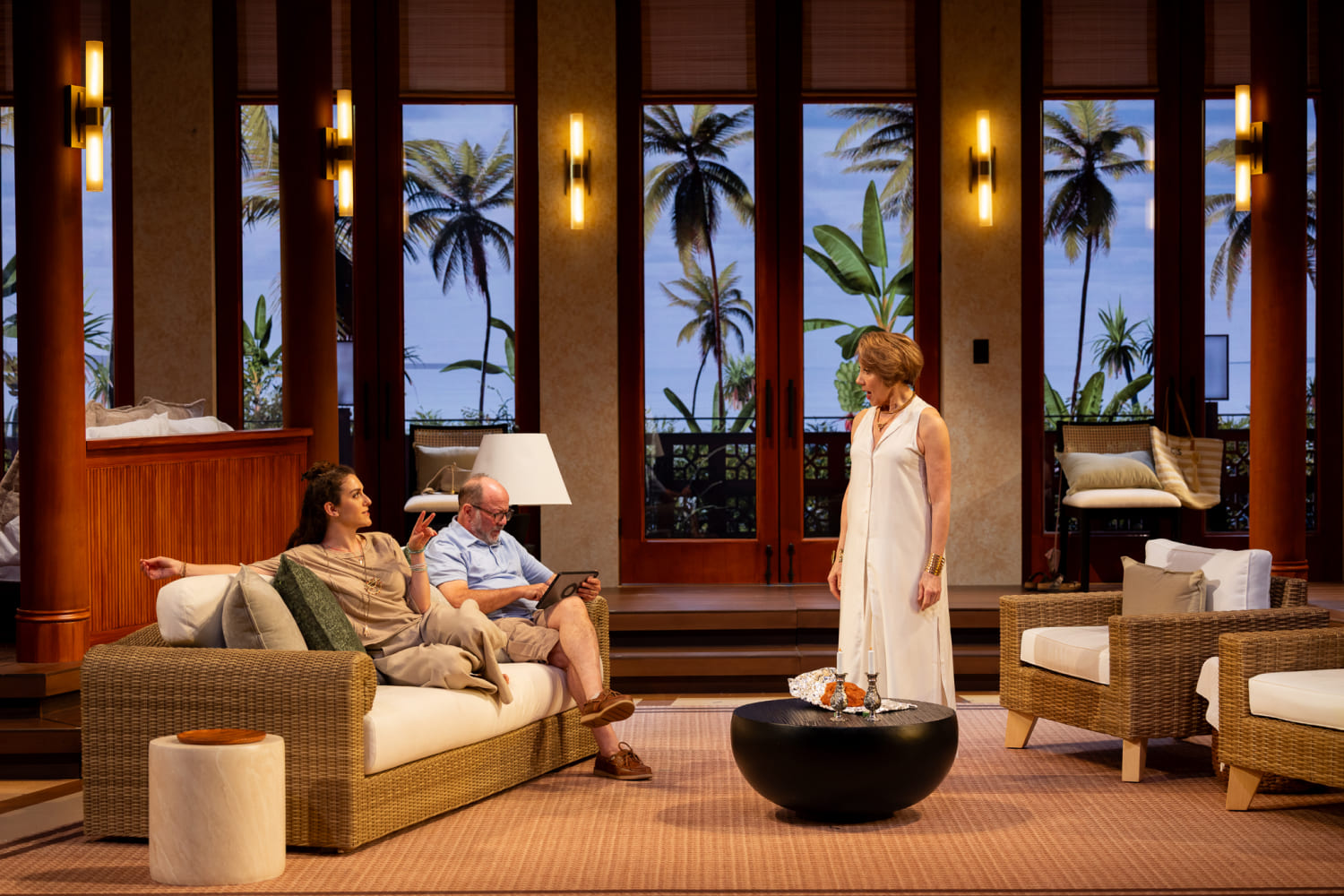
Dani Stoller as Bex, Avi Hoffman as Mitchell, and Joanna Glushak as Ruth. (Photos by Morgan Sophia Photography)
Thanks to Cutler's impressive projections/video design, projections engineer Steve Covey's fine work, and the realistic sound design, we hear what resembles real thunderclaps and howling wind, and we see seemingly authentic pouring raindrops. Soon, everything comes crashing down. In addition, the power goes out, leaving the characters in the dark with a tall pile of items forming a barricade blocking the door. As a result, the characters can't leave the confines. Therefore, they talk about their past, and the action calms down, resembling a dark campfire-like setting for storytelling. The characters become wistful for simpler times, but the calm eventually evaporates and they're fighting again.
While they bicker, the Rosenbergs realize they may not escape the situation alive. As Ruth tries to impress upon them, if families cannot get along at home, what chance is there for world peace to prevail? Ruth and Mitchell urge their children to consider this, and cooler heads begin to prevail. They turn to their faith during a frightening time of uncertainty and volatility. Clearly, Gelman wants us to sit with uncertainty as well; the play ends without a clear resolution.
The actors portraying the siblings inject them with believable intensity while remaining natural. With grayish hair and glasses, Weiner's David clearly looks older than Getzug's dark-haired Aaron. Weiner portrays David as a serious man with a sarcastic edge, suggesting someone who is barely containing himself before pouncing when he can no longer do so. Getzug's Aaron is a vibrant young man with strong convictions—an articulate, sharp-voiced activist who matches David's passion.
As their parents, Glushak's Ruth is a fearless advocate for various causes who stands tall and confident after Mitchell suggests she "can't fix everything." "Watch me," she replies. "I have worked my entire life to find peaceful solutions to conflict. If I can't even bring my own family back together, what hope do we have for peace?" While Glushak's Ruth seems empowered in that moment, she is equally convincing in vulnerability toward the end, bending and pleading with her children to stop fighting.
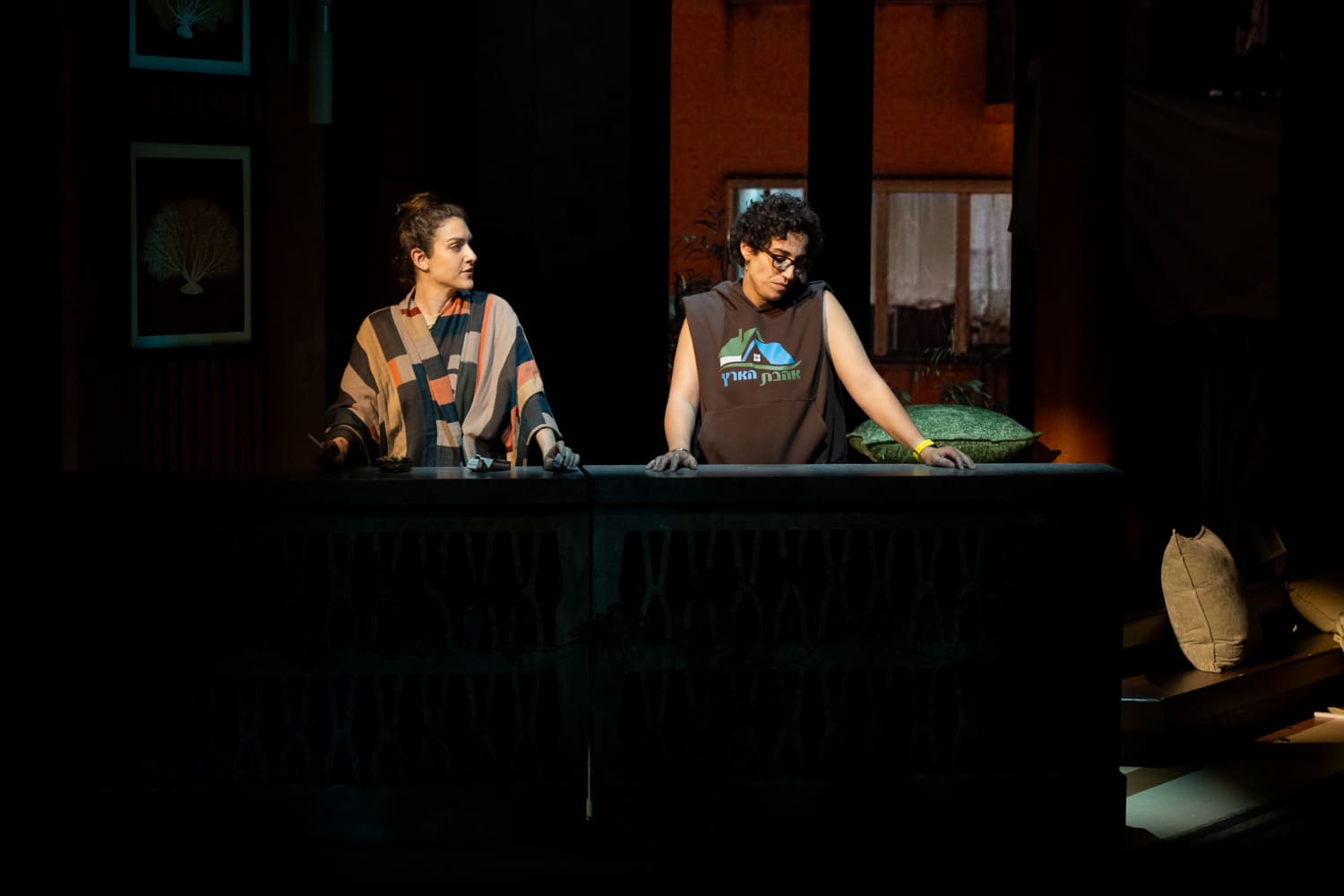
Shira Alon as Dana and Dani Stoller as Bex (Photos by Morgan Sophia Photography)
Hoffman, a widely respected and accomplished performer, brings potent realism to Mitchell. He is believably easygoing and jocular, but just when he seems harmless, he turns convincingly commanding and severe during the play's most intense moments.
The actors excel individually and as a cohesive ensemble. The company encompasses Shira Alon as Dana, William DeMeritt as Zephyr, Coby Getzug as Aaron, Joanna Glushak as Ruth, Avi Hoffman as Mitchell, Jamie Ann Romero as Maria, Dani Stoller as Bex, and Gregg Weiner as David.
"The Zionists: A Family Storm" isn't a play that resolves conflict or offers easy answers. Instead, it forces us to sit with uncertainty and hear things that may unsettle us. At the same time, it encourages us to remain open to different points of view, recognize our shared humanity, and remember that a more peaceful world begins at home.
IF YOU GO
WHAT: Miami New Drama and Midnight Theatricals' production of "The Zionists: A Family Storm."
WHEN: Through Sunday, May 10.
WHERE: The Colony Theatre, 1040 Lincoln Road in Miami Beach. After it plays at the Colony, the production will move to Barrington Stage Company (https://barringtonstageco.org) in the Berkshires, where it will run in the Boyd-Quinson Theater from June 16-July 3.
TICKETS: https://miaminewdrama.org, or call (305) 674-1040.