



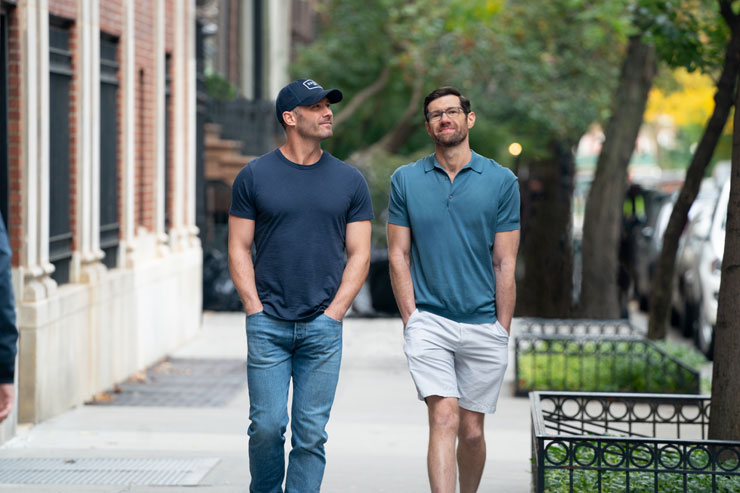
Luke Macfarlane and Billy Eichner in a scene from "Bros." (Photo by Nicole Rivelli/Universal Pictures)
It's a war zone out there. No, I'm not talking about the various international conflicts currently dominating the news cycle. The theatrical release landscape is littered with the bodies of box-office disasters. Expensive flops. Underperforming non-starters that failed to draw Joe Moviegoer to the multiplex.
Cue the belly-aching, I-told-you-sos and finger pointing on social media. Condescension runs rampant as the films' defenders blame poor marketing, then turn around and chastise dissenters for their vitriol. This is the part where I weigh in and lambast the reductive mentality that big, CGI-afflicted tentpoles are the only releases that merit shelling out the big bucks for overpriced tickets, babysitters, parking and even more overpriced concession goodies. “You say you want me to pay to see a rom-com or an arthouse oddity in a THEATER?! Don't make me laugh; that's what streaming and video on demand are for.”
Call me old-fashioned, but I remember the days, not as long ago as you may think, where people looked forward to catching movies of all shapes and sizes in the confines of a darkened auditorium. An individual outing that becomes a communal experience. That's what gives the movies its magic touch. Have we been so conditioned by the convenience of stay-at-home creature comforts that we're all too willing to part ways with going to the movies, big-budgeted exceptions aside?
And yet, with the lackluster summer that just wrapped up, it's all too understandable why you may be dragging your feet. You may have noticed I haven't found much worthwhile to write about these past few months. That's because the majority of late-summer releases gave this weary critic precious little to motivate me to put pen to paper. (Andrew Dominik's unfairly maligned “Blonde” roused me from my review-writing slumber two weeks ago.)
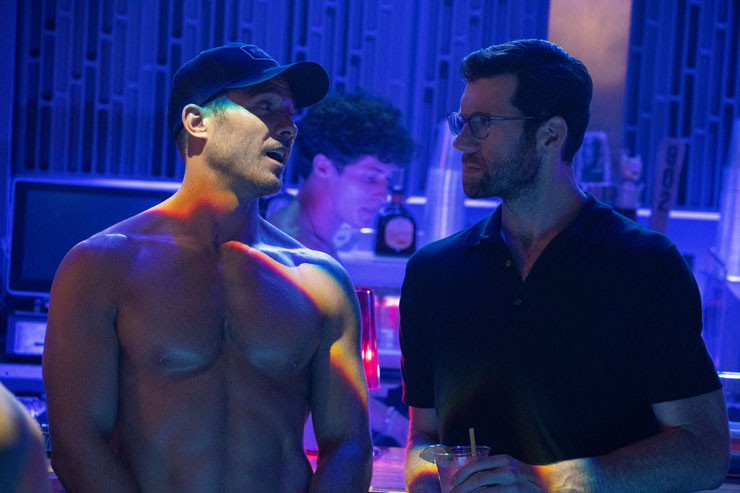
Luke Macfarlane and Billy Eichner in a scene from "Bros." (Photo by K.C. Bailey/Universal Pictures)
The winds are changing, now that fall (and awards season) is finally here, but there's no denying the reality that movies have not measured up to what has, to date, been an outstanding year for TV and streaming programming. (Though don't get me started on HBO's underwhelming “House of the Dragon.”)
Hear me out. Come back to theaters. A trio of R-rated movies, two recent comedies and a late-summer literary adaptation, did not deserve their grim box-office fate. Let's not allow this to be the new normal. I'm stubbornly resistant to the notion that it's just the way things are now. There's still time to turn things around, even as the fatalist in me is shaking his head in resignation. Let's dig in.
“Bros”: It's not a look you're used to seeing in a nightclub. It's neither lust nor contempt, not a casual nod of the head. Hunky, chiseled Aaron stares up at nerdy, pouty Bobby. Curiosity is intertwined with … could that possibly be vulnerability?
The initial meeting of gazes that kicks this disarming rom-com into gear is a bit like Fantasyland, only not as realistic. It's highly unlikely a jock like Aaron would lock eyes with a neurotic mess like Bobby, much less in the noisy trappings of a New York City meat market. But stars Luke Macfarlane and Billy Eichner sell the moment with unforced charm. You know, the way big-screen rom-coms used to before being largely relegated to streaming purgatory.
The characters click, and so do the leads, in this tale of a podcaster with a reputation for jamming every misgiving he has about, well, everything, down people's throats, as he embarks into a dalliance (don't you dare call it dating, much less the “r” word) with a handsome estate attorney from upstate New York with his own set of hangups. What ensues is a gentle ribbing of the LGBTQ+ community's “masc for masc” subculture that ends up indulging in the very aspects it grills.
It steps out of the rom-com formula to view its shopworn traits in quotations, then steps back in and surrenders to the demands of the genre. The film's ultimate refusal to subvert the rom-com trappings is a compromise, but not a deal-breaker, thanks to director Nicholas Stoller's assured stewardship and his outsider's perspective as a straight dude peeking in at gay culture.
Stoller (“Forgetting Sarah Marshall,” “The Five-Year Engagement”) collaborated with Eichner on the screenplay as a vehicle for the “Billy on the Street” personality.
“Bros'” initial trailers promised an insufferable expansion of Eichner's abrasive persona, so imagine my relief that, while it's clear Stoller has deep affection for his characters, he's not blind to the off-putting part of his star's screen presence. The director takes a sizable gamble in positing his boy next door as overbearing damaged goods, but he finds a pleasing yin-yang synergy in the meeting of two commitmentphobes navigating what each of them refuses to label as a budding relationship, for their own separate reasons.
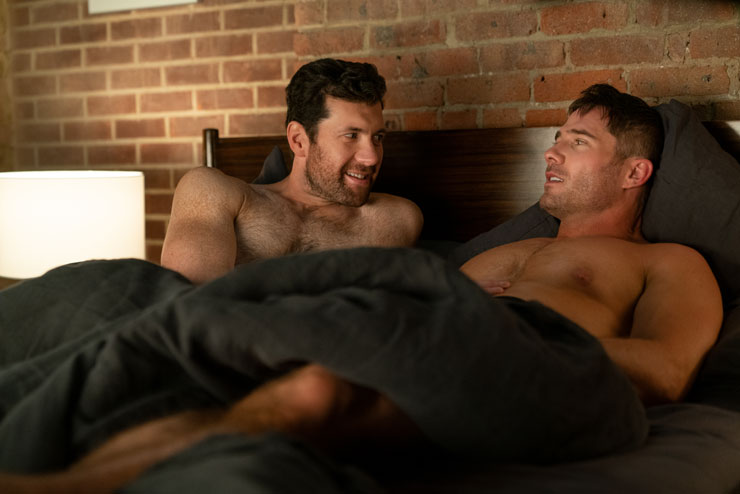
Luke Macfarlane and Billy Eichner in a scene from "Bros." Photo credit: Nicole Rivelli/Universal Pictures.
Stoller is not a filmmaker known for shying away from depicting sex on screen, and in “Bros,” he walks a tightrope between exploring the rough 'n' tender physicality between two men while taking pains not to alienate a straight audience. The results should have been saucier and friskier, but at least it's not the impersonal coupling depicted as background noise in this summer's gay-directed, gay-scripted “Fire Island.”
Stoller also borrows from the right sources, such as a couple of visual cues from “Trick,” Jim Fall's delightful 1999 boy-meets-go-go-boy comedy, also set in the Big Apple.
What does hold “Bros” back from being funnier and more romantic is the weight it takes on from being, as it has been billed, the first studio-produced major rom-com with a predominantly LGBTQ+ cast. Bobby sits on the board of a gay history museum plagued by money and identity troubles threatening its future, and the scenes where he clashes with his board members wear out their welcome pretty quickly.
The free-flowing peanut-gallery banter bears the imprint of Judd Apatow, the film's producer. There are some choice sound bites, but mostly they just make “Bros,” clocking in at nearly two hours, feel longer than it should.
But “Bros” also draws blood, particularly in a squirm-inducing dinner scene where Bobby calls out Aaron's schoolteacher mom for not teaching her second-grade students about queer history, clinging, as so many well-meaning straight people do, to the “they're too young” excuse. The scene crystallizes how Eichner, obnoxious as he may be, is doing something pretty important and much needed: throwing deep-seated biases back on people's faces.
This tendency was brought into even greater relief when Eichner took to Twitter to make straight moviegoers accountable for the film's disappointing opening weekend numbers. Out came the knives from the Twitterati. “The gall!” Not a good look.” “Could you just please shut up and go away?” It's the haters who ought to take a step back. Eichner has every reason to defend his imperfect but still winsome romance. Because when it comes to the future prospects of other LGBTQ+ projects currently in development, the bile from review-bombing homophobes has got nothing on the cold shoulder from casual moviegoers who aren't willing to say the quiet part out loud: that they have zero interest in seeing two dudes hook up. Their apathy is deafening.
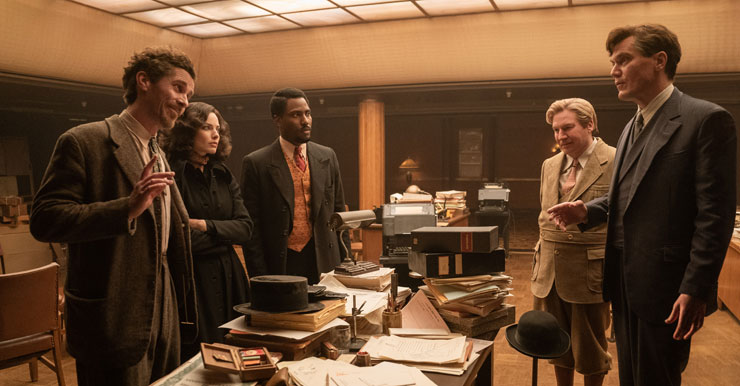
Christian Bale, Margot Robbie, John David Washington, Mike Myers and Michael Shannon in a scene from "Amsterdam." (Photo by Merie Meismiller Wallace/20th Century Studios)
“Amsterdam”: “Bros” was budgeted at $22 million and in two weeks of release has grossed a paltry $9.5 million. This past weekend, it was eclipsed by this bigger fiasco. Boasting an all-star cast and an $80 million budget, David O. Russell's period romp scraped $6.4 million on its opening weekend. It stands to lose between $80 and $100 mil by the time the dust settles. (Yikes.) It's a shame, because this buoyant comedy put a silly grin on my face that rarely faded.
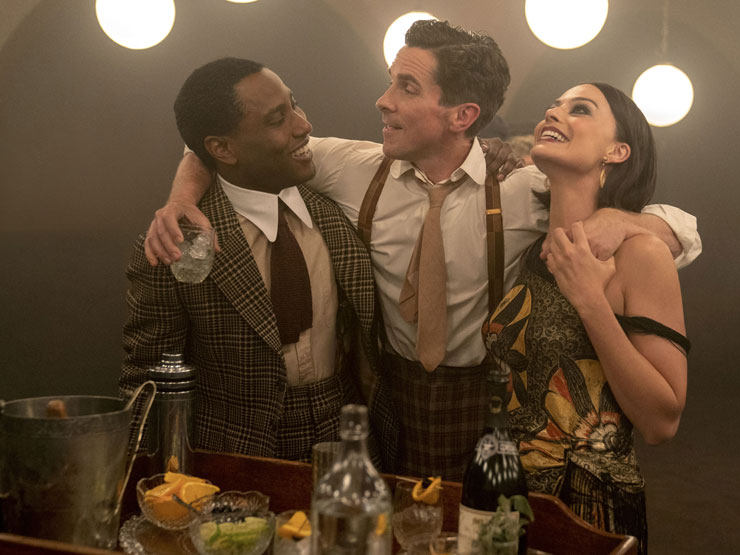
John David Washington, Christian Bale and Margot Robbie in a scene from "Amsterdam." (Photo by Merie Meismiller Wallace/20th Century Studios)
The film's title is at once misleading, since the bulk of the action unfolds in New York City circa 1933, and wholly representative, since the titular European city doubles as a state of freedom and unhindered glee for the film's central trio. The plot sounds convoluted, but it ends up being pretty simple. World War I vets Burt Berendsen (Christian Bale) and Harold Woodman (John David Washington) are accused of a crime they didn't commit and reconnect with their WWI nurse Valerie (Margot Robbie) as they attempt to clear their name, in the process uncovering a larger conspiracy that puts democracy in the U.S. in its crosshairs.
But to reduce “Amsterdam” to the building blocks of its narrative doesn't convey the joy in watching the film's stars bouncing off each other. A richly satisfying flashback, reveals how Burt, a struggling doctor, future attorney Harold and the vivacious, eccentric and enigmatic Valerie first met. The extended sequence shows the trio making a pact to always be there for each other, and the unconditional devotion between the three of them is palpable.
Russell, claiming “a lot of this actually happened” at the beginning of the film, is not afraid to be baldly political, but he never loses sight of the dynamic between his three main characters. The film uses a specific moment in America's past to comment on its tumultuous present, yet it also depicts justice work as playtime. It doubles as an exploration of the ineffable nature of friendship, how what defines forming the family we choose is so hard to put into words.
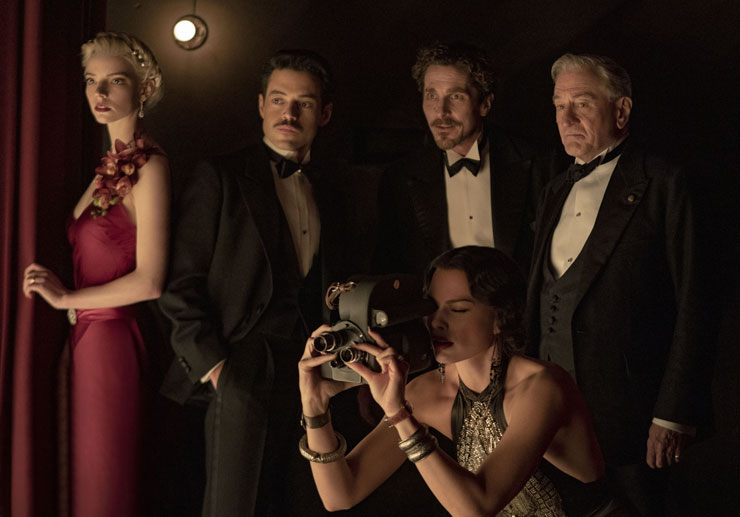
Anya Taylor-Joy, Rami Malek, Christian Bale, Robert De Niro and Margot Robbie in a scene from "Amsterdam." (Photo by Merie Meismiller Wallace/20th Century Studios.)
Russell (“American Hustle,” “The Fighter”) walks a tightrope between staging daffy slapstick and driving home the urgency of what's at stake. The balancing act doesn't always work. Some of the comic bits land with a thud or come across as labored and awkward. But the filmmaker's knack for whipping an ensemble cast into shape is on ample display here, from Mike Myers and Michael Shannon as birdwatchers with barely concealed government ties, to Russell regular Robert De Niro as a decorated general who may just have enough sway to stop the forces of evil dead in its tracks.
The filmmaker is essentially treading on tonal and thematic territory that Adam McKay (“The Big Short,” “Don't Look Up”) is known for, but without the latter director's heavy-handed self-importance. Russell serves up a kooky tapestry of patriotism and integrity that, in the way his dialogue echoes and ricochets, feels like stepping into his unfettered id. Like in “American Hustle,” there's a beguiling rat-a-tat rhythm that recalls Howard Hawks, another filmmaker who blended silliness and nuance with winning results. Russell is my kind of movie nut, and “Amsterdam” is his nimbly executed variety hour.
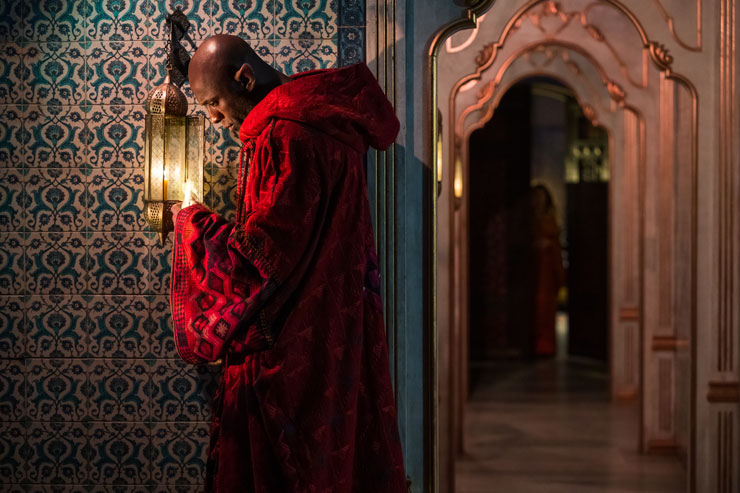
Idris Elba in a scene from "Three Thousand Years of Longing." (Photo by Elise Lockwood/Metro-Goldwyn-Mayer Pictures Inc.)
“Three Thousand Years of Longing”: Russell is hardly the only auteur driving movie audiences away in droves from his latest effort. George Miller, the eclectic Australian creator of the “Mad Max” movies, “Lorenzo's Oil” and “Happy Feet,” conjured up a stimulating adaptation of A.S. Byatt's 1994 short story “The Djinn in the Nightingale's Eye.” It apparated into theaters back in late August, but nobody showed up. A blend of “Aladdin” and “Arabian Nights” for grown-ups is what the filmmaker was selling, but no magic lamp could save this neglected gem from box-office oblivion. (Budgeted at $60 million, it has grossed just under $18 million worldwide.)
Rather than adopt a dignified “cinema of quality” glaze so many of these page-to-screen endeavors share, “Longing” is witty and sharp as a tack, bolstered by a sprightly energy and an endless curiosity that reflects the personality of its protagonist. Dr. Alithea Binnie is a narratologist, a fancy word that essentially means “storytelling expert.” On a trip to Istanbul to attend a convention where she's a featured speaker, the red-headed Scottish scholar, played with bookish gusto by Tilda Swinton, picks up a blue and white glass lamp.
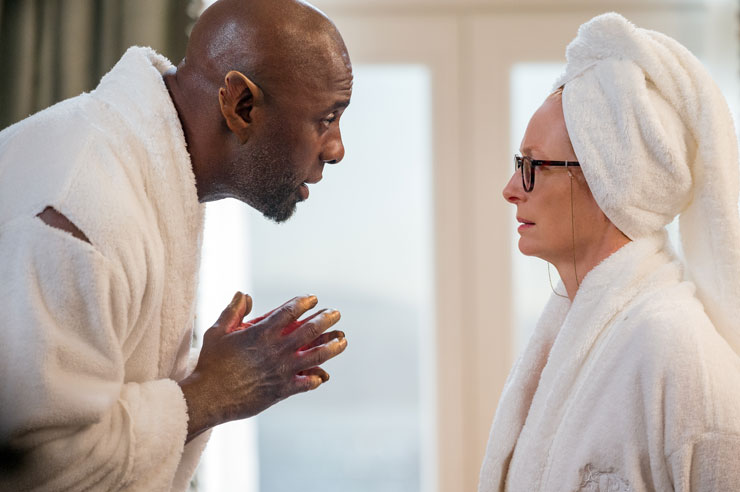
Idris Elba and Tilda Swinton in a scene from "Three Thousand Years of Longing." (Photo by Elise Lockwood/Metro-Goldwyn-Mayer Pictures Inc.)
What happens next goes more or less like you'd imagine. Alithea, whose poise and sense of purpose is reminiscent of the heroine in Emeric Pressburger and Michael Powell's “I Know Where I'm Going,” accidentally unleashes the Djinn bottled up in the lamp; out comes a bald, pointy-eared Idris Elba and a three-wishes proposal. This all happens inside the hotel room where Alithea is staying, the very place where, she is told, Agatha Christie wrote “Murder on the Orient Express.”
But what unfolds after the Djinn's appearance isn't quite the adventure some would expect. (As the director of the ambitious, Gilliamesque “Babe: Pig in the City,” Miller is no stranger to subverting audience expectations.) Instead, “Longing” is a more intimate and subdued meeting of minds. Miller turns back the clock more than a few centuries, as the Djinn shares several lifetimes' worth of bad fortune, palace intrigue and romantic woes. (As usual for Elba, his charisma burns off the screen.) Alithea, who views this unexpected encounter as an intricate puzzle to solve, has to decide whether or not to trust a supernatural being who might treat her wishes the way that Photoshop whiz turns photo-altering requests into jokes at the expense of the very people who requested the changes.
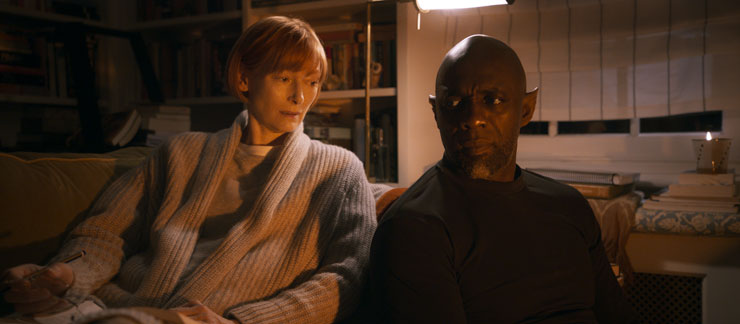
Tilda Swinton and Idris Elba in a scene from "Three Thousand Years of Longing." Photo credit: Courtesy of Metro-Goldwyn-Mayer Pictures Inc. © 2022 Metro-Goldwyn-Mayer Pictures Inc.
The result is an eye-popping, handsomely mounted celebration of the power of stories aimed at adults, but every bit as spry and playful as a children's storybook. Are you thinking what I'm thinking? “Longing” is suffused with Neil Gaiman vibes, and often plays like an intelligent and polished adaptation of one of the “Coraline” and “American Gods” author's short stories. It's grounded by the baggage and heartache that brings Alithea and the Djinn together, but it never loses its sense of wonder or narrative sweep. If there is one quibble, it's that the screenplay, credited to Miller and Augusta Gore, feels too airtight and self-contained, perhaps a reflection of its compact source material.
But there's no denying Miller has crafted a banquet for movie lovers that, one senses Roger Ebert would have adored if he were still with us. It's ultimately more cerebral than sentimental, yet one comes away with a profound appreciation of how each of its central figures views the world, the pain that led them to this juncture and the solace they find in one another. “Longing's” magic emanates from life's hard knocks. It gives you the cinematic equivalent of curling up with a good book, and these days, such pleasures are few and far between.
“Bros” and “Amsterdam” are now showing in wide release at theaters across South Florida. “Three Thousand Years of Longing” is now available for rental through various digital platforms, including Prime Video, Google Play and YouTube.