



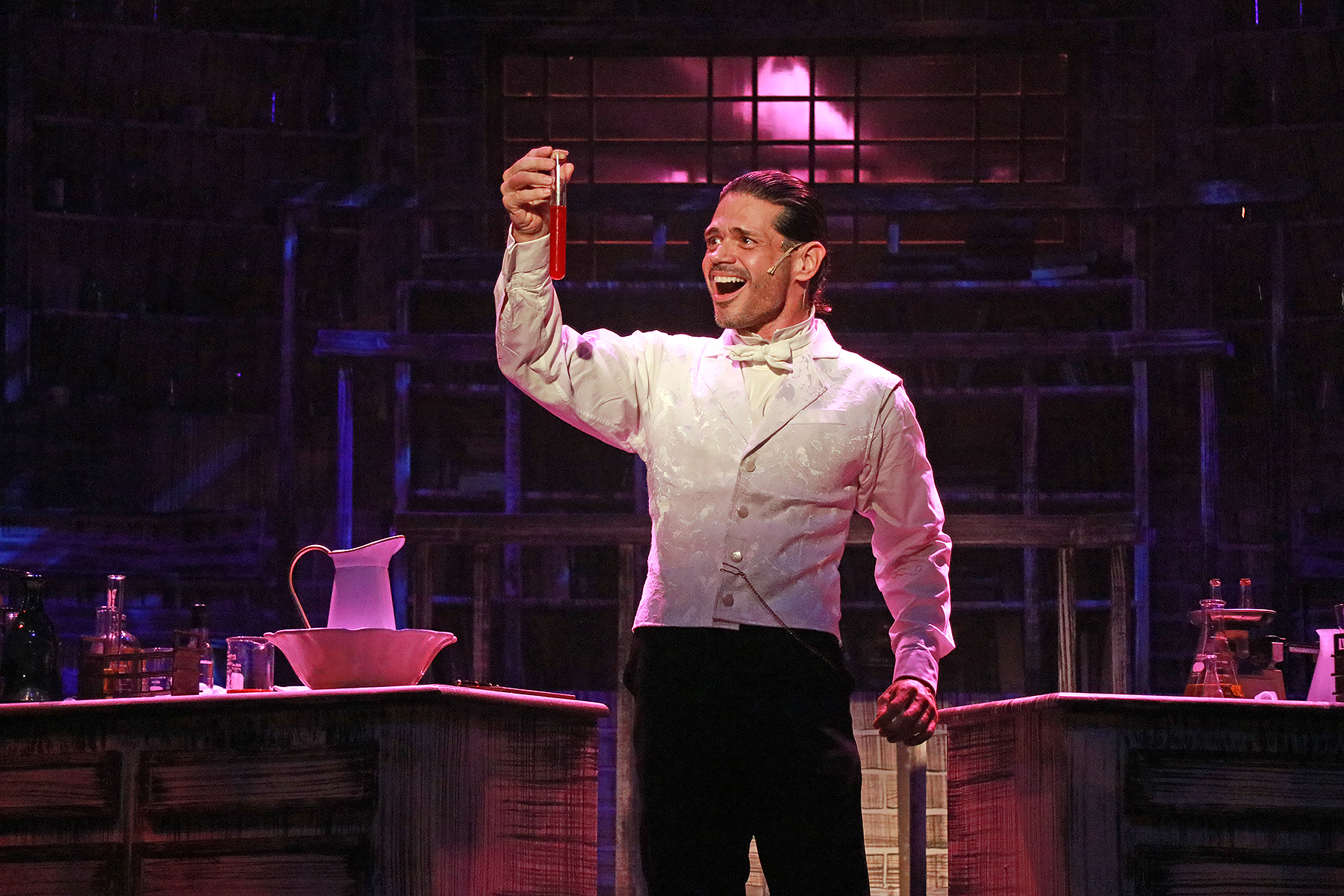
E.L. Losada as Dr. Henry Jekyll (Photo credit by Alberto Romeu)
Down goes Dr. Henry Jekyll in Actors’ Playhouse’s moving and riveting production of the 1990 musical “Jekyll & Hyde.” When we next see and hear him from the ground, he’s not Jekyll, but the good doctor’s sinister alter ego, Edward Hyde, a man whose literal low position corresponds to his moral lowness.
The production runs at Actors’ Playhouse at the Miracle Theatre in Coral Gables through Sunday, Nov. 1 in the company’s Stein Center for the Performing Arts on Miracle Mile. Under Actors’ Playhouse Artistic Director David Arisco’s precise and sensitive direction, the production stars E. L. Losada in the dual roles of Jekyll and Hyde. Losada leads a large and talented cast in the Actors’ Playhouse’s mounting, which lasts about two and a half hours, including intermission.
The show, which debuted on Broadway in 1997, is no stranger to South Florida audiences; Slow Burn Theatre Company in Fort Lauderdale presented it in 2019 at the Broward Center for the Arts, and the now-defunct Broward Stage Door Theatre also presented it. The musical is an adaptation of Robert Louis Stevenson’s 1886 Gothic horror novella, “The Strange Case of Dr. Jekyll and Mr. Hyde.”
The musical takes place in mid-1880s London. Jekyll’s father’s mental illness drives the younger man, a devoted scientist, to seek a medical breakthrough that could separate the good and evil in people. When the hospital board rejects his research, he makes himself the subject of his own dangerous experiment and inadvertently unleashes Hyde, a terrifying alter ego. As Hyde’s reign of terror grows, Jekyll’s pursuit of scientific discovery becomes a deadly battle for his identity, his relationships, and his soul.
Arisco, with assistance from Henry Gainza, helps the performers believably bring Victorian London to life. A clear contrast exists between the lower-class characters, who tend to speak with a Cockney accent, and the upper class’s more formal British accent. The upper-class characters are also generally more refined in movement and gesture. The pacing feels right: we’re able to follow the action clearly, and the show never drags. The actors disappear into their characters’ world, and each beat of dialogue and song, along with the accompanying movements, seems purposeful. In addition, the director and his cast give tender moments time to land and move us. Transitions between scenes unfold smoothly.
As we’ve come to expect from Actors’ Playhouse productions, the performances are first-rate. Losada, who recently and convincingly brought another idealistic character to life as Don Quixote/Cervantes in Actors’ Playhouse’s triumphant production of “Man of La Mancha,” shines here as well. He won his second Carbonell Award for Best Actor in a Musical when he portrayed Jekyll and Hyde at the now-defunct Broward Stage Door Theatre. Through his performance at Actors’ Playhouse, Losada demonstrates a deep familiarity with these dual roles while keeping them fresh and spontaneous.
One of the show’s songs is titled “In His Eyes.” Losada’s expressive dark eyes convey qualities such as goodness, determination, conviction, and frustration. We peer into those eyes and encounter a well-meaning, polished, polite, but imperfect man who cares deeply, even obsessively, about making a difference.
Those same dark, wide, expressive eyes take on a menacing, sly quality after Jekyll transforms into Hyde. Losada’s voice turns scratchy, creepy, and devilish, complete with a sinister laugh. The struggle between Jekyll and Hyde is intense at the end. But even though Jekyll falls, he gets back up like an indomitable prizefighter who refuses to concede. As much as we admire him, we mourn at the end, when he can no longer contain Hyde and makes the ultimate sacrifice to protect his fiancée.
As Jekyll’s fiancée, Emma Carew, Anette Barrios-Torres radiates charm, positivity, and compassion toward Jekyll when he conveys believable vulnerability. Her supportive voice seeks to calm her fiancé and calms us as well. Barrios-Torres’s Carew is sympathetic, but we also notice her independent-mindedness and assertiveness. The performer conveys these qualities without making Carew mean or arrogant. When she tells her father, Sir Danvers Carew (a well-meaning, concerned Barry Tarallo), that she’s marrying Jekyll, Barrios-Torres’s Carew sounds less like an eye-rolling teenager with an attitude and more like a spirited young woman eager to experience life’s pleasures.
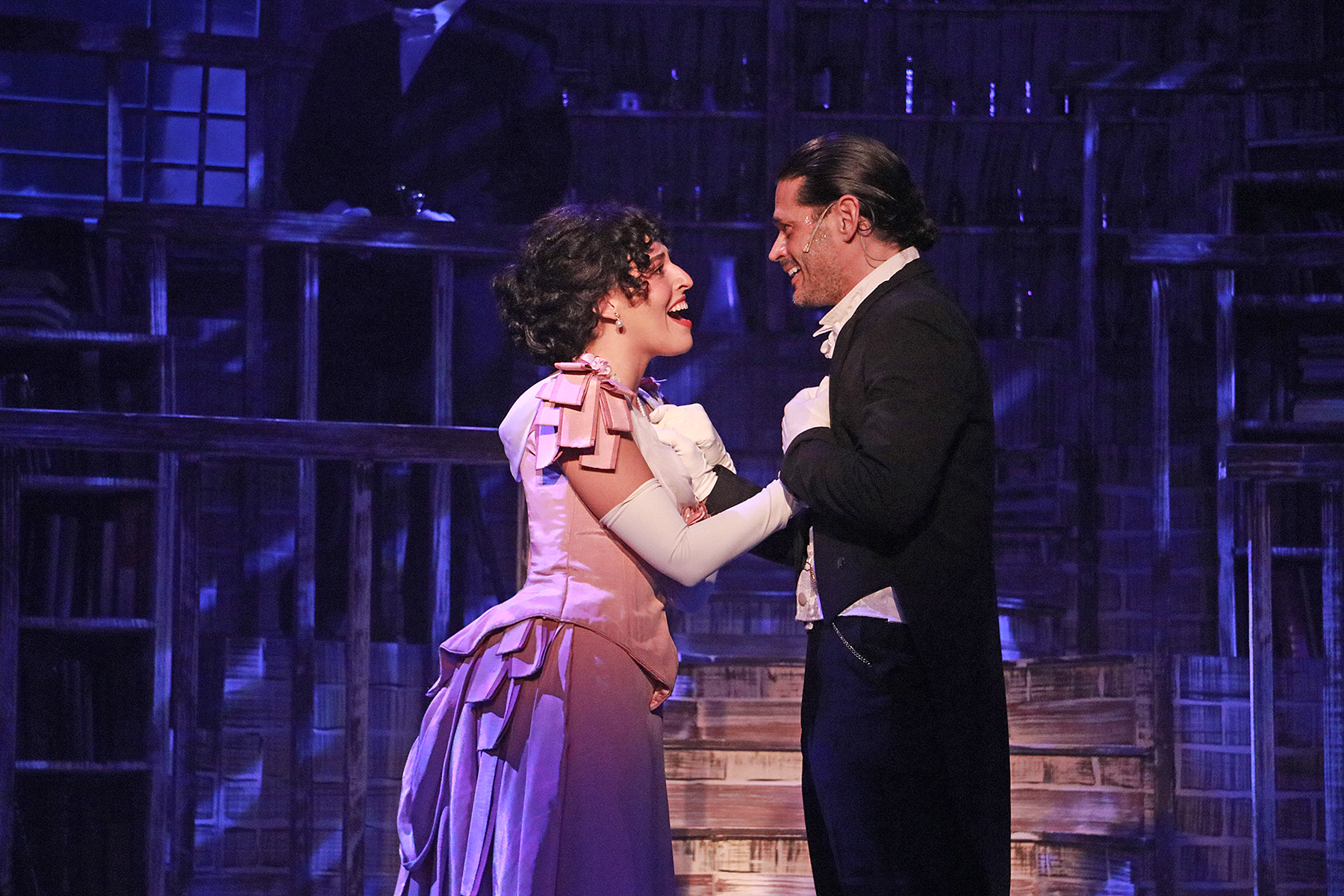
Anette Barrios-Torres as Emma Carew and E.L. Losada as Dr. Henry Jekyll (Photo credit by Alberto Romeu)
Emily Van Vliet Perea convincingly embodies prostitute and performer Lucy Harris as a flawed but sympathetic character who wants to make something more of her life. Soon after we meet her, Perea nails her character’s seductive quality. She comes across as a natural performer who places her foot atop Jekyll’s table at The Red Rat, where she works. Seduction seems so ingrained in her persona that it comes automatically to her. But soon, Perea makes it clear that Harris wants a different life. We hear her sincere hope in the song “A New Life.” We also sense her revulsion at Hyde, her fighting spirit, and her faith in how Jekyll can positively impact her life.
The leads aren’t the only strong points among this large cast. The ensemble deftly differentiates the different classes in Victorian London and brings energy and believability to this world. Don Seward, with a rich, low voice that recalls James Earl Jones, lends lawyer Gabriel John Utterson polish and genuine concern for Jekyll, his client and close friend. By stark contrast, Jeremy Sevelovitz is unrecognizable as a sinister Spider, the proprietor of The Red Rat. With a menacing voice and a tall hat, Sevelovitz’s Spider recalls the malevolent Bill Sikes in “Oliver!”
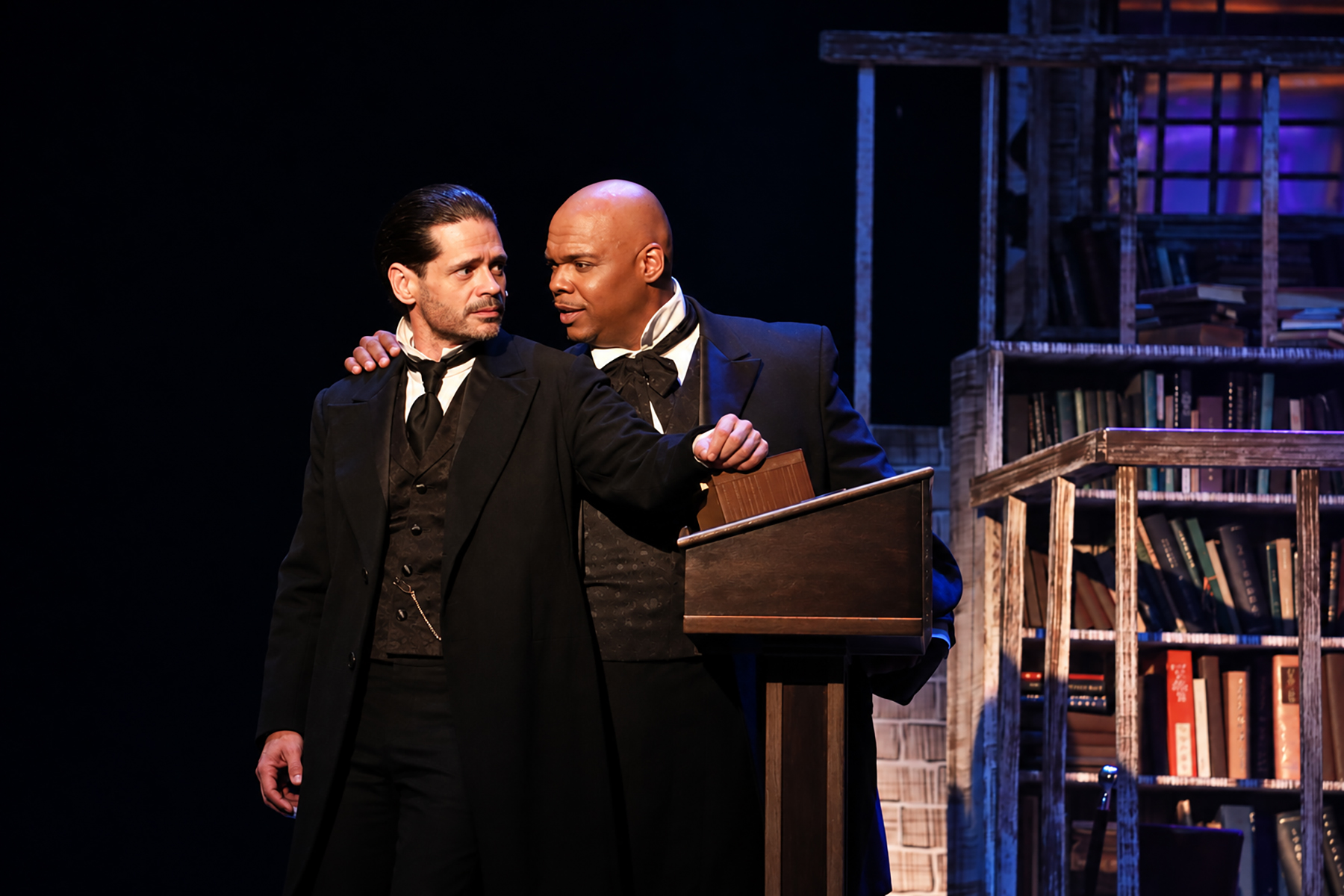
E.L. Losada as Dr. Henry Jekyll and Don Seward as Gabriel John Utterson (Photo credit by Alberto Romeu)
Just as the performers shine, so do the behind-the-scenes artists.
Brandon M. Newton’s set design is flexible and detailed. It includes props such as chandeliers to establish the upscale aura of a particular location and shelves of books and other items to suggest Jekyll’s study. At different points during the production, appropriate for a show about transformation, actors or stagehands seamlessly reconfigure the set into locations as different as a brothel, a church, and an upscale home.
Eric Nelson’s lighting design produces shadows that, coupled with stage fog, enhance the show’s gothic atmosphere. Nelson uses dim lighting to establish darkness, befitting the musical’s mood, while also enhancing romantic scenes. Hues such as purple and red reinforce danger and seduction. The lighting understandably brightens during upbeat scenes, such as the celebratory engagement party for Jekyll and his fiancée. This is an action-packed show of romance, suspense, and theatrical spectacle in which even the lighting equipment moves.
Costume designer Ellis Tillman’s period attire includes both dark and lighter-colored outfits, an appropriate contrast for a show about humankind’s dual nature of good and evil. Some costumes glisten, making them suitable for occasions such as an engagement party. Tillman’s designs also include period details such as pocket watches. To represent the upper class, elite characters such as Sir Danvers Carew and Simon Stride (a condescending Stephen G. Anthony) wear pristine, tailored, layered period garments. In contrast, ensemble performers playing lower-class characters wear distressed, dark, gritty attire, emphasizing the hardships of Victorian poverty. Altogether, Tillman designed 150 costumes for a cast of 21. It’s quite a feat.
Reidar Sorensen’s sound design produces a clear, crisp sound, although at times microphones appear to cut in and out. While we may not be able to make out every sung lyric, the performers’ nonverbal expressions usually compensate. A rich-sounding live band, under conductor and keyboardist Max Milian, accompanies the performers’ strong, expressive voices without overpowering them.
The show’s score features music by Frank Wildhorn (“The Scarlet Pimpernel,” “The Civil War,” “The Count of Monte Cristo,” “Bonnie and Clyde”) and lyrics by Leslie Bricusse (“Willy Wonka & the Chocolate Factory,” “Doctor Dolittle,” “Scrooge,” and “Goodbye, Mr. Chips”). The music blends pop-rock with gothic musical theater. The score features pop-Romantic ballads, rock-tinged, gritty anthems, music-hall ensemble patter, and gothic orchestral melodrama. It relies heavily on minor keys, minor chord progressions, and dark, driving harmonies to establish its dark, psychological atmosphere. The songs are not particularly memorable, and you probably won’t walk away humming any of these tunes. However, they allow the characters to express themselves on a deeper level than through spoken words alone.
One of the show’s highlights, “This Is the Moment,” is the soliloquy Jekyll sings immediately before drinking the formula intended to separate good and evil. It creates a mood of intense anticipation, soaring determination, and dramatic tension. The number acts as a triumphant release of Jekyll’s built-up anxieties, framing the dangerous experiment not as madness but as his ultimate, glorious destiny. As Losada performs the number, it begins quietly, yet with resolve. Appropriately, Jekyll rolls up his sleeve, suggesting he’s prepared for the hard work ahead. Losada’s wide, dark eyes convey concern, while his voice communicates resolve and conviction. He raises the vial during the long ending note, underscoring its importance to Jekyll’s quest.
Another key song is “A New Life,” a major turning point for Harris and a bittersweet moment of hope before the show’s tragic climax. Alone in her room, Harris, overwhelmed by Jekyll’s kindness, sings this powerful, soaring ballad. She contemplates the freedom of leaving her desperate past behind, dreaming of a better life. Perea spreads her arms and spins as though envisioning herself as a carefree bird flying toward the song’s titular new life. Her soaring, expressive voice conveys believable hope as Harris considers her future. Perea doesn’t just sing to show off her fine voice; through song, she acts out the emotions behind the lyrics. This is true not just for Perea but for her castmates as well.
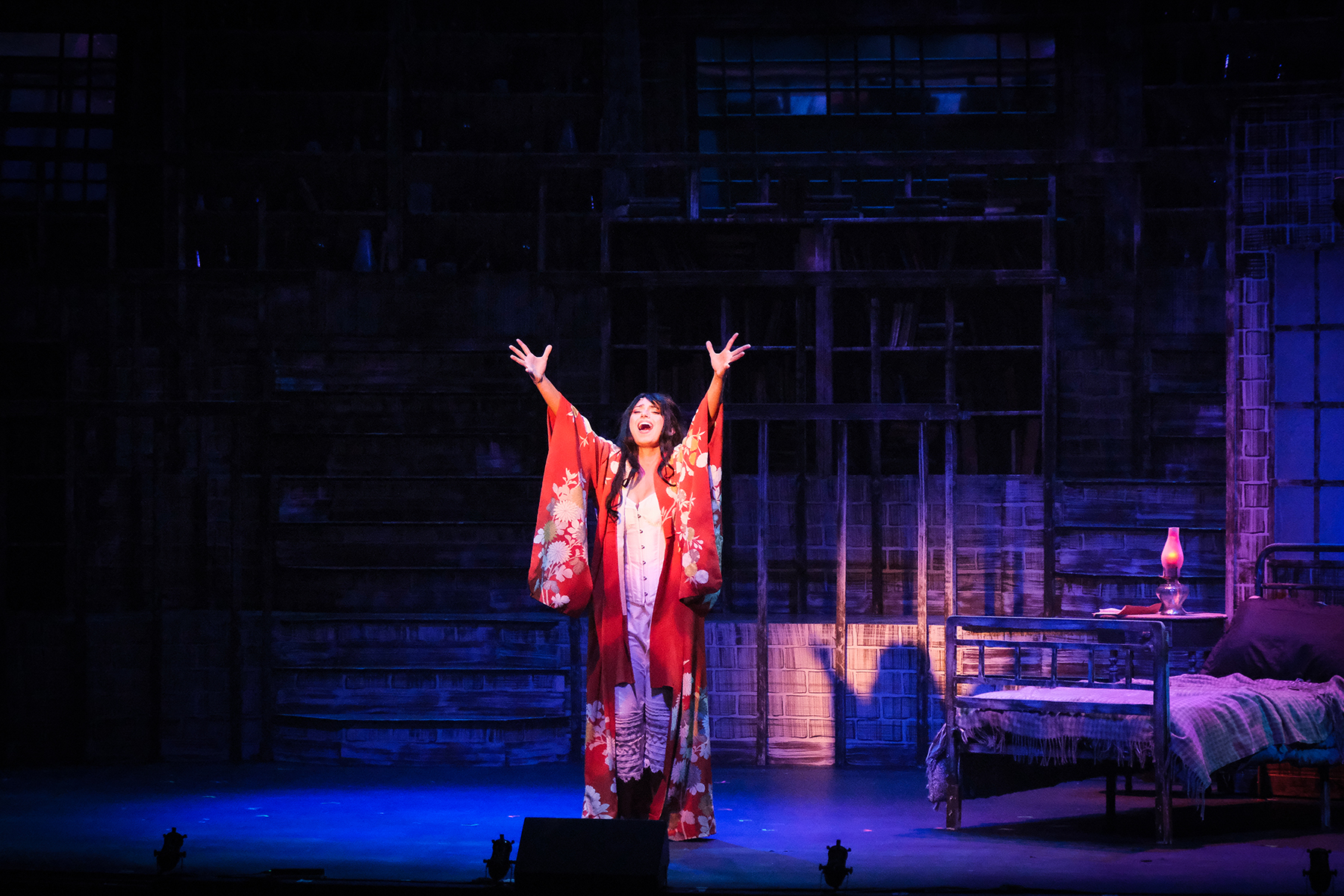
Emily Van Vliet Perea as Lucy Harris (Photo credit by Javier Franceschi)
An aura of dark dramatic intensity suffuses the Act 2 opening number, “Murder, Murder,” which functions as a sensationalized news broadcast. Accompanied by red lighting, London’s panic-stricken citizens and high-society elites gossip about Hyde’s brutal killing spree. Significantly, unlike in Stevenson’s novella, in which Hyde commits random acts of violence, the stage musical gives Hyde a specific target list. He systematically assassinates the hypocritical members of the Board of Governors of St. Jude’s Hospital: the same people who mockingly rejected Jekyll’s medical research in Act 1. Hyde is now out for revenge. Of course, we don’t condone his acts, but we come to understand his motivation.
In a more relaxed, sexy environment, cast members infuse “Bring on the Men,” sung at the seedy establishment The Red Rat, with a high-energy, darkly seductive, provocative aura. The song acts as a floor show meant to entertain the tavern’s rowdy male clientele from both the upper and lower classes.
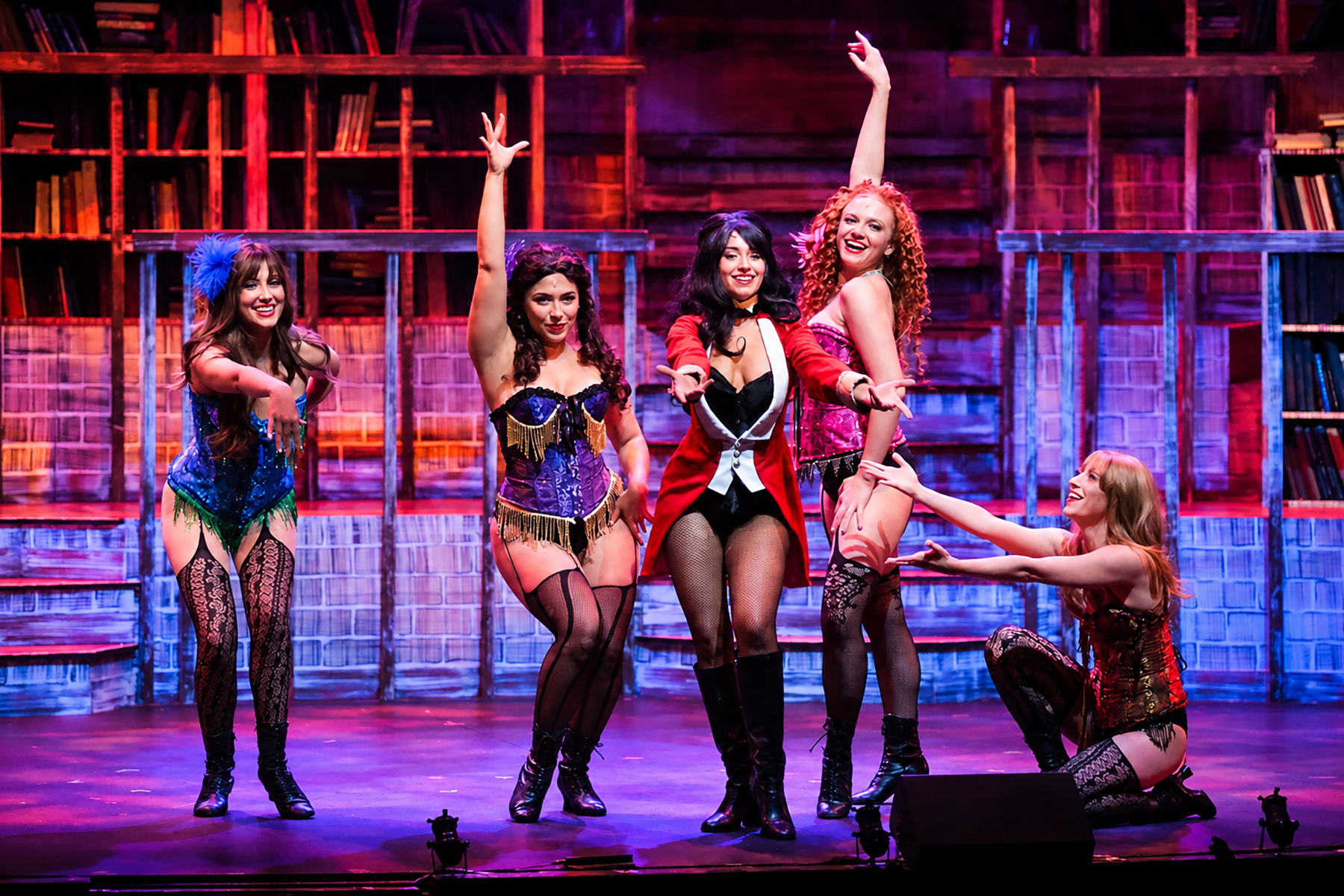
Alexandra Van Hasselt, Lauren Horgan, Emily van Vliet Perea, T.J. Canlon, and Cat Pagano (Photo credit by Javier Franceschi)
“Confrontation,” a song near the end, features a rapid-fire vocal and physical duel for dominance over a single body. Losada performs a riveting rendition, leaning back when singing as Jekyll, the more upright character. When Hyde takes over, Losada thrusts forward as though he’s a wild animal primed to attack.
The musical and its source, Robert Louis Stevenson’s novella, share a common premise about human duality but differ in their approach. Both explore the psychological struggle between the civilized self, represented by Jekyll, and the repressed, dark, violent impulses embodied by Hyde. In both versions, Jekyll is not simply the victim of an accidental experiment; he consciously creates Hyde as an outlet for his own darkness.
Stevenson tells the story largely from the perspective of lawyer John Utterson, framing it as a Victorian mystery and suspense tale that conceals the connection between Jekyll and Hyde until the end. In contrast, librettist Leslie Bricusse’s musical focuses on Jekyll’s internal psychology, grand rock-operatic anthems such as “This Is the Moment,” and theatrical confrontations between the two personas. The musical also introduces two prominent female characters: Emma Carew and Lucy Harris.
Both versions explore human duality, the dangers of hubris and unchecked science, social hypocrisy and façades, and the downward spiral of addiction. In the musical, one can understand Jekyll’s final act as an acknowledgment of responsibility: realizing he can no longer contain Hyde, he chooses death rather than risk becoming permanently consumed by his alter ego. His sacrifice also reflects his desire to protect his fiancée.
It’s understandable to grow heartbroken after the musical’s tragic ending, but we also leave the theater deep in thought. We may ponder the façades we don and how we can put our goodness to use while curbing whatever baser inclinations we may possess.
IF YOU GO:
WHAT: Actors’ Playhouse’s production of “Jekyll & Hyde”
WHEN: Through Nov. 1.
WHERE: Stein Center for the Performing Arts at Actors’ Playhouse at the Miracle Theatre, 280 Miracle Mile in Coral Gables.
TICKETS: $50–$100.INFORMATION: (305) 444-9293 or visit www.actorsplayhouse.org.