



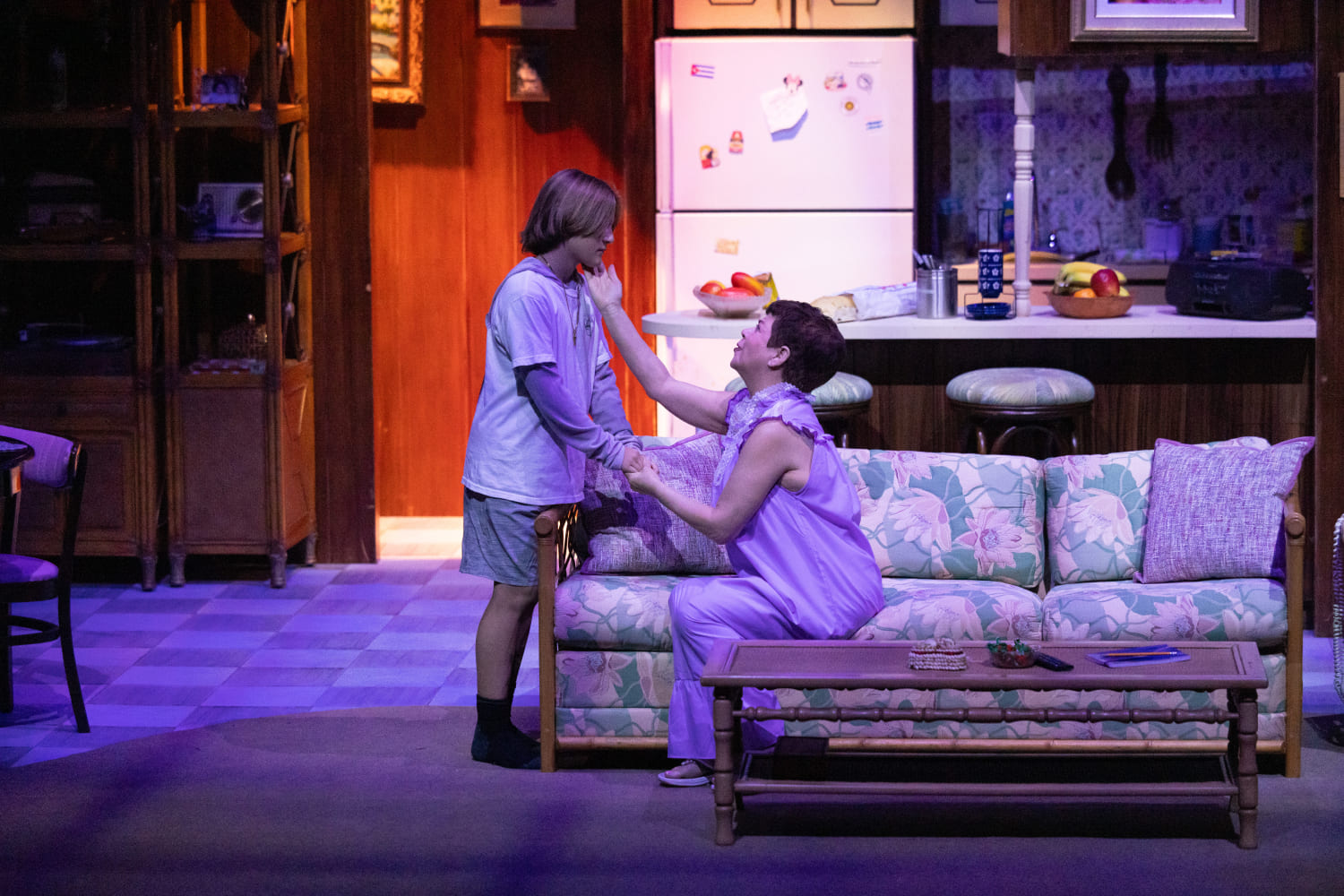
Franco Kiglies and Barbara Bonilla in the world premiere of "How To Break In A Glove." The production by City Theatre and Adrienne Arsht Center is playing at the Carnival Studio Theatre through Feb. 22.(Photo by Morgan Sophia Photography)
An elderly family matriarch lies dying, and her daughter sits at her bedside. Though weak and in pain, the older woman summons the strength to reassure her daughter with compassion.
Carmen: “I need you.”
Aleida: “Mija, you have me every time you look in the mirror.”
This intimate, heartrending moment unfolds in City Theatre's moving world premiere of Chris Anthony Ferrer's poignant and deeply affecting play, “How to Break in a Glove,” a co-production with the Adrienne Arsht Center. The play runs through Sunday, Feb. 22 in the intimate Carnival Studio Theatre at the Arsht in downtown Miami. The performance runs about an hour and 45 minutes without intermission.
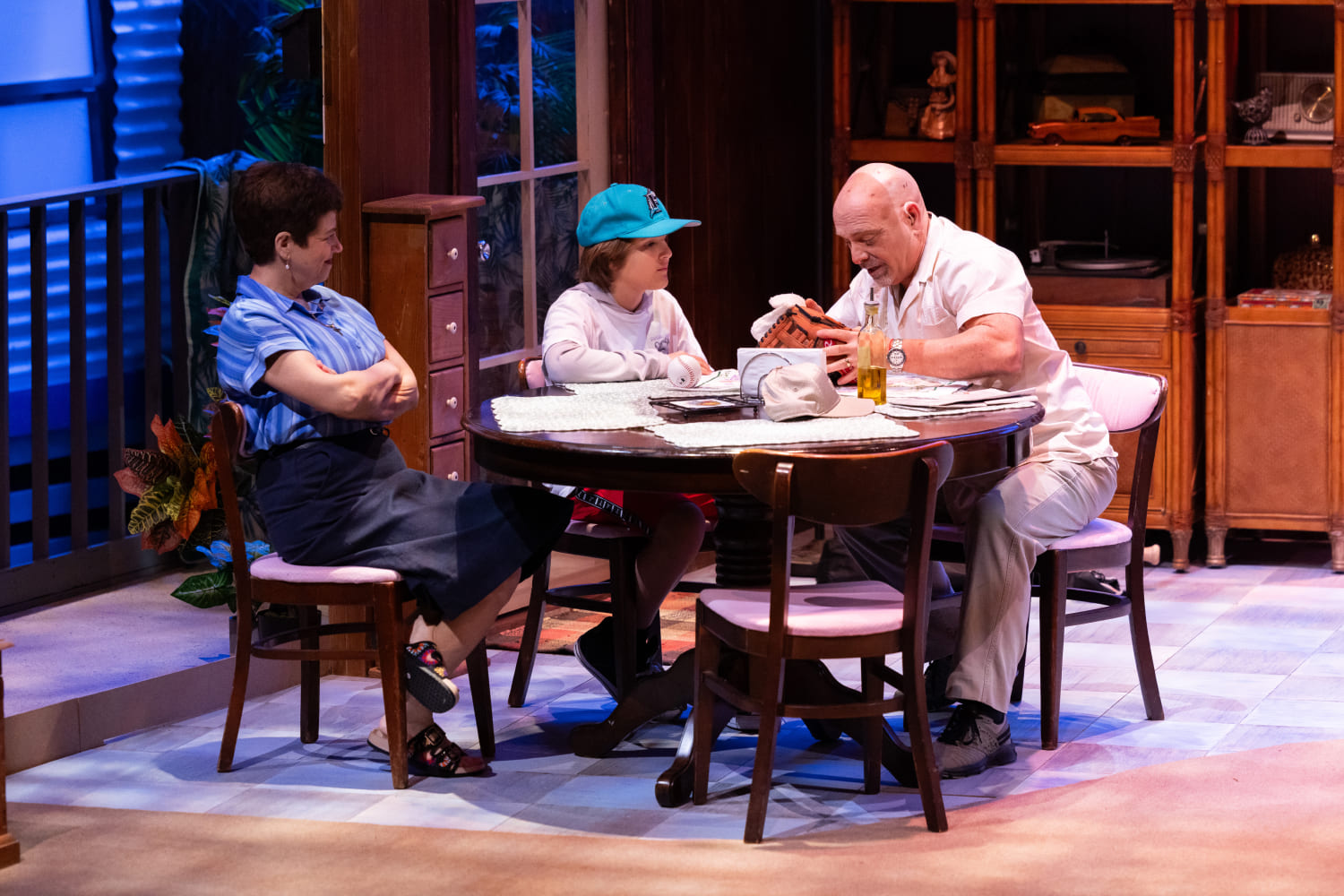
Barbara Bonilla, Franco Kiglies and Andy Quiroga in the world premiere of "How To Break In A Glove." (Photo by Morgan Sophia Photography)
The pain and vulnerability in Carmen's voice make clear how much she relies on her mother, while Aleida's gentle words carry the compassion of someone who will always be there - even after death.
Kaelyn Ambert-Gonzalez and Barbara Bonilla, as Carmen and Aleida, play the scene with moving sincerity, free of sentimentality. They are part of a cast of equally gifted actors under Gladys Ramirez's sensitive direction. Under her guidance, the pacing is fluid, and moments of silence land with the same strength as beats of dialogue.
[RELATED: An Interview With the Playwright]
The ensemble includes Andy Quiroga as Francisco, Aleida's husband; Randy Garcia as Carlos, Carmen's ex-husband; and 13-year-old Franco Kiglies as Carlos and Carmen's son, 11-year-old Tony Lugo. Young performer Cris Amado serves as the alternate for Tony (during the reviewed performance, Kiglies appeared onstage).
Aleida and Francisco are strong-willed Cuban immigrants and devout Catholics who came to America in search of a better life. In 1999, they live in Hialeah under one roof in a trailer park home with their daughter, Carmen, who works double shifts at a department store.
Carmen, Carlos's ex-wife, spends long hours not only working but also drinking and dating her boyfriend -- he is only mentioned but never seen.
The former couple share joint custody of their 11-year-old son, who worries when his mother doesn't come home until late. The youngster has problems of his own.
The play unfolds before, during, and after a family crisis, during which its members rely on one another to get through the pain. Before the play ends on a hopeful note, secrets spill, grievances come to light, and Tony's sudden collapse - likely the result of an overdose - forces the family to confront just how fragile life can be.
When we meet 11-year-old Tony Lugo, as Kiglies skillfully portrays him, he may initially resemble a carefree, all-American boy (with Cuban roots). Sporting a white baseball uniform, longish light-brown hair, and dark eyes, he looks ready to happily take part in a youth baseball game.
But this kid is not alright. Tony suffers from chronic insomnia, nightmares and feels compelled to perform repetitive behaviors - likely to keep anxiety at bay - worries about his mother, and, for reasons we don't fully understand, engages in self-harm.
He repeatedly scratches himself. We also learn that Tony keeps a journal, and when a family member discovers its contents, the reaction is one of shock and alarm. Though we never learn what Tony has written, we later witness his sudden collapse. An overdose from sleeping pills?
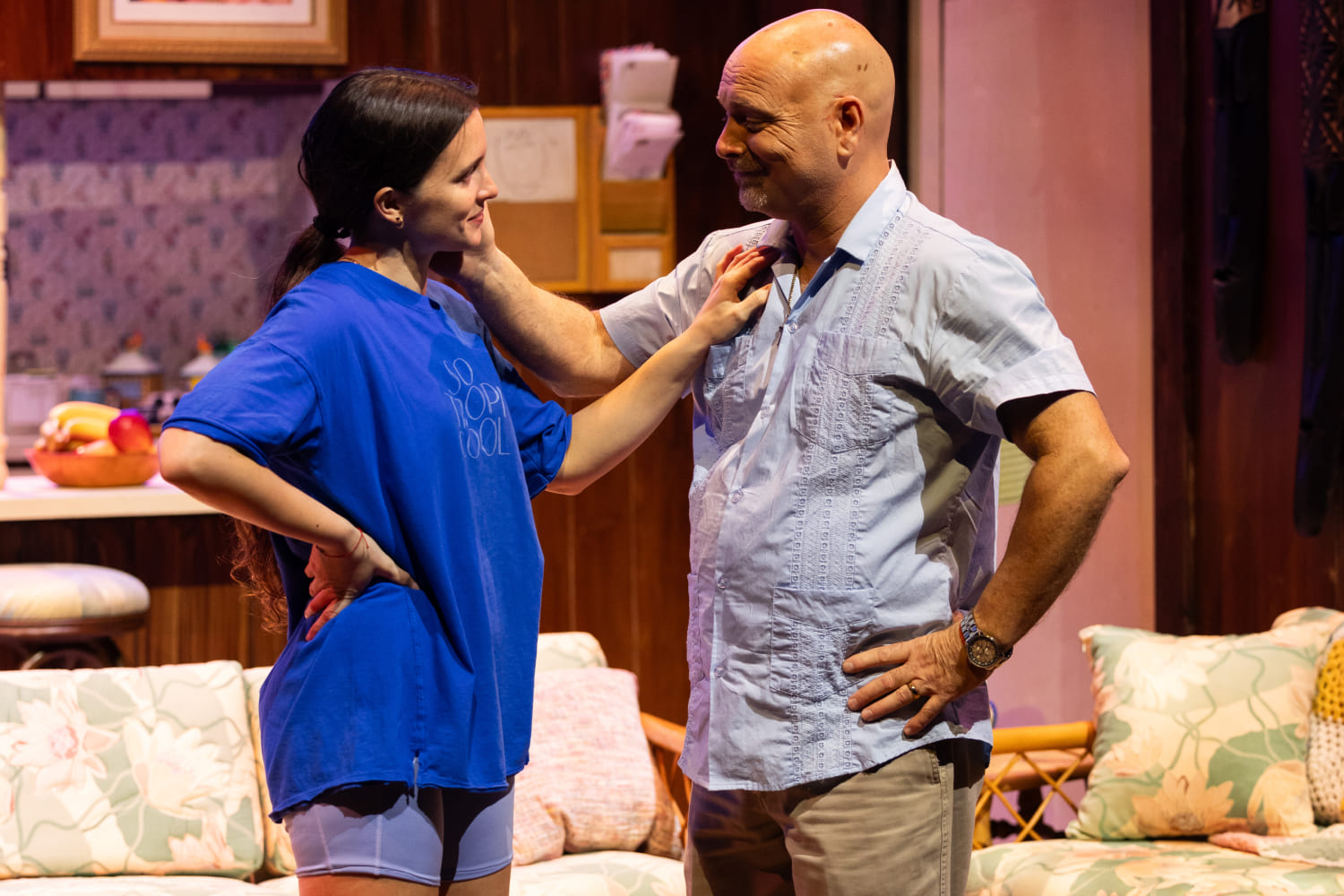
Kaelyn A Gonzalez and Andy Quiroga in the world premiere of "How To Break In A Glove." (Photo by Morgan Sophia Photography)
Kiglies, a local actor who excelled as Noah Gellman in Actors' Playhouse at the Miracle Theatre's fine 2024 professional production of the musical “Caroline, or Change,” delivers here as well. With a brightness that endears us to the boy, Kiglies' Tony moves quickly and speaks with contagious enthusiasm. He conveys compassion and a maturity forced upon him too soon.
While the actor communicates believable vulnerability and makes Tony's collapse credible, he also exercises notable restraint: Tony does not explode with anger or tears, nor does he visibly shake with anxiety. Instead, he suffers inwardly - a quiet pain that makes his collapse all the more upsetting.
Tony's baseball uniform, of course, includes a mitt - a visual echo of the play's title. The “breaking in” of the glove serves as a metaphor for family relationships: just as a new, stiff glove must be softened with patience and effort, so too must family members work through disagreements, cultivate flexibility, and learn to care for one another. Like an inflexible glove, some people develop hardened edges.
According to Francisco, his wife was once such a person. He recounts a moment from their past when he and Aleida took their young daughter to a park. At some point, an Anglo-American girl pushed young Carmen off a swing. Aleida screamed “horrible things” at the other girl's mother and shook her.
“All those gringos? They're not used to our passion - and that was her going easy. They were all scared of this five-foot crazy Cuban,” Francisco recounts.
As Bonilla deftly portrays her, Aleida can be commanding and strict, such as when she lectures Carmen for staying out late and breaking a promise to Tony.
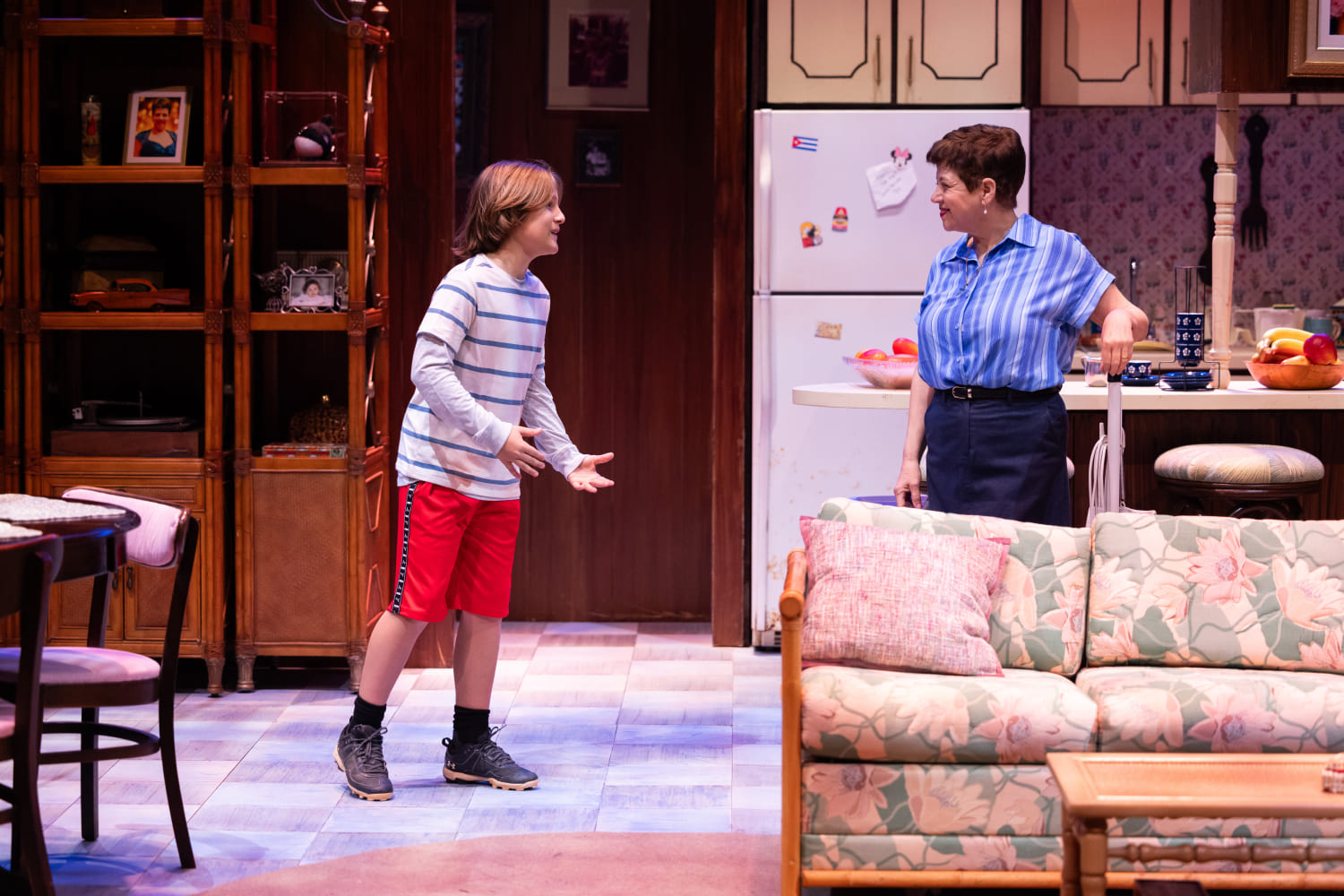
Franco Kiglies and Barbara Bonilla in the world premiere of City Theatre's "How To Break In A Glove."(Photo by Morgan Sophia Photography)
With a sharp voice and confident stance, Bonilla punctuates Aleida's no-nonsense demeanor by pointing. But she also reveals Aleida's playful and even seductive side. At one point, Aleida tells Francisco she feels “like dancing.” When he hesitates, she issues an ultimatum: “Dance with me or sleep outside.” The couple then dance slowly to tender recorded music, bathed in dim lighting (lighting designer Eric Nelson).
Francisco may not initially seem like the dancing type. In Ferrer's script, the playwright describes him as “Cuban, very rough around the edges. Deeply repressed. A tenderness that is buried by the masculinity of his cultural generation.”
Like Bonilla's Aleida, Quiroga's Francisco can appear tough. With unapologetic directness, he tells Carlos that while his ex-son-in-law has a “good heart,” he is not a “man.” Later, when relations thaw, Francisco firmly shakes Carlos's hand - and then, still gripping it, pulls the younger man toward him.
Yet Quiroga also conveys Francisco's vulnerability with conviction.
Ambert-Gonzalez and Garcia also shine as the sometimes-feuding ex-couple, Carmen and Carlos. While their sarcastic exchanges sting, the actors balance tension with tenderness, humanizing these flawed former spouses. Both make it abundantly clear that they love Tony. Individually and together, the performers create rounded, conflicted, and believable characters.
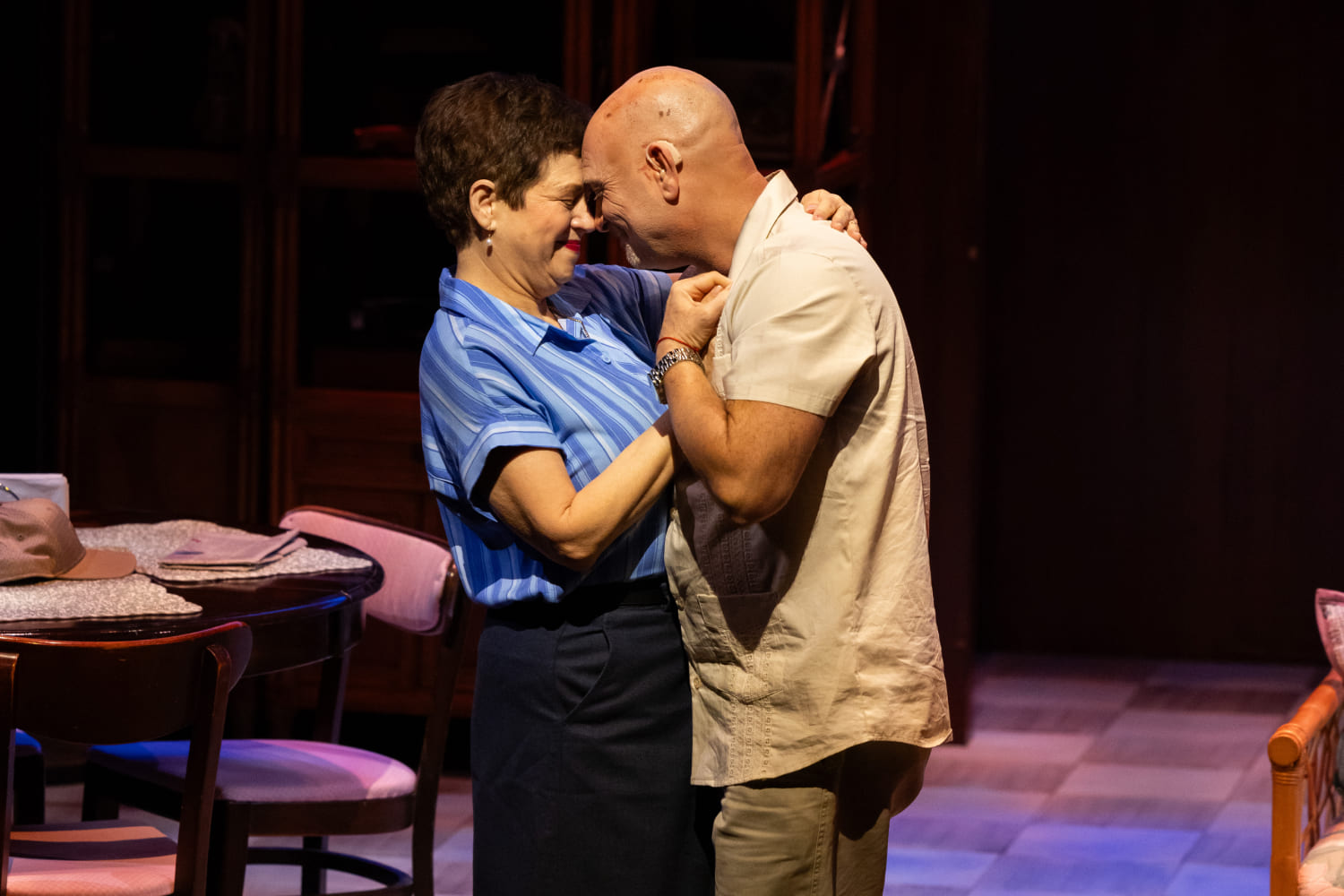
Barbara Bonilla and Andy Quiroga in the world premiere of "How To Break In A Glove." (Photo by Morgan Sophia Photography)
Under Ramirez's direction, and with intimacy choreography by Nicole Perry, physical closeness - hugs, kisses - consistently feels genuine, while David Hyland's fight choreography renders moments of forceful contact convincing.
The actors perform on Andrew Rodriguez-Triana's realistic depiction of the family's trailer home. The spacious set includes visible details of neighboring trailer parks and their addresses, along with exterior telephone wires. The interior, set on a raised platform, feels roomy and lived-in. With dark brown walls, a hanging lamp, plants, fruit in a basket, board games in a corner, and a white refrigerator dotted with Post-it notes, the home appears neat and cared for - despite the surprising revelation that it contains only one bathroom. Rodriguez-Triana designed the set, which Rey Bode & Little Shop of Woodworks constructed.
Dario Almiron's character-appropriate costumes and Joel Rodriguez's clear sound design further contribute to the production's success.
“How to Break in a Glove” marks a milestone for Ferrer and City Theatre. The play originated in the first cohort of City Theatre's “Homegrown” playwright development program, launched in 2021 with a CreARTE grant from Miami's Perez Foundation. City Theatre's initiative gives local playwrights time, resources, and creative guidance to develop new work over multiple years in dialogue with artists and audiences from their own communities. This is the first full-length play to reach the stage through the program.
Ferrer's writing is focused and vivid. “Why do I feel like I'm dangling at the edge of a cliff?” Carlos asks. Elsewhere, Francisco wonders, “What do you want me to say? That it's stuck in my brain like a spike I can't take out?”
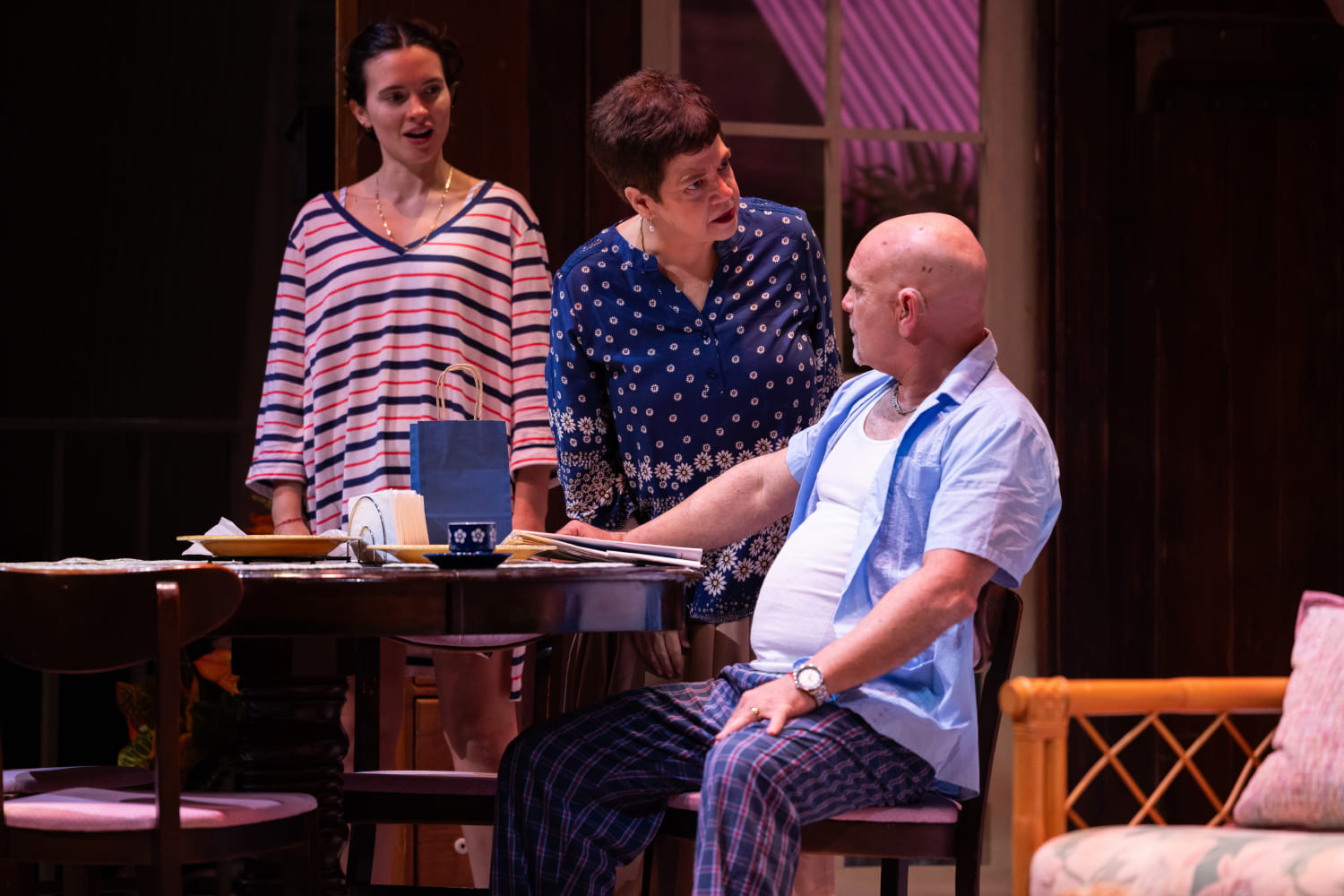
Kaelyn A Gonzalez, Franco Kiglies and Andy Quiroga in the world premiere of "How To Break In A Glove." (Photo by Morgan Sophia Photography)
If the play has a shortcoming, it lies in how quickly we learn of a happy development following a shocking revelation from Aleida's diary. The good news seems designed primarily to usher the play toward its upbeat conclusion. Still, there are no wasted words, scenes, or subplots here. The play recalls Tracy Letts' combustible "August: Osage County," with its startling revelations - though the family in Ferrer's drama is far gentler and far less toxic than Violet Weston, Letts' acerbic, pill-popping cancer patient. Ultimately, “How to Break in a Glove” is more intimate and hopeful.
While Ferrer's play is rooted in Cuban and Cuban-American culture, it never makes non-Cuban (or non-Hispanic) audiences feel like outsiders. True, the characters sometimes use Spanish words - and the production does not include subtitles - but their emotions are vivid enough to make meaning unmistakable. In fact, the use of Spanish enhances the characters' authenticity as Cuban immigrants. Moreover, the play speaks to audiences well beyond its specific cultural setting.
Ferrer sensitively explores themes that resonate universally, including generational trauma, family, mental health, relationships, loss, legacy, the balance between tradition and change, and the need for connection and belonging.
At a trying moment for immigrants in 2026 America, City Theatre's production opens our hearts to people who may be different from us, reminding us that regardless of where we come from, we are all human and share many of the same needs.
IF YOU GO
WHAT: City Theatre and the Adrienne Arsht Center's world-premiere professional production of “How to Break in a Glove” by Chris Anthony Ferrer
WHEN: Through Sunday, Feb. 22. Performances are 7:30 p.m. Wednesday through Saturday and 2:30 p.m. Sunday.
WHERE: The Carnival Studio Theatre at the Adrienne Arsht Center, 1300 Biscayne Blvd. in Miami.
TICKETS: $66.69-$72.54.
INFO: www.arshtcenter.org/tickets/2025-2026/theater-up-close/