



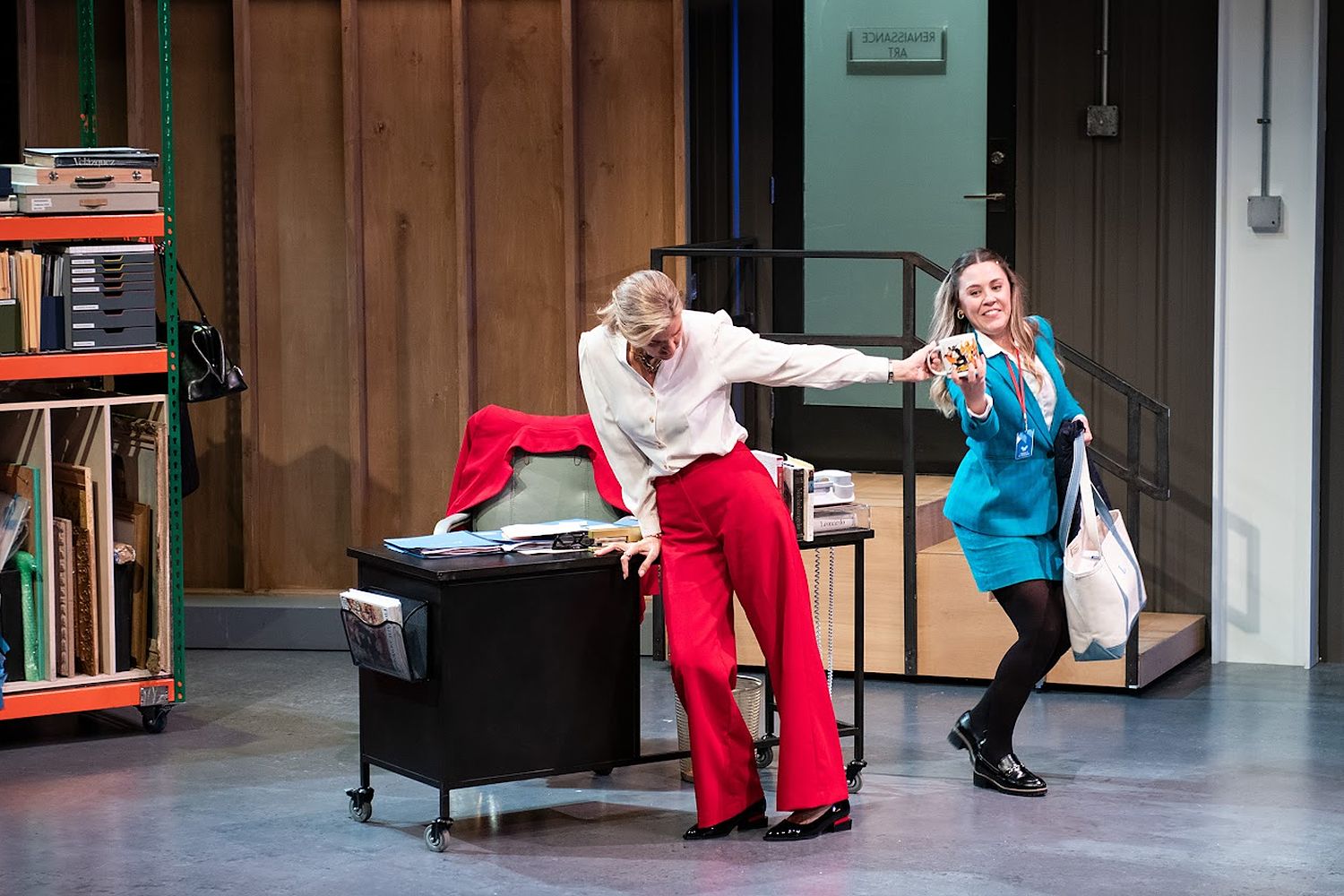
Mia Matthews as Jodi Dean and Casey Sacco as Lauren Sanders in the GableStage production of "True Art." (Photo © Magnus Stark, 2026).
Want to be Michelangelo? It might be easier than you think.
In the age of Artificial Intelligence, it can be a cinch for John Doe to create a highly impressive work of art and attribute it to one of the greats. Buddy Silver might have the secret down to a science in Jessica Provenz’s intriguing and thought-provoking play, “True Art,” which GableStage is staging in a polished and entertaining production running through Sunday, Dec. 20.
Performances last about two hours and 15 minutes, including intermission, and take place in the company’s Wolfson Family Theatre next to the Biltmore Hotel in Coral Gables. Under Bari Newport and Jeni Hacker’s sensitive direction, the production features a cast of talented performers who deliver honest and nuanced performances.
In “True Art,” Lauren Sanders, an eager art history graduate, lands a job at a prominent, modern-day New York City museum, where she gets pulled into a fast-moving game of ambition, dishonesty, and a high-stakes dispute over a newly discovered Michelangelo work. Jodi Dean, who is eyeing a possible promotion, is the Renaissance Art curator who employs Sanders; Silver is a fun-loving, enthusiastic art dealer who brings the Michelangelo work to the museum’s attention; and “floater” J.J. Winchester is the museum board chairman’s aimless son who also plays a major part in the action.
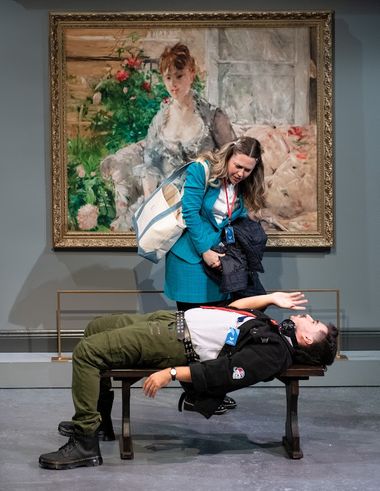
Casey Sacco as Lauren Sanders and Samuel Krogh as J.J. Winchester. (Photo © Magnus Stark, 2026).
Newport and Hacker keep the action moving fluidly through different locales and tones. Under their guidance, the energy never lags. That’s a credit not just to the skilled performers but also to the stagehands, whose brisk movement of scenery during seamless transitions reinforces the hubbub at a busy museum. Newport and Hacker, along with the cast, nail the play’s multiple tones—comedy, suspense, and pathos—while maintaining sincerity throughout. The actors also enhance their naturalness with bits of stage business.
The performance begins in medias res, plopping audiences into the high-stakes, fast-paced environment of a busy, big-city museum. At the top of the show, the stage is crowded with various items you might find in a museum. Stagehands remove items, bring some on, clean them, and perform similar preparations. It turns out they’re preparing for an auction. The play includes a neat bookend; it begins and ends with an auctioneer at the start of an auction. The closing auction’s description includes a slight but significant qualification—“thought to be by Giorgione”—that acknowledges uncertainty at a time when things such as AI beckon.
The performances are uniformly strong.
Casey Sacco, who portrays Sanders, lends the character a wide-eyed, eager willingness to immerse herself in the art world. Her high-wattage smile clearly conveys that she’s in “love” with the museum, as J.J. observes. Sacco’s Sanders leans forward and is clearly engaged. But Sacco’s performance isn’t one-note; she doesn’t merely embody a wide-eyed, eager blonde. In a multi-faceted performance, Sacco’s enthusiasm for and knowledge of art comes across, for example, when she mentions artists’ names from memory, as though she’s a walking encyclopedia. But her boss is apparently less than impressed. “Who are you, Rain Man?” the older woman asks?
Sacco also imbues Sanders with a sense of urgency and exasperation when she frustratingly asks, toward the end, “Why can’t anyone just tell the truth?” With determination, she seems prepared to relay to a New York Times critic that she questions the authenticity of the artwork at the play’s center. Earlier, she spoke on the phone with that critic with an Elle Woods-like bubbliness that might lead you to believe she was talking to her bestie. The character’s commitment is clear when, out of breath, she hurries on and offstage.
Later, Sacco illustrates her character’s growth by standing tall and confronting her boss authoritatively, showing her transformation from an eager but green newcomer to a more mature woman unwilling to compromise on her principles and ethics.
Samuel Krogh, making his regional debut at GableStage, where he regularly works in different capacities, turns in a multi-dimensional performance as J.J., son of the museum’s board chairman. The actor lends J.J., a self-described “floater,” a believable carefree, cavalier demeanor, playfulness, and an impulsivity that can be off-putting. At the top of the play, Krogh’s J.J. sneaks up to Sanders and starts talking with her as though he’s known her for some time. Sanders seems caught off guard by the talkative stranger. While speaking with her, he becomes self-aware of a faux pas and mouths the word “F—K” without letting her see his frustration. “S—t,” he also exclaims when he’s similarly irritated.
Krogh’s portrayal of J.J. makes you wonder whether, as a youngster, he was the class clown. “Look at you, doing your thang!” he tells Sanders in a playful tone that suggests good-natured teasing. At another point, he jumps and screams during an exuberant moment. He also howls loudly.
The dark-haired Krogh wears a black outfit and appears to sport black eyeliner, lending the character a hint of Goth-like rebellion. He puts his feet up on a desk and lies on a couch as though he owns the place and unapologetically calls Jodi “Demon Lady” and “Cruella” (after the villainess in the novel “One Hundred and One Dalmatians”).
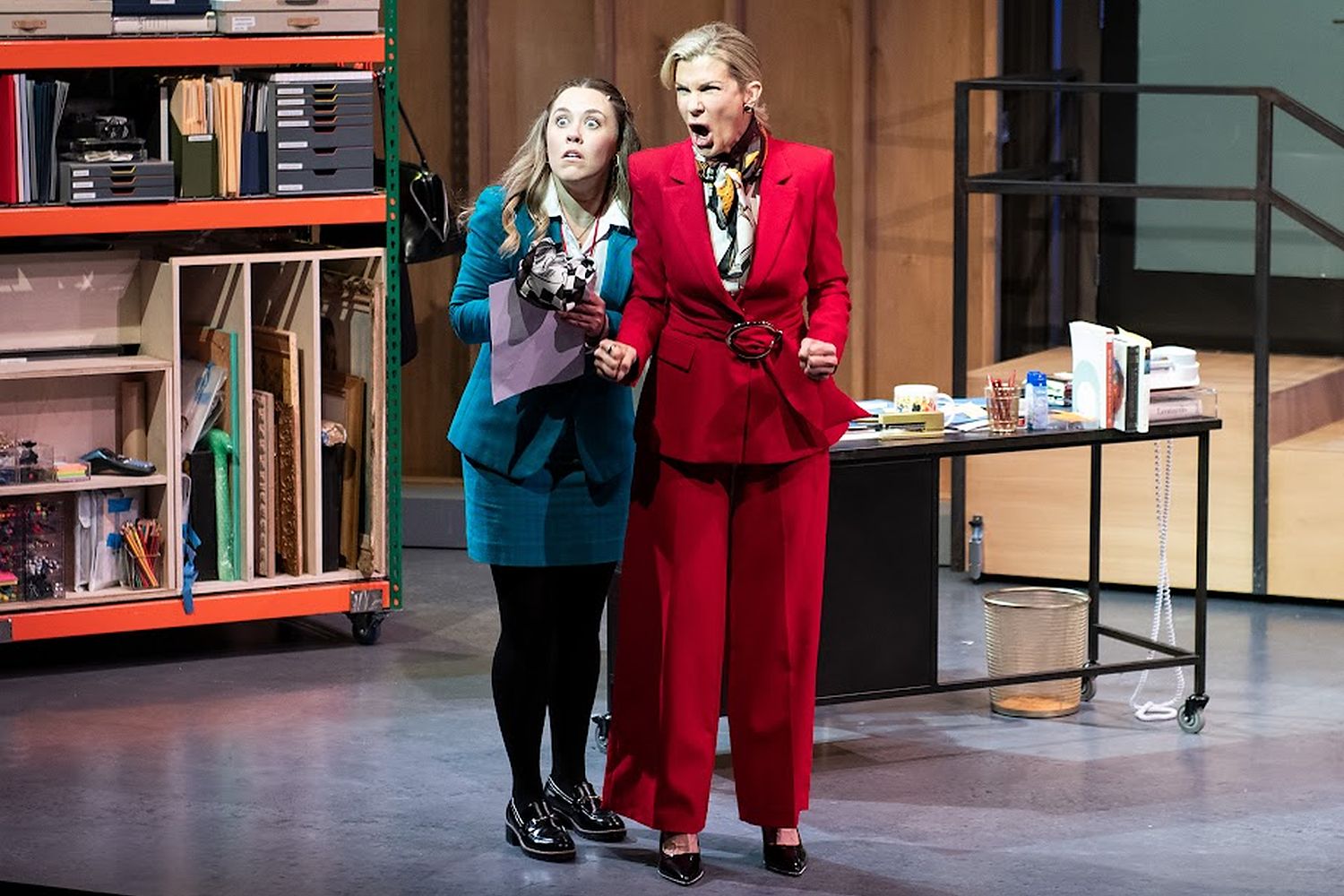
Casey Sacco as Lauren Sanders and Mia Matthews as Jodi Dean. (Photo © Magnus Stark, 2026).
Fortunately, Krogh’s J.J. possesses emotional depth. Indeed, his playful exterior gives way to more genuine emotion at different points. When he asks Sanders whether they can be friends, he sounds sincere rather than playful. At another point, he tells her, compassionately, “I got you, O.K.?” Krogh’s J.J. also expresses sincere concern about his father. However, you wonder about his future when he announces that he’s moving into cryptocurrency, which, in his view, is less corrupt than the art world.
J.J. and others might refer to Dean in less-than-flattering terms, but Mia Matthews wisely doesn’t turn her into an outright b--ch. Matthews’ Dean can be pleasant, elegant, and eloquent but is supremely confident in a contented sort of way. She stands tall, and her busy, self-assured demeanor may create the impression that she has no time for people like the newcomer, Sanders. She also makes distasteful remarks such as, “I can’t have an assistant who f—ing faints. If you’re hungry, eat. I can’t do anorexics.” However, she utters the line not with malice but with a dismissive quality that falls short of nastiness. Matthews reserves viciousness for later, when she raises her voice and venom drips from it. In fact, she growls when Sanders suggests she’s almost 70. “I am decades from 70!” she thunders.
Matthews can also be dramatic, as when she spreads her arms and declares the museum directorship “is going to be mine! Mine, mine, all mine!” Afterward, she emits a cackle that doesn’t sound quite as menacing as the Wicked Witch of the West’s evil laugh. She can also be competitive, as when she narrows her eyes and encourages Sanders to be relentless. “Be a dog with a bone!” she roars. “Be hungry. Be ravenous. Be a starving, mangy mutt eying a big, fat, juicy beef marrow bone!”
Matthews’ Dean also possesses appealing qualities, and the performer conveys them when, for instance, she triumphantly tells Sanders, “I broke the glass ceiling (and) I can help you up over the shards.” Toward the end of the play, she acknowledges that credible questions have been raised about the painting. She notes that, as the museum’s director, she will conduct an investigation. “We would at least have the truth,” she says, calmly and reasonably. “Lesson Twenty-five. That matters.”
With his hearty laugh and cheery, charming disposition, Stephen Trovillion’s flashy Buddy often comes across as everyone’s favorite, jolly uncle. He hums to himself while walking, dances while humming, audibly inhales and smells the chocolate in his hands.
Sporting a slight dark grayish mustache and beard, black-rimmed glasses, and dressed fancifully, he looks appealing and shares strong chemistry with Matthews’ Dean. You can tell they are close and have known each other for more than two decades. He affectionately calls Dean “JoJo.” At one point, Buddy and Sanders, full of glee, take each other’s hands and jump excitedly. “Isn’t she a little young for you?” Matthews’ Dean asks with a tinge of sarcasm.
While Trovillion’s Buddy is generally pleasant, his demeanor changes briefly when Sanders confronts him. “How dare you,” he says, viciousness gushing from his suddenly harsh voice. Toward the end, Buddy vanishes without a trace. “His apartment’s listed by an LLC, he disappeared,” Dean says. “Just poof. I’ve known the man over twenty years, and I don’t even know if his actual name is Buddy Silver. He was a fake.”
In addition to playing Buddy, Trovillion doubles as a polished auctioneer with a clear British accent at the beginning and the end.
While cast members believably create the world of the play, backstage artists help them inhabit it.
Scenic Designer Frank J. Oliva has created a striking, spacious set, illuminated with Tony Galaska’s realistic lighting, that is flexible enough to become multiple locations. Certainly, the most visually appealing and appropriate elements are the numerous works of art that run horizontally across the top of the proscenium in two rows and vertically down the proscenium. These displayed works clearly establish that this is a play about art.
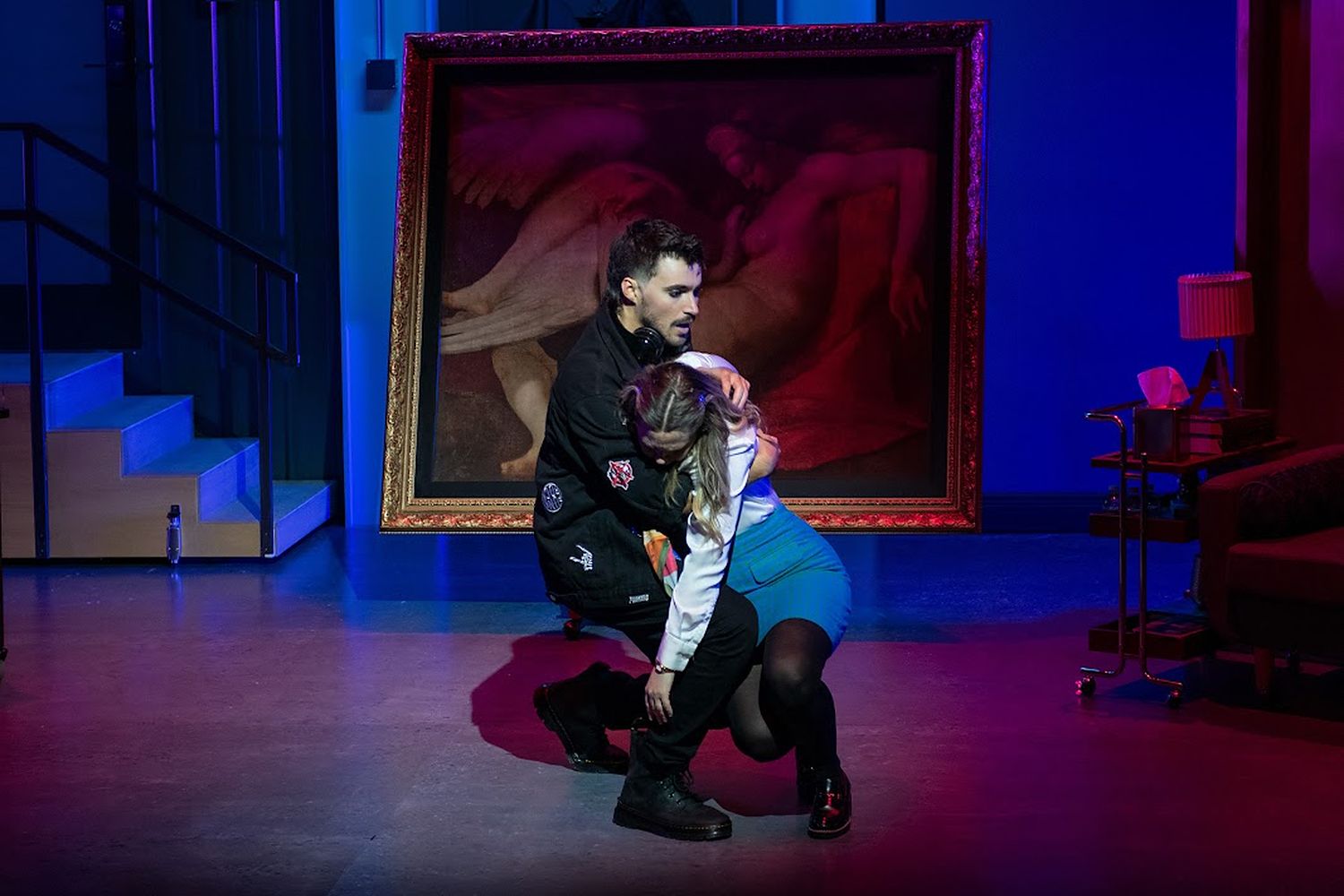
Samuel Krogh as J.J. Winchester and Casey Sacco as Lauren Sanders in GableStage's "True Art." (Photo © Magnus Stark, 2026).
Aside from the artworks, objects such as carts of various equipment, a ladder, and a statue head help establish the environment. For Dean’s office, Oliva adds little more than a couch and desk. For J.J.’s “man cave,” clothing on the floor and a profane sign reinforce this young man’s irresponsible, irreverent tendencies.
Costume Designer Paula Calvo and Assistant Costume Designer Andrea Guardo Cuao outfit the performers in elegant attire that you’d normally see in sophisticated, upscale settings. For instance, Silver wears a black tuxedo to a formal event put on by the museum. Also, Dean and Sanders sport stylish evening wear. At other points, Dean wears a tasteful red jacket that matches the color of her pants and the hue of her lipstick. Meanwhile, J.J. sports more casual clothing, which befits his often-cavalier demeanor. During one scene, he is shirtless, which also fits in with his manner.
“True Art” contains vivid, snappy dialogue, humor, and familiar pop-cultural references to make “True Art” light and accessible. The best plays about art don't lecture on art history or appreciation but connect art to relevant themes and tell a compelling story to draw readers in. Some plays about art, such as “Red,” by John Logan, explore the creative process. By contrast, “True Art” examines authenticity, attribution, ambition, and the art world’s influence.
In “True Art,” Provenz, who blends sharp humor with emotional heart, asks questions such as: How far will people go to advance their careers? At what point does professional ambition compromise personal ethics? Who gets to determine what is authentic and what makes something genuine? Is it the artist’s hand, the history attached to the object, expert judgment, or the story people want to believe? While the play leaves audiences with plenty to think about, it doesn’t offer easy answers. Instead, it’s likely to spur thought and conversation.
During the age of “Fake News” and Artificial Intelligence, “True Art” is especially timely. We may question not only whether a work of art is genuine but also how people decide what to believe when it’s easy to manufacture conclusions that sound good and leave us feeling whole, even if those conclusions are less than truthful.
Without preaching, the play encourages us to take extra steps to verify the truth, even if both the process and the truth itself are inconvenient. But it’s hard to question the sincerity of GableStage’s funny and touching production, which is filled with truthful performances that live up to the standard of excellence we have come to expect from live theater in South Florida.
IF YOU GO
WHAT: “True Art,” by Jessica Provenz; directed by Bari Newport and Jeni Hacker
WHERE: GableStage’s Wolfson Family Theatre, 1200 Anastasia Ave., Coral Gables
WHEN: Through Sunday, Dec. 20. Performances are Wednesday–Saturday at 7:30 p.m., with 2 p.m. matinees Wednesdays and Sundays. There are also Saturday matinees Nov. 28 and Dec. 19; no evening performances Nov. 25 or 26.
HOW MUCH: Tickets start at $50, with discounts for military personnel, students, teachers, artists and groups of eight or more. Students and teachers with valid ID can request a free rush seat 45 minutes before curtain, subject to availability. GableStage
MORE INFO:gablestage.org or 305-445-1119.