

The Goldmund Quartet comes to Miami’s Temple Bet Shira,7500 Southwest 120th St., Miami, on Sunday, March 29 for a 4 p.m. concerts of Friends of Chamber Music Miami.
The program features two masterworks of 19th-century chamber music: Johannes Brahms’ String Quartet No. 2 in A minor, Op. 51, known for its lyrical warmth and structural elegance, and Franz Schubert’s String Quartet No. 14 in D minor, D. 810, “Death and the Maiden,” a dramatic and emotionally charged composition that stands as one of the cornerstones of the string quartet repertoire.
Miami audiences will also be treated to seeing some spectacular and valuable instruments. Since 2019, the Goldmund Quartet has performed on the “Paganini Quartet,” a set of four Stradivarius instruments once owned by Niccolò Paganini, loaned by the Nippon Music Foundation.
The Paganini Quartet was separated after Paganini’s death and only reassembled in the 1950s by dealer Emil Herrmann in New York. It was played by the Paganini and Cleveland Quartets and then became the first acquisition of the Nippon Music Foundation in 1994.
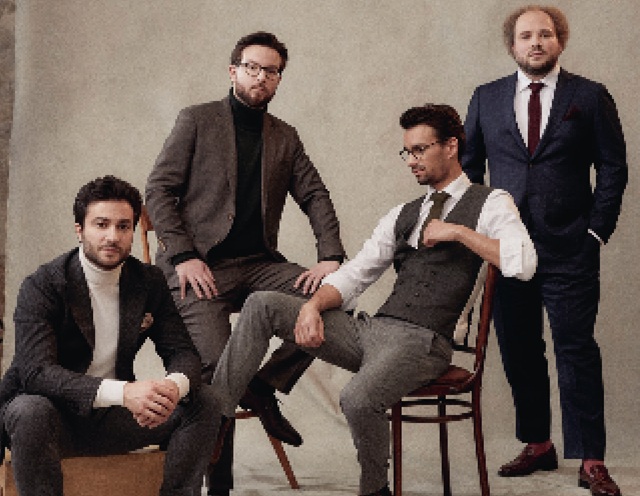
miamiartzine.com spoke with Goldmund Quartet co-founder cellist Raphael Paratore. Formed in 2009 in Munich, the quartet also features violinists Florian Schötz and Pinchas Adt, and violist Christoph Vandory, The four musicians from Munich have a long-standing musical friendship that goes back to their school days and they say it still characterizes their unique sound today.
miamiartzine: I think your appeal of being younger musicians is a way in to introducing a younger audience to something that could be perceived as “stuffy.” You know, classical music has this connotation like, I need to wear a gown to go to the opera, or a tiara to the ballet.
Ralphael Paratore: For us, we're very aware of the fact that, especially that the string quartet world, even within the classical music world, it’s even more a niche. Many people may be interested in opera and symphony, but then chamber music gets very specific. But it has such a history. For composers it was kind of a laboratory.
maz: In what way?
RP: The string quartet genre was where composers tried things out. Haydn, he’s the father of the string quartet. He wrote over 70 string quartets and not one sounds the same. The composers were always experimenting with musical forms. They call it the der König’s discipline – they always say the King’s discipline because it is the hardest thing to do, to write for a string quartet.
maz: And there’s a respect around that, correct?
RP: Yes, it became such an important formation that we are just now in this lucky situation to have this most beautiful repertoire written for string quartets and that brings me to the point. We want to put away any etiquette for how you have to dress or be for this kind of music, because in the end it’s just wonderful music. We want to share it and bring it to as many people as possible. So we do all kinds of projects.
maz: What are you working on now?
RP: We are recording our own arrangements of Bavarian folk tunes, Alpine folk music, and that’s fun and it brings the interest of a different audience. Also we really try to build a bridge to a younger generation for this music. We do it with our social media and how we promote it.
maz: What will you be playing for Miami audiences?
RP: Two major, really major works. The Brahms Second String Quartet is an all time classic for string quartets. Brahms was his own worst critic and battled with himself. He actually wrote over 20 string quartets, but burned most of them and only three survived. He only finished three but they are real masterpieces. And there’s such momentum. It’s kind of unstoppable and fun to play.
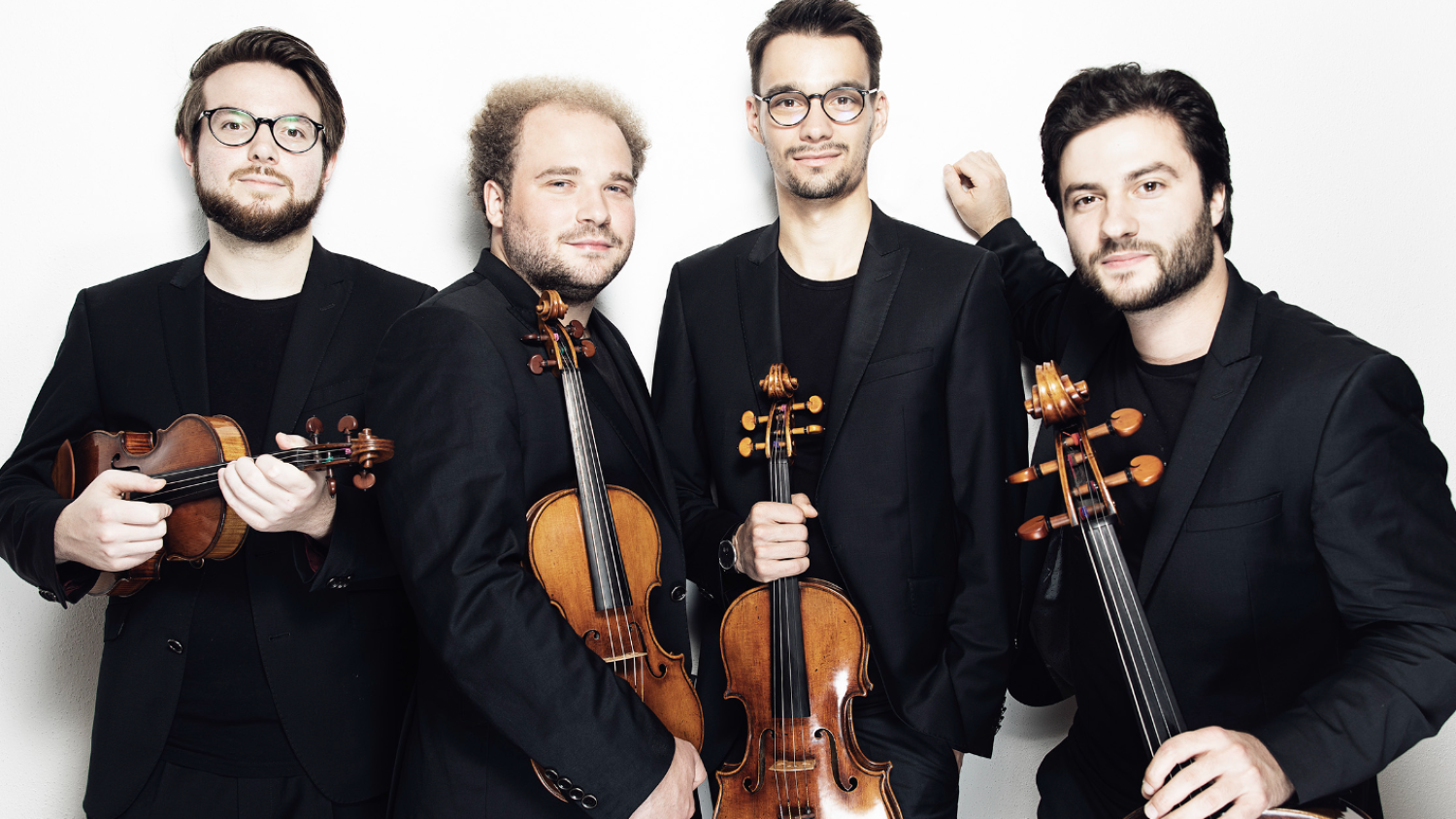
Members of The Goldmund Quartet will be in Miami. (Photo courtesy of The Goldmund Quartet)
maz: And the other?
RP: The other is a piece that’s very dear to us. It’s from Schubert – “Death and the Maiden.” And this, by the way is a piece that just really speaks to a younger audience. When we were teenagers, we wanted to play this. Everyone wants to play Schubert, because he has such an emotional way . . . his lyricism and sometimes a melancholic language. This was actually one of our first string quartets that we started playing back in high school. You know, we were actually a high school band. Christoph (Vandory, viola) and I, for example, have known each other since we were 11, 12 years old. We played in the youth orchestra together
maz: You will be playing in an intimate space at Temple Bet Shira presented by the Friends of Chamber Music Miami. Is playing in smaller locations more ideal for an audience to hear a string quartet?
RP: We’ve experienced all kinds of different settings. The chamber music concert tradition comes from playing in chambers, kind of like a more and more, kind of like a house or in a salon – this is the kind of settings where it evolved from. Schubert used to play in the living room of his friends and they all gathered, and it was very intimate. It is and was about being very close to the music, feeling the music, and sharing emotions with each other. And so, that is kind of the essence of chamber music – to have a very direct and intimate experience with the audience.
maz: Tell me about the instruments you’ll be playing. I heard about the Nippon Music Foundation loaning to you the historic Paganini Quartet, four instruments once owned and played by the 19th century Italian violinist/composer Niccoló Paganini. You will be playing on them for four years. That must be amazing.
RP: These instruments are actually quite, quite special for us. It's a great honor that we're able to play on them now since 2019.
maz: Tell me more about how you started the group.
RP: Well, we always played but it wasn’t until our last year’s of high school that we founded the Goldmund Quartet in the formation that it is today. We didn’t give much thought that this string quartet thing would become something we’d do professionally.
maz: And the name? Where did the name come from?
RP: It was a school lecture and from a German author, Herman Hesse, and he wrote “Narcissus and Goldmund.” They both grow up in a monastery and Goldman is the artist that leaves the monastery searching for fulfillment in art. He was a sculpture and he learned from many different masters and traveled a lot, so we saw parallels. Plus it is a name easily pronounced in any language.
IF YOU GO
WHO: The Goldmund Quartet presented by Friends of Chamber Music Miami
WHERE: Temple Bet Shira, 7500 SW 120th St., Miami
WHEN: 4 p.m. Sunday, March 29
HOW MUCH: $35 general admission, $15, faculty and teachers, $5 students.
TICKET INFO: https://www.miamichambermusic.org/concert-tickets/p/mar292026