



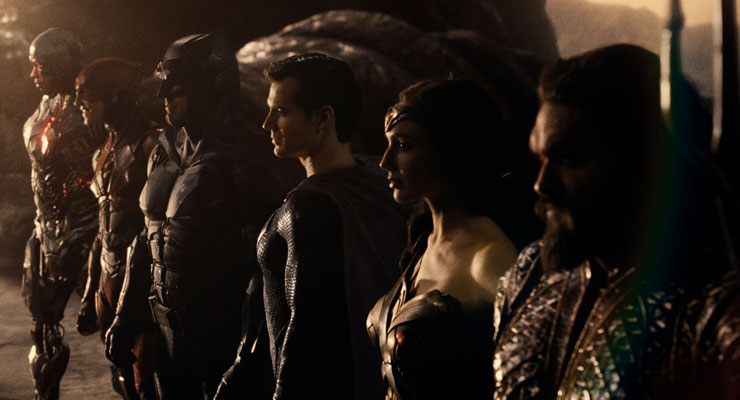
Ray Fisher, Ezra Miller, Ben Affleck, Henry Cavill, Gal Gadot and Jason Momoa in a scene from "Zack Snyder's Justice League." Courtesy: HBO Max.
We've been down this road before. Iconic figures in spandex put aside their differences to band together in order to save the world from an otherworldly menace. And you might hear an inner voice wondering, how many times can we sit through variations of the same story before we say enough?
How many seasons of this series do we finish before we look elsewhere for our at-home consumption?
How many crossover issues must we buy before déjà vu sets in? And for those of you who have either gone back to the multiplex or are eagerly awaiting their first movie outing in over a year, are you really going to invest your time and hard-earned cash into the latest product from the Marvel factory or the house of DC?
I don't have the answers. In this regard, this critic hasn't really changed that much from the nerdy, bespectacled teen who began collecting “Action Comics” and “Superman” after picking up some issues at his neighborhood Pueblo supermarket. I know what I like (hello, “Spider-Man: Into the Spider-Verse”) and what I don't particularly care for (sorry, James Gunn, but your “Guardians of the Galaxy” movies rub me the wrong way).
The actors might come and go and might even later return because nostalgia demands it. The pages of that new comic book might no longer stain your fingers, and those sets and costumes have never looked more vibrant than on your recently purchased 4K flat-screen. But I'm not making excuses for the cyclical nature of one of pop culture's reigning artifacts: the superhero tale. The hero's journey continues to draw us in like bees to honey, like Black Friday shoppers to a doorbuster deal, and despite what we've been through over the past year, that's probably not going to change anytime soon.
Jason Momoa, Ray Fisher and Ezra Miller in a scene from "Zack Snyder's Justice League." Courtesy: HBO Max.
So what does it say about the current media landscape that the most satisfying live-action film in years involving do-gooders in tights is not only something that plays in a thoroughly familiar sandbox but is not even a new movie?
But that's what “Zack Snyder's Justice League” often feels like: a turning of the page for a franchise, the DC Extended Universe, that has been spotty and erratic from the start, but unlike its more squeaky-clean counterparts from the Marvel Cinematic Universe, has also given filmmakers the freedom to make mistakes. Those last five words. That's a phrase I keep coming back to when it comes to the DCEU, for good reason.
But first, here's a Cliffs Notes summary of this film's troubled production history. Principal photography began back in April of 2016. In October, Snyder stepped down following a family tragedy (more on that later), and the reins were handed over to Joss Whedon, who showed in Marvel's “The Avengers” that he could deliver a thrilling ensemble piece and meet the demands of such a gargantuan undertaking. Whedon's cut was released in November of 2017 to lackluster box office and reviews that ran the gamut from mixed to vicious.
Me? I didn't hate it like a lot of my friends and colleagues did, but two things became apparent: Whedon's more lighthearted sensibilities were an ill fit with Snyder's grimdark inclinations and, duty-bound to deliver a two-hour film, Whedon made a film that inevitably feels like a three-hour movie chopped down to two.
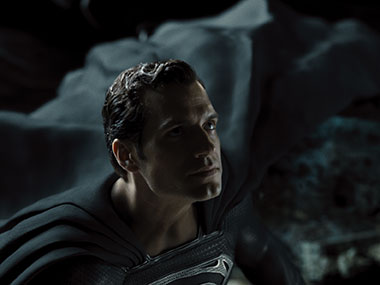
Henry Cavill in a scene from "Zack Snyder's Justice League." Courtesy: HBO Max.
Snyder fans are, hmm, how can I put this tactfully? Ah, yes: loud, set in their ways and driven when they set their minds to do something. They intuited there was a much better film in the footage Whedon discarded, and so they took to Twitter to call on Warner Bros. to give Snyder a shot at assembling his own cut of “Justice League.”
The hashtag #ReleaseTheSnyderCut began to trend, and thus a movement was born. It was a movement for something that remained a pipe dream for years, at least until the streaming service HBO Max saw an opportunity to draw in more members. As in many things Hollywood, the pursuit of art coincided with the quest to make a buck.
HBO Max gave Snyder an estimated $70 million to shoot new scenes and integrate them with the footage he already shot. Oh, by the way, there's just one detail, Snyder said. His “Justice League” would be four hours long. Not a limited series, he clarified as the release date grew nearer. A four-hour FILM. (Thirty-two minutes longer than “The Irishman,” in case you're counting.)
I purposefully opted against revisiting the Whedon cut before sitting down on a sofa with my laptop. The right call, as it turns out, because despite following a similar structure, the “Snyder Cut” is a film reborn, a dark phoenix rising from the ashes of the mess the DCEU has wrought.
The film is a banquet for comic book nerds in general and DC Comics collectors in particular. It pays homage to decades' worth of storylines, as well as the more recent films, yet molds them to fit what Snyder is after here: a multi-layered portrait of grief and dysfunctional families, with eye-popping fight sequences that take full advantage of the boxy, IMAX-ready Academy aspect ratio he has chosen.
DC's heavy hitters are all here. Batman (Ben Affleck), Wonder Woman (Gal Gadot) and Aquaman (Jason Momoa) figure prominently in a narrative arc that, like the Whedon version, involves efforts to bring Superman (Henry Cavill), that square-jawed Kryptonian, back from the dead to help defend the planet.
If Snyder's ballyhooed, underrated “Batman v Superman: Dawn of Justice” was the DCEU's “Wrath of Khan,” “Justice League” is its “Search for Spock.”
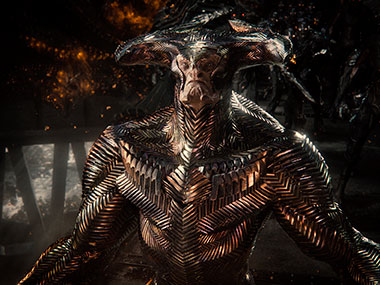
Ciarán Hinds (voice of) in a scene from "Zack Snyder's Justice League." Courtesy: HBO Max.
Their nemesis this time is a step up from the Saturday-morning baddie they faced in the Whedon cut. Steppenwolf (the voice of Ciarán Hinds) looks like a CGI spin on something Guillermo del Toro might have conjured up. He is searching for the three Mother Boxes, “indestructible living machines” that were hidden away in different parts of Earth following a battle depicted in a flashback that tips its hat to Peter Jackson's “Lords of the Rings” trilogy.
Taken together, these mystery cubes could spell the end of life as we know it. Steppenwolf, a dastardly mix of brute force and cunning resolve, does the bidding of Darkseid (the voice of Ray Porter), a supervillain familiar to those of us who grew up reading DC Comics but who hasn't been explored much beyond appearances on animated series.
If this world destroyer rings a bell, it might be because he shares quite a few traits with MCU villain Thanos. Actually, the Mother Boxes sure sound awfully close to the MCU's Infinity Stones, don't they? They're by far the movie's most generic and least interesting aspect.
Okay, so the narrative spine of the “Snyder Cut” is not quite as different from its truncated predecessor as the film's marketing team may make it appear, but in Snyder's world, awash in brooding premonitions and Christian imagery, God in the details. Many, many details.
A plethora of add-ons enrich the main characters and give more screen time to more minor figures in the DCEU, but you don't have to be a DC groupie to appreciate the sight of Batman's butler/tech assistant Alfred (Jeremy Irons) as he shows Diana Prince/Wonder Woman how to steep tea properly, or Martha Kent (Diane Lane) giving Lois Lane (Amy Adams) the nudge she needs to move on with her life.
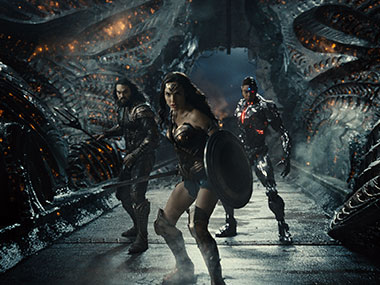
Jason Momoa, Gal Gadot and Ray Fisher in a scene from "Zack Snyder's Justice League." Courtesy: HBO Max.
Then there are the newer faces that round out the current incarnation of this superhero alliance's sextet. The first is Barry Allen (Ezra Miller), aka The Flash, the closest this “Justice League” comes at having a comic relief. But Snyder and screenwriter Chris Terrio go beyond the wisecracks to give us a young man who is trying to make his way in the world and make his dad (Billy Crudup, appearing unbilled), who is serving a prison sentence, proud of him.
The second new addition is Victor Stone (Ray Stone), a football champ who barely survives a crash and is reconstructed by his estranged scientist dad Silas (Joe Morton) using alien technology, thus turning him into Cyborg, an ultra-elaborate hacking software on two legs. The link is clear: fathers and sons with complicated relationships, united by loss.
This thematic strand, more than any of the skillfully executed setpieces (those kick major butt, by the way), is what makes this version of “Justice League” more than just a noteworthy upgrade. The film begins with a brief flashback of Superman's death in “Dawn of Justice,” but the grieving never stops. Every gifted crimefighter here is carrying that weight like a cross. Snyder has made an epic that plays like an extended funeral procession in reverse, a group therapy session on a grand scale. Its Wagnerian sweep evokes the Ring Cycle as much as it does Peter Jackson's work, yet for all its scope and heft, it feels deeply personal.
The tragedy that led Snyder to bow out of production was the suicide of his daughter Autumn, to whom the film is dedicated. I know that hindsight is 20/20, but even without knowing this, “Zack Snyder's Justice League” would still feel like a filmmaker's Herculean efforts to grapple with mortality. Even the most boilerplate aspect of the story, the horcrux-like boxes that would enable Steppenwolf to destroy Earth, are depicted as a sci-fi variation on the Fates, those figures from Greek mythology who are in charge of the destinies of all living beings.
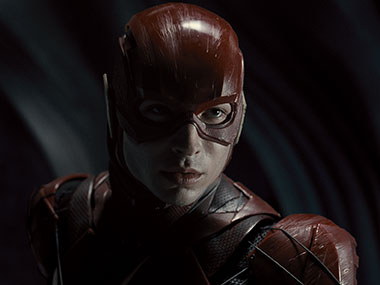
Ezra Miller in a scene from "Zack Snyder's Justice League." Courtesy: HBO Max.
And ultimately, that's Snyder's aim: to present these beloved DC characters as contemporary mythological figures. It's there in the slo-mo tableaux that sometimes resemble an Alex Ross panel come to life, albeit embedded into the stylish motifs we've come to associate with Snyder. But it's no longer empty spectacle, as in, say, “300” or the destruction porn that marred “Man of Steel.” The black suit that Superman wears here is no accident. This is a film in mourning.
If this somber approach sounds too depressing for a superhero story, it actually isn't. Another great virtue Snyder displays here is the ability to juggle all the storylines in a way that keeps the film moving with the magnetic pull of a graphic novel. Despite its extended dance with the grim reaper, Snyder's is a hopeful and life-affirming vision, set to a rousing score by Thomas Holkenborg (aka Junkie XL). Its only major stumble is an epilogue that introduces some fan-favorite characters and teases a sequel that might not even come to pass.
It dilutes the cathartic thrill of seeing this text brought to fruition, with a heavy auteurist bent, much closer to what was originally intended, and in parts, perhaps better. Ambitious and overstuffed, “Zack Snyder's Justice League” might not be perfect, but given the choice between filmmaking-by-committee uniformity and audacious risk-taking, this overgrown fanboy will take the singular vision that aims high, however imperfect the results. In other words, free to make mistakes. Emphasis on free.
“Zack Snyder's Justice League” is now streaming on HBO Max. Snyder's next project is Netflix's “Army of the Dead,” a heist movie, set to drop May 21, that marks his return to the zombie universe he explored in his 2004 “Dawn of the Dead” remake. The next DCEU film scheduled for theatrical release is “The Suicide Squad,” set to open on Aug. 6. It was directed by James Gunn, who, as it happens, wrote the screenplay for Snyder's “Dawn of the Dead.”