

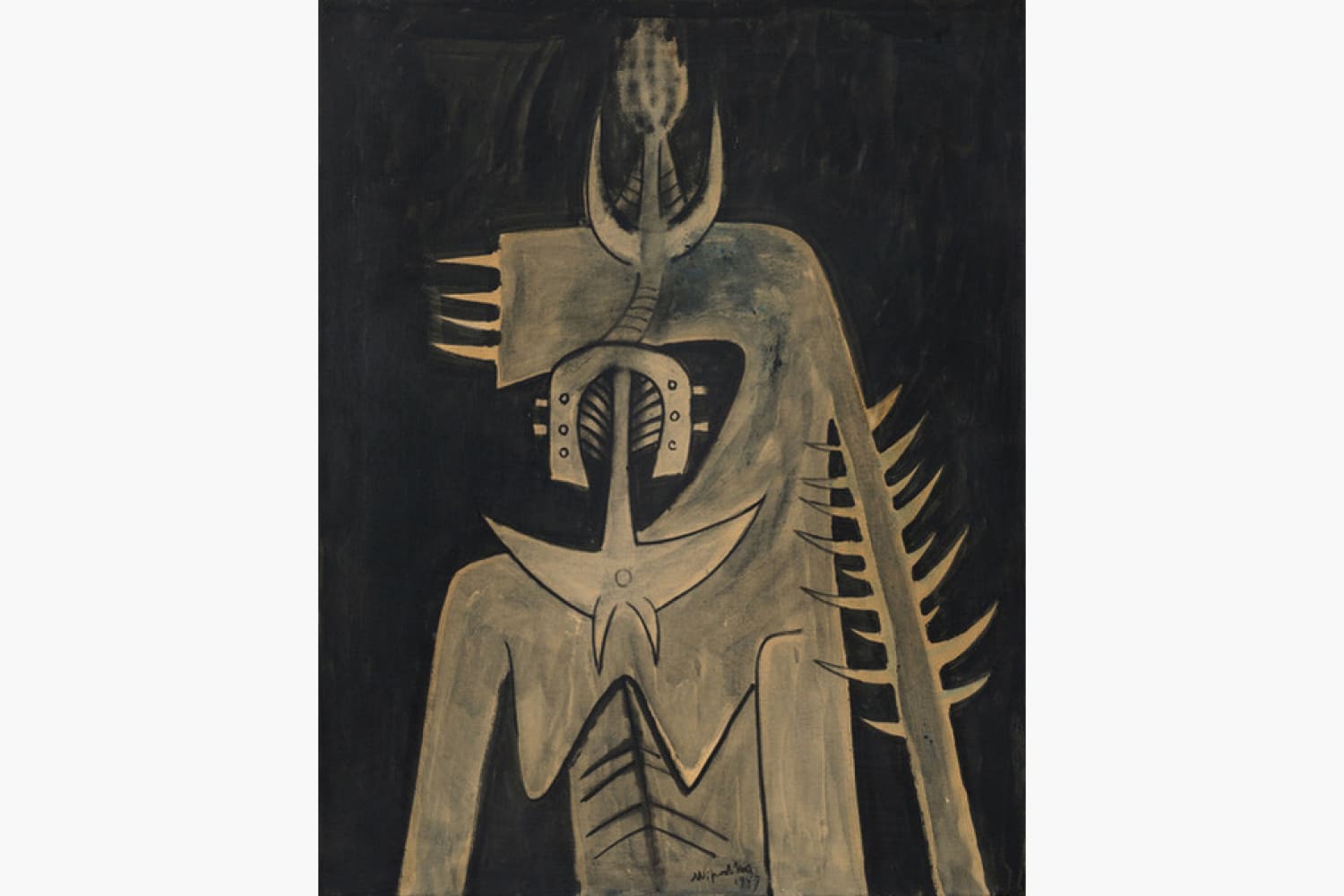
Wifredo Lam, "Le Sorcier de l'océan (Alafi Incam / Ogun Ferraille)," "The Wizard of the Ocean," 1947, Oil on canvas, 42 × 34 in. Private Collection (Image Courtesy of FIU Frost Museum)
In 1944, the founding director of Manhattan’s Museum of Modern Art, Alfred Barr Jr, debuted MoMA’s remarkable new exhibition: “Modern Cuban Painters from Havana to New York.” Barr had toured Cuba for the first time in 1942, finding the profusion of highly sophisticated Modernists a knock out, adding to the islands consistent superior output in art, music, prose and poetry.
These Cuban Modernists of the 1940s have, once again, been rounded up for an exhibition in Miami’s Patricia and Phillip Frost Art Museum at FIU. Brilliantly revisiting MoMa’s 1944 show that had alerted New York to Cuba’s Modernist progressions, the country’s previous century's work had consisted largely of traditional landscape paintings. Cuba, in the forties, was rapidly embracing European Modernists, many living abroad for extended periods. Traditional Cuban culture continued to have a hand in the work as Modernism was infused into a new movement.
The latest iteration of that 1944 exhibition was launched in New York in early 2026 before traveling to Miami in May.
Eighty years after the original show, Bonhams, the 232-year-old auction house, opened its new flagship site with “Modern Cuban Painters from Havana to New York, Revisited.”
Under the gaze of Fundación Mariano Rodríguez, the re-envisioned 1944 show evolved. Miami and New York versions vary somewhat in tone and content, Miami benefitting from new discoveries unfolding as the latest exhibition progresses. Original works shown in MoMA were unearthed from galleries and private collections, accompanied by archival documents of this journey from there to here.
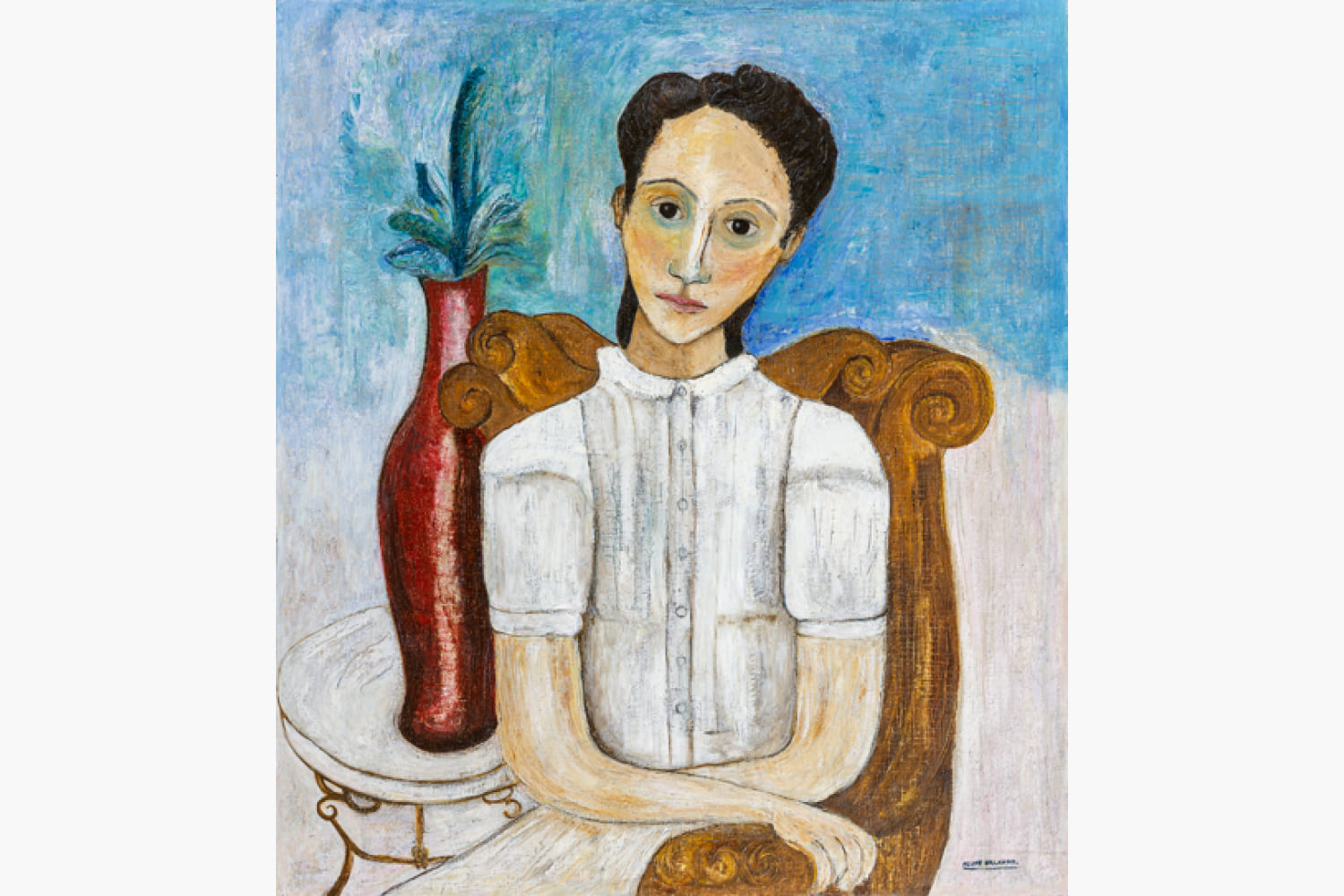
Felipe Orlando, "Retrato de Concha (Portrait of Concha)," 1941. Oil on canvas, 26 x 23 inches. Dr. Blas Reyes Collection. (Image courtesy of FIU Frost Museum)
First things first: A visit to the Frost Art Museum to form my own impressions before speaking with curator Elizabeth Goizueta who added depth and understanding to the endlessly fascinating map of who, what and why the Cuban Modernists came to be.
For me, this is the most enjoyable part of writing reviews; the assignment becomes an historic “novel” of the exceptionally talented, occasionally flawed, but always a journey through lives and careers worth living. Cuba’s roller coaster ride of eras adds background, the stunning countryside furnishes a tropical zone of romantic visual input. Creative outflow is bound to erupt given the set up.
My findings: The most striking aspect of this show, and of Cuban Modernism across the board, is a stunning diversity and depth of thought, style, ideas, mediums, treatment and intensity. Colors are brighter, shapes stronger and more defined, lines often sharper and boldly intentional. Most work is vibrant, generous and exuding information... this did not spring from a simple culture, but overflows with emotion and the vagaries of daily life.
Co-curated by the highly capable team of independent curators, Elizabeth Goizueta and Cristina Figueroa Vives, I spoke with Goizueta who generously shared with us reams of nuggets regarding the epoch.
The curator spoke of the original exhibition meant to showcase the culmination of the second Cuban avant-garde modernist painters movement which started in 1939. This current show works to reimagine and recreate the original with as many pieces as could be found from 1944.
There were other Cuban born painters, such as Antonio Gattorno, one of the pioneers of the island's modern art movement, who were not in the original 1944 exhibition. He had left for Europe in the mid 1930s, and not in Cuba at the time Barr visited in 1942.
Superstar Wifredo Lam was invited to MoMA, and originally accepted, but there are letters in this Miami exhibition displaying correspondence between Barr and Lam indicating there was some discussion, and about Lam not needing this MoMA show. I had to pause here to imagine how successful Lam must have been to eschew the New York museum; but then it had only been in existence since 1929, yet to earn the gravitas it now enjoys. Lam had five exhibitions at the (NY) Pierre Matisse Gallery (son of Henri) between 1939 and 1949, so . . . there is that point to consider in his decision.
Curator Goizueta added insight: “His piece, his gouache, which had been in a joint show with Picasso's work in 1939, was actually already purchased by MoMA, and was the first to form a permanent collection for Wifredo Lam, (ergo) he already had a piece at The Museum of Modern Art, so he was pretty much well on its way.”
Lam is always included when speaking of ground-breaking Cuban artists. In the 2026 shows, both in New York and Miami, Lam is given the space he rightly deserves when speaking of the modernist movement.
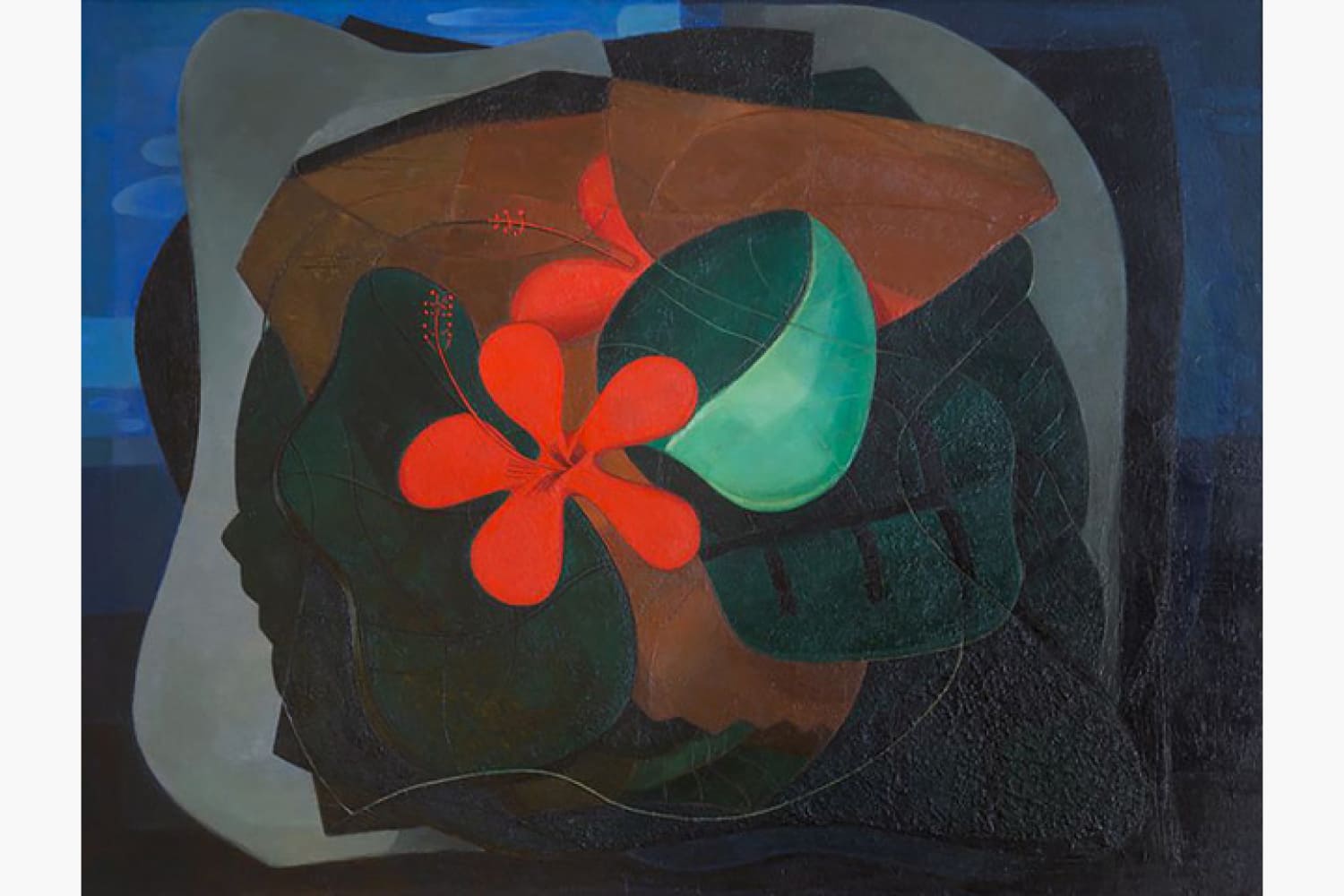
Amelia Peláez, Marpacífico, 1936. Oil on canvas, 29 x 37³/₈ inches. Giulio V. Blanc Collection. Courtesy of Lodovico and Margherita Blanc. (Image courtesy of FIU Frost Museum)
Background on the lone female artist to compete in the original MoMA exhibition was revealed. Amelia Paláez was not the only woman in the Modernist movement, but they were a little bit later, and some did not get showcased the way that Amelia presented. She had been abroad in Paris, but came back to Cuba, bringing this strong style with her.
Alfred Barr toured the exhibition for two years, 1944 to 1946, introducing these works to twelve highly varied venues in the United States, including San Francisco, Kansas, and Washington State. They were offered for sale along the way so some had to be replaced as the exhibition traveled. Goizueta is writing an essay on tracking down these paintings. One of the works by artist Fidelio Ponce De León, was purchased byAlfred Hitchcock and used in his 1948 American psychological crime thriller film “Rope.”
Miami (2026) is curated a little differently from the recent New York show, Goizueta mentions.
“We included Antonio Gattorno because he was part of this broader development that was going on in that decade in New York, 1939 to ’49.”
The FIU Frost Museum is a bit more spacious (than NYC) which is a defining factor when curating.
“Ponce de Leon is another outlier, in that his works do not scream color. They are much more subdued. Both in New York and in Miami, you will see astounding works from the two masters of Cuba's modernist tradition, both Lam and Ponce de Leon. They work together with these very subdued colors and play off of each other in this room. It's very effective.”
The 1944 MoMA exhibition published a phenomenal “companion book” that served as a catalogue titled "Pintura Cubana de Hoy" ("Cuban Painting Today"). Edited by art patron María Luisa Gómez Mena with text by art critic José Gómez Sicre (oft referred to as the “father” of Latin American art), it is now out of print and very rare, but there is a copy in one of the glass cabinets at the FIU show. Goizueta underlined the import of this tome.
“For researchers, like my co-curator, Cristina Figueroa Vives, and for myself, it was really important to have a copy so that we can look in it, we can analyze it.” Each of the 2026 exhibitions, NY and Miami, will have their own catalogue.
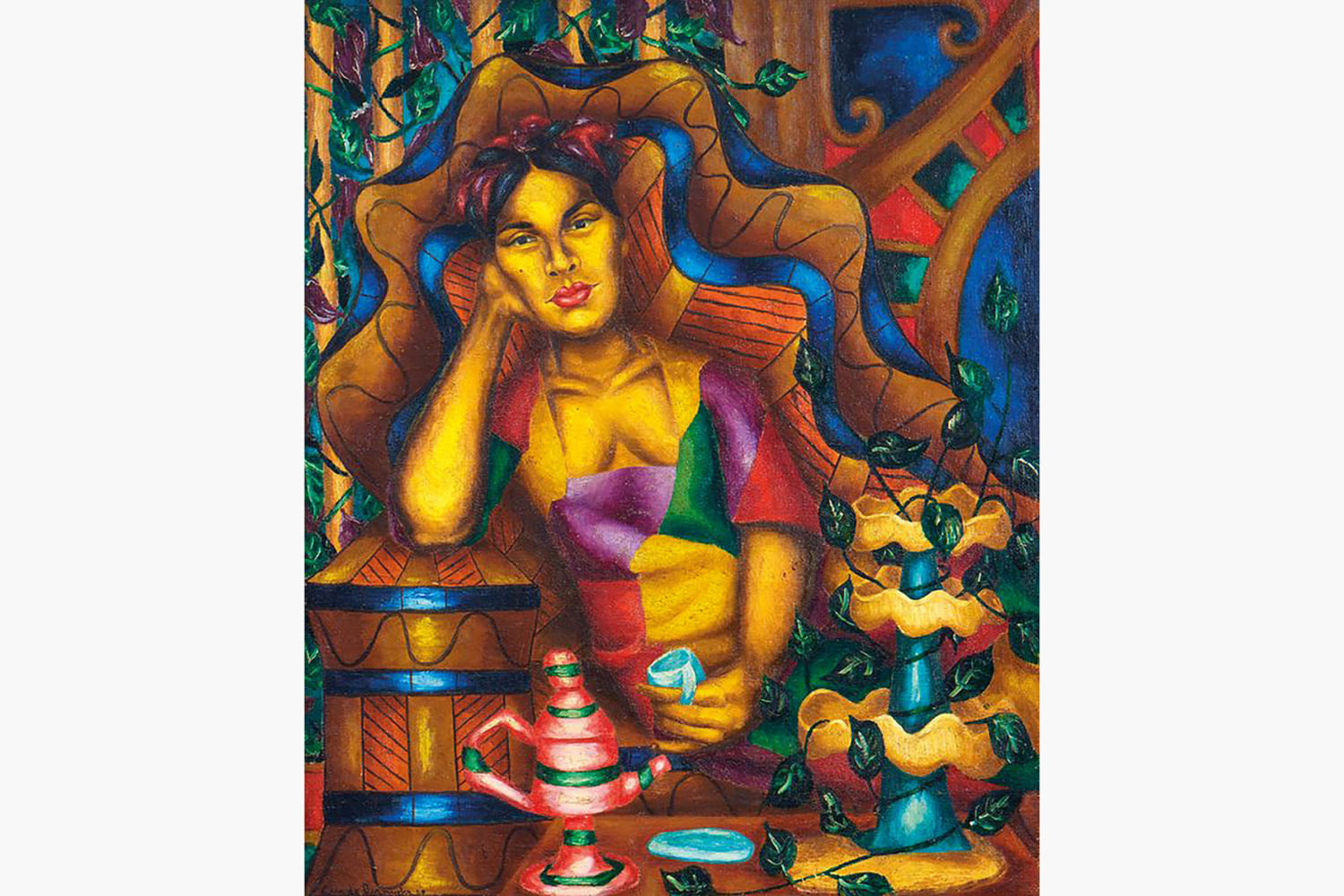
Cundo Bermúdez, "Retrato de María Luisa Gómez Mena (Portrait of María Luisa Gómez Mena)," 1943. Oil on burlap, 29 × 23³⁄₄ inches. Capriles Cannizzaro Family Collection. (Image courtesy of FIU Frost Museum)
For the first time, original materials from the José Gómez Sicre Visual Archive have been presented to the public; photographs, scrapbooks, correspondence, and unpublished documents are in the glass cases sprinkled throughout the Miami exhibition. Goizueta believes she and co-curator Figueros Vives were the first ones officially admitted into the archives: “This was just a plethora of first-hand information. We had the original letters that José Gómez-Sicre had between Alfred Barr, Jr. and himself, and letters between Maria Lena Gomez Mena, who was the one who financed that book and edited ‘Cuban Painting of Today’. She represented all thirteen artists that were in the exhibition, During the war, she not only financed the publication, but the exhibition at MoMA. Alfred Barr Jr. gives her much credit, saying that she had done more than anybody, anyone else in Havana, to promote Cuban work.”
Christina Figueroa Vives was instrumental in putting together the (2024) book, “Modern Cuban Painters: From Havana to New York,” published by the Fundación Mariano Rodríguez. It commemorates the 80th anniversary of the 1944 MoMA historic exhibition “Modern Cuban Painters” as well as the seminal book “Pintura Cubana de Hoy.” It features essays by scholars Elizabeth Thompson-Goizueta and Luz Merino Acosta, as well as scholar/curator Susanna Temkin, with chronology by Cristina Figueroa Vives, underlining the moment 1940s Cuban Modernism broke through into the United States' .
I received a history lesson on timelines during my discussions: The first group of academics from the modernists, or the avant garde group, had been to Europe, which was basically between 1927-1938. This generation that went abroad, mostly to Paris, and exposed to fundamental post World War I deconstructive ideas about art and life. They brought ideas back and started to deconstruct the traditionalist methodology, which had made them famous for a century. Continuing to develop, the second generation was around 1938-1950 . . . the third generation occurred from 1950 to the revolution, and even post revolution.
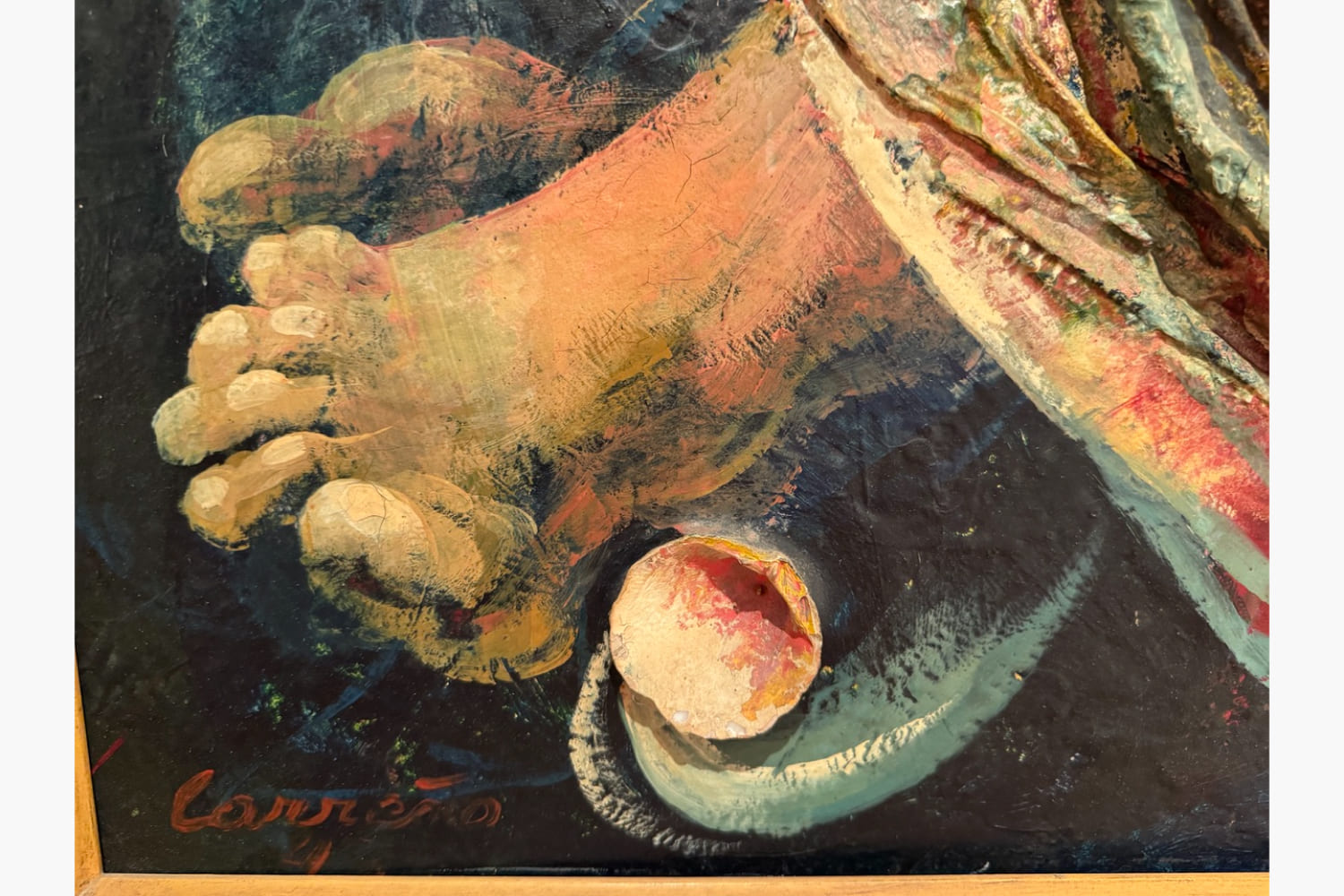
Mario Carreńo, "La Diosa del Mar (Goddess of the Sea)" Duco, seashells, sea fan and fabric collage on panel, Latin Core Gallery Collection, Miami. Experimental use of industrial paints; lacquer for automotive industry with seashells. (Image courtesy of FIU Frost Museum)
At the beginning of the revolution the Instituto Superior de Arte was, and still is, a leading institution in Havana focusing on the arts, with specialized programs in music, dance, theater, and visual arts. Through all the country’s difficulties, the quality of art has prevailed. Curator Goizueta noted, even during scarce times of oil and and linen for their art pieces, they segued to wood and peeling paint for material. Unstoppable.
I have to interject some of my own observations here regarding Cuban artists throughout the ages, seeming to continually surpass their own creative abilities, rolling new ideas into original Cuban lore.
Effectively learning from other cultures, they create a rich environment, digging under the surface to feel a strong sensibility for music, art, poetry, prose, dance, architecture, and spirituality from deep within. The Academia Nacional de Bellas Artes San Alejandro (1818) is Cuba's oldest fine arts academy and the second of its kind in Latin America after Mexico's Academy of San Carlos, established as the Free School of Drawing and Painting in Havana.
Is it the physical beauty of Cuba, and/or the social environment that has embraced art from this land and elsewhere while not losing their own identity?
Cuba is officially an archipelago of mountains, hills, and lowland plains, like Viñales Valley on the western end of Cuba, mainly supporting traditional farming techniques used for several centuries. The Valley is a UNESCO World Heritage Site.
Cuban writer Alejo Carpentier on the work of painter Lam.
“And it had to be a painter from the Americas, the Cuban Wifredo Lam, who showed us the magic of tropical vegetation, the uncontrolled Creation of Forms in our nature—with all its metamorphoses and symbioses—in monumental paintings whose expression is unique in contemporary art.”
You cannot get bored for a minute at this exhibition. It is a manageable size; I did not leave feeling overfed. It successfully gets to the core of its subject confidently and intelligently. This will stay with you long after departing.
Facts and figures: MOMA’s 1944 show had approximately 75 pieces. The New York exhibit this past winter had approximately 40 pieces on show. Miami has 54. There will be a catalogue from each of the 2026 shows, both New York and Miami.
Visit the website for a list of the artists and info on other FIU exhibits: Modern Cuban Painters from Havana to New York Revisited, Now through Sunday, Oct. 18, 2026
Patricia & Phillip Frost Art Museum
Florida International University
Modesto A. Maidique Campus
10975 SW 17th St
Miami, 33199Hours
Tuesday – Sunday
11 p.m.– 5 p.m.
Closed MondaysParking available in adjacent garage across from the Museum.