



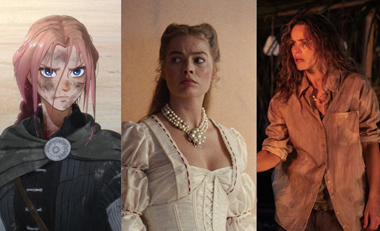
Scarlet, voiced by Mana Ashida, in "Scarlet," Margot Robbie as Catherine Earnshaw in "'Wuthering Heights'" and Rachel McAdams as Linda Liddle in "Send Help."
The world seems to be against them, but they won't back down. The stubborn, ferociously driven women at the center of three new films now unspooling at your local multiplex refuse to take no for an answer, propelled in a way that makes it difficult to tell where determination ends and bullheadedness begins.
One of these women is a familiar tragic figure in 19th century English literature whose story was meant to be experienced on Valentine's week. Another is a variation on another tragic figure from a United Kingdom author, and in this animated retelling, this Danish Royal speaks in Japanese. Our third lead character is an office whiz who finds her survival skills put to the test when catastrophe strikes.
Spunk, grit and, yes, some lingering hangups come together in this trio of winter releases that bear the unmistakable imprint of their directors' signature styles. Two of them are fun, competently rendered works that won't top any lists of these filmmakers' best work. The third is the latest effort from a polarizing iconoclast who tends to make a splash in front of and especially behind the lens. Let's dive right in.
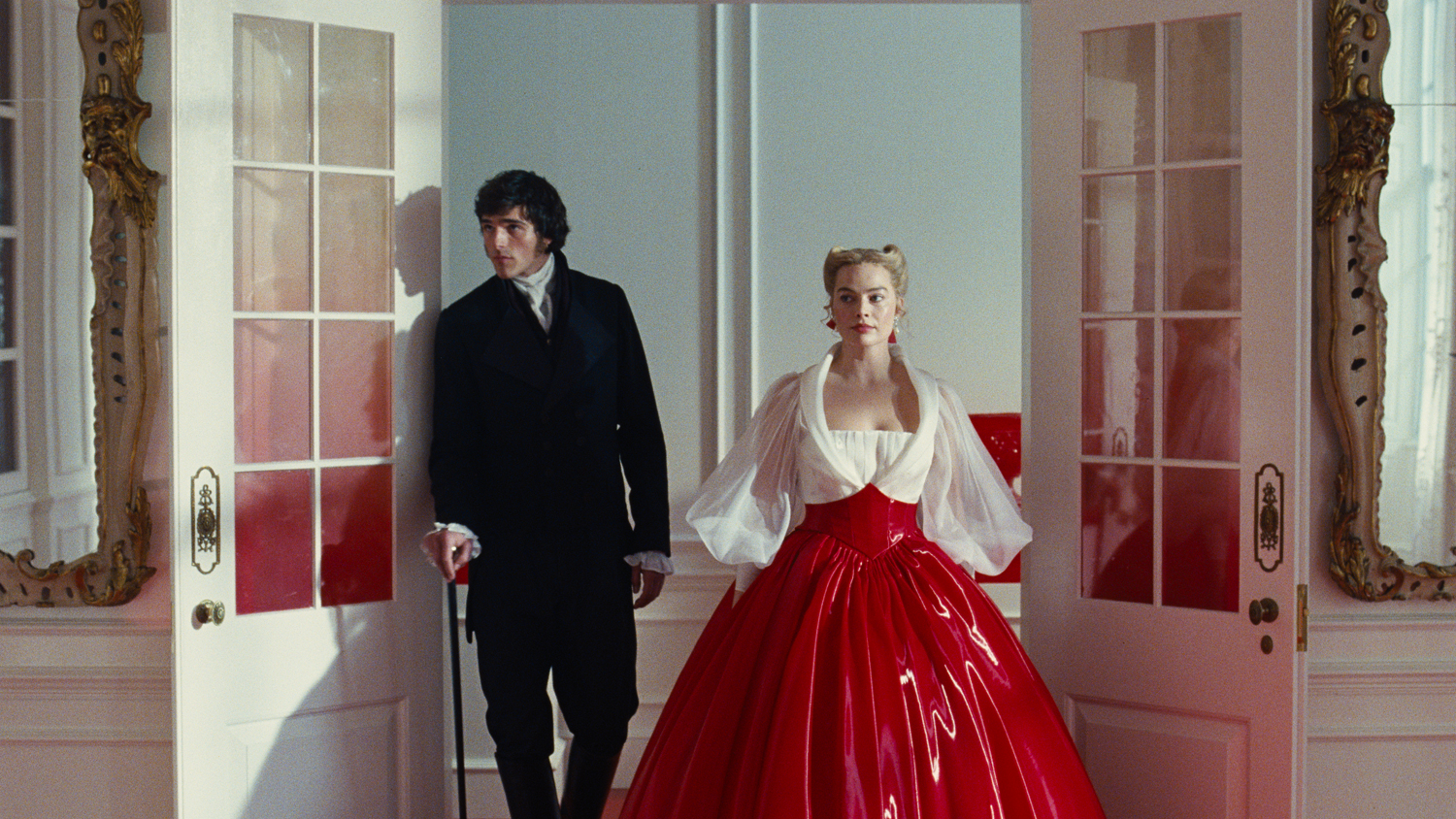
Jacob Elordi as Heathcliff and Margot Robbie as Catherine Earnshaw in a scene from "'Wuthering Heights.'" (Photo courtesy of Warner Bros. Pictures)
“'Wuthering Heights'”: Those windswept Yorkshire moors immortalized in the novels of the Brontë sisters have lured filmmakers with their siren song for more than a century. Unbridled passions, feral longings, wounding betrayals, destructive obsessions and a low tolerance for decorum make these books a no-brainer to be adapted for the big and small screens. And yet, few adaptations have pulled off the neat trick of remaining true to their source material while working on their own terms.
Add Emerald Fennell, the provocateur behind “Promising Young Woman” and “Saltburn,” to the list of visual storytellers eager to give their own spin to the Brontiest Brontë that ever Bronted: “Wuthering Heights.” Perhaps second in name recognition to her sister Charlotte's “Jane Eyre,” Emily Brontë's 1847 novel tells a story of “amour fou” that amounts to one giant middle finger to Victorian England's rigid class system. Seems like a good fit for Fennell, who just over two years ago gave us the indelible sight of Barry Keoghan slurping up the bathwater of his character's much richer friend, played by Jacob Elordi in "Saltburn.
And Fennell blows it, big time. Not because she took a number of liberties with the novel. (Thus the quotations in the title. “'Wuthering Heights'” is not a typo.) Not because she inserts elements of camp and broad laughs into this brooding Gothic tale. And certainly not because she entrusted pop singer-songwriter Charli xcx, a fellow Brit, to compose 12 new songs that lend an anachronistic dissonance to the proceedings.
No, the reason why her “'Wuthering Heights'” is such a punishing dud is that she doesn't take pains to delve deeper, to get to the root of those roiling passions that captured the imagination of readers and viewers. Hers is an overheated costume drama of color-coordinated surfaces, copious gnashing of period-accurate rotten teeth, and petty bickering punctuated by dust-ups with all the appeal of nails on a chalkboard. One look under the hood yields precious little beyond Fennell's flashy music video aesthetic.
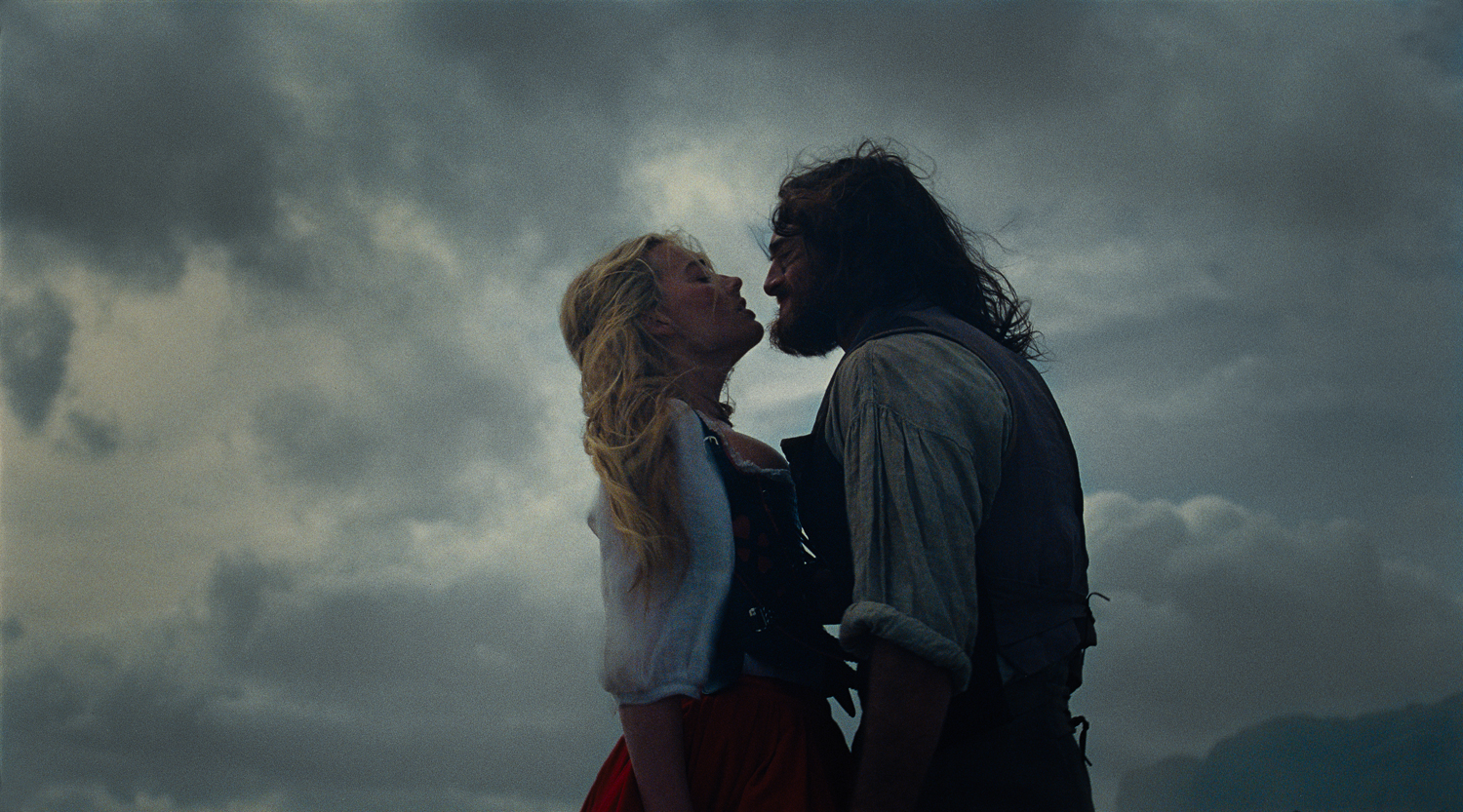
Margot Robbie as Catherine Earnshaw and Jacob Elordi as Heathcliff in a scene from "'Wuthering Heights.'" (Photo courtesy of Warner Bros. Pictures)
The narrative streamlines Brontë's byzantine family saga, jettisoning several characters and focusing on the star-crossed romance between Catherine Earnshaw (Margot Robbie, also credited as a producer) and Heathcliff (Elordi), but other than limiting herself to adapting only a portion of the novel, Fennell doesn't stray all that far from the source. There are glimmers of what could have been in the film's first act, which follows our protagonists as children after Catherine's dad (TV vet Martin Clunes) brings home the orphaned Heathcliff, well played as a boy by Owen Cooper, the star of the Netflix limited series “Adolescence.”
But in a sign of things to come, Charlotte Mellington plays the younger Catherine as such an unpleasant and obnoxious brat that there's little room for this spoiled chatterbox to show much vulnerability. That approach to Catherine, short on nuance but high on histrionics, carries over when Robbie and Elordi step into the roles. You struggle to find a romantic spark amid the purportedly good-natured battle of the sexes that unfolds between the two.
What sets the rest of the plot in motion is the choice Catherine must make: whether to surrender to her alleged attraction to the rough-hewn but hunky Heathcliff, though he's beneath her station, or to wed the wealthy Edgar Linton (“Star Trek: Discovery's” Shazad Latif). The latter lives with his kooky sister Isabella (Alison Oliver, mostly reduced to comic relief and plot device duties) in an estate not far from the Earnshaws and is clearly infatuated with Catherine.
Latif's understated pining is a welcome respite from the succession of clashes that numb rather than captivate, though it must be said that Elordi with long hair makes him come across as Jesus of Nazareth gone to seed. Not an uninteresting look.
Words are misunderstood, unexpected makeovers make an impression, and adulterous yearnings are acted upon. It's here, in the consummation of Catherine and Heathcliff's carnal hunger, where Fennell could have given this material an electric charge, but she falls short in the sexytime department as well. This “'Wuthering Heights'” is horny, all right, but it's oddly buttoned up as well, literally hemmed in by the fact that the libido is there but the clothes stay on. There's a limit to how raw and uncompromising your bodice ripper can be when the bodice remains in place. Ah, those no-nudity clauses.
Fennell wants to have it both ways, portraying unfettered passion between her photogenic stars while making sure not to rock the boat for the demographics who made (the far superior) “Barbie” a trendsetting hit. The filmmaker, who won an Original Screenplay Oscar for “Promising Young Woman,” has her ardent admirers, but I've always felt she drops the ball in all of her films despite strong work from her cast and crew. “Saltburn,” for instance, is a hoot as a satire of the idle rich, but it goes belly up when it becomes clear Fennell's endgame was to make her very own variation on “The Talented Mr. Ripley.”
Her “'Wuthering Heights,'” pretty yet putrid, serves up toxicity without insight. She tries to pull off something akin to what Baz Luhrmann did back in the 1990s when he imbued “Romeo and Juliet” with his trademark florid style. Fennell, alas, tries to make us care for a thoroughly unappealing couple, and why should we? Robbie and Elordi showed up to work, but Fennell leaves the stars stranded in a maelstrom of poor writing and even more misbegotten creative decisions. At crucial moments in this cringe-inducing bust, she uses a loud, wall-to-wall soundtrack to drown out her lovers, so it's hard to tell what they're even saying. She's shutting us off as well.
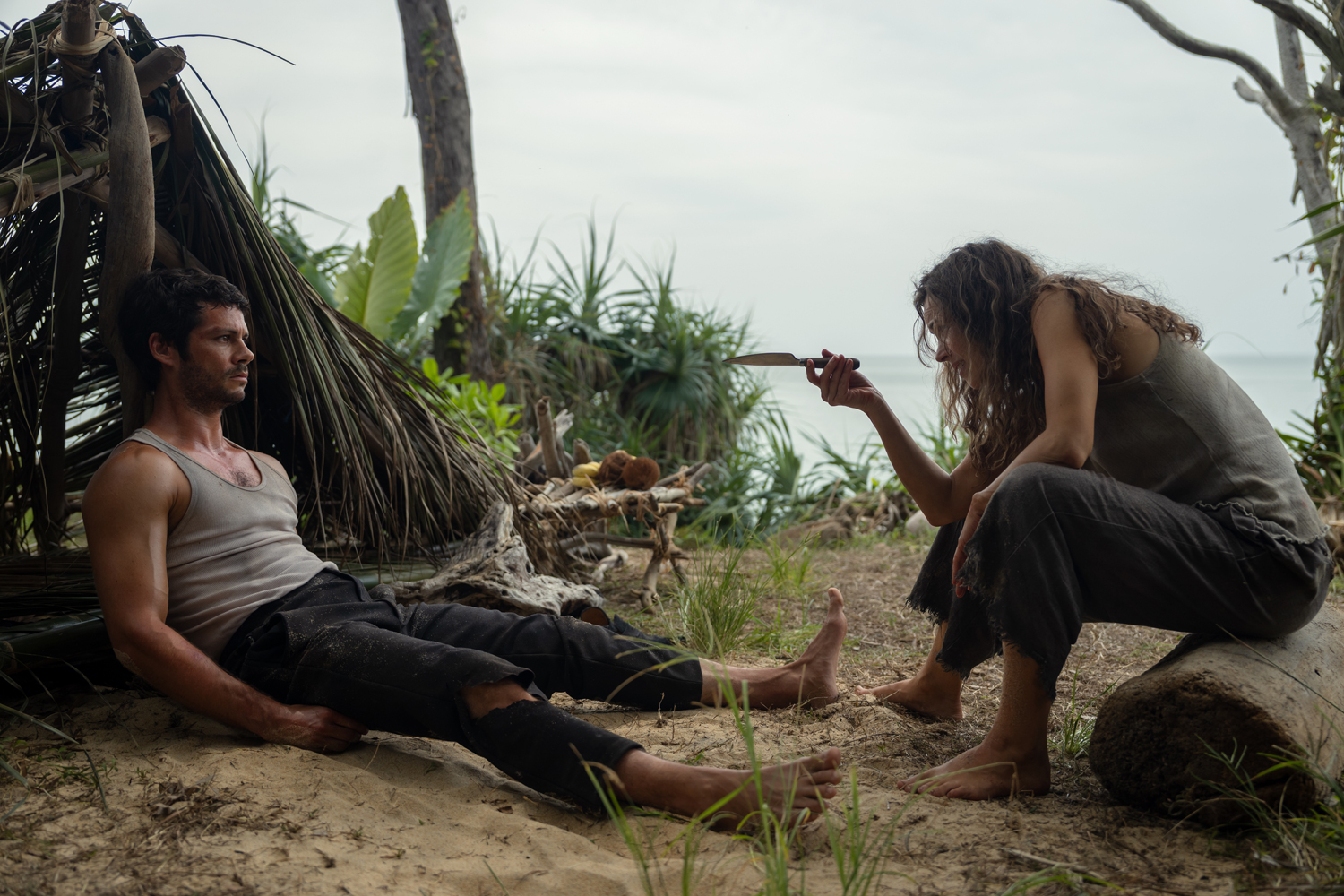
Dylan O'Brien as Bradley Preston and Rachel McAdams as Linda Liddle in a scene from "Send Help." (Photo credit: Brook Rushton. Courtesy of 20th Century Studios)
“Send Help”: To wash off the sour taste of Fennell's insipid McMovie, one doesn't have to look far. The top box office draw these past two weekends is this wicked dark comedy that stirs in some grisly mayhem and a dash of Hitchcockian suspense into the genre-splicing pot. It's a nasty piece of business with a jolly demeanor. That spring in its step would feel right at home in a rom-com.
For director Sam Raimi, the 20th Century Studios release marks a return to his horror roots, even though Marvel fans got a taste of it in his underrated “Doctor Strange” sequel a couple of years ago. Which makes it all the more gratifying, and a tad surprising, that this is, above all, an actor's showcase.
The film's first act, with its antiseptic corporate setting, gives Raimi and screenwriters Damian Shannon and Mark Swift a chance to skewer entitled CEOs. They don't come more oily and self-absorbed than Bradley Preston, the preening peacock who inherited his dad's job when the old man croaked. The thorn in his side comes in the form of strategist Linda Liddle (Rachel McAdams), a numbers expert so good at her job she makes most of her co-workers look like underachievers. (Shades of Simon Pegg's obsessively efficient cop in “Hot Fuzz.”)
Linda, a tightly coiled workaholic with low self-esteem and underdeveloped social skills, is miffed that Bradley passed her over for a coveted promotion that he gave to his old college frat buddy, so she brings that animosity, and an impulse to once again prove herself, to a work trip to Bangkok.
Then fate intervenes. The private jet carrying Bradley, his work posse and Linda crashes into the ocean in a deliciously staged sequence that accentuates the cartoonish way Raimi depicts “Send Help's” workplace tensions.

Rachel McAdams as Linda Liddle and Dylan O'Brien as Bradley Preston in a scene from "Send Help." (Photo credit: Brook Rushton. Courtesy of 20th Century Studios)
The rest of the film is a taut desert-island two-hander. Linda, who perhaps all too conveniently was obsessed with survival reality TV prior to her current predicament, is pitted against Bradley, who watches helplessly as the power dynamic that gave him his air of superiority dwindles away after discovering that Linda is the ever-resourceful alpha to his beta.
Raimi lets things get a little too serious, but something he does achieve is sustaining an ambiguity about Linda, whom we had assumed was the audience surrogate and the go-getter we were glad to root for. There's a whiff of “Lord of the Flies,” as well as Ruben Östlund's social satire “Triangle of Sadness,” in how “Send Help's” power shift plays out.
But taking a step back, there's another influence that's key to understanding what Raimi is after. The film plays like a feature-length episode of “Tales from the Crypt,” the HBO series based on the EC Comics title that was also an integral part in the DNA of George Romero's “Creepshow.” Which is why it's baffling to me that some claim “Send Help” is not horror-oriented enough. It has the genre oozing from its pores, and not just when showing a wild boar on the island that feels like it scurried out of an early Peter Jackson movie.
If anything holds back this nifty ride, it's in the somewhat facile way it divulges its secrets, as well as a resolution that's too pat and cutesy to be worthy of its inspirations. This is minor Raimi, not quite as satisfying as “Drag Me to Hell,” his similarly EC Comics-adjacent demonic curse yarn from 2009. But that's okay, because McAdams and O'Brien, both of them stellar, do enough heavy lifting to ensure “Send Help” reaches dry land.

Scarlet, voiced by Mana Ashida, in a scene from "Scarlet." (Photo courtesy of Sony Pictures Classics. ©2025 STUDIO CHIZU)
“Scarlet”: Leave it to Mamoru Hosoda to take a concept as iffy as a gender-swapped, sword-and-sandal fantasy riff on “Hamlet” and run with it. The prolific anime director is on a bigger-is-better kick of late, and his latest opus, awash in the titular shades of crimson, delivers the trippy, eye-popping goods with an emphasis on Grand Guignol and a bracing sense of scale.
Our heroine, voiced by Mana Ashida, is a late 16th century Danish princess hellbent on revenge after Claudius ("Perfect Days'” Kôji Yakusho), her Machiavellian uncle, has her dad, the benevolent King Amleth (Masachika Ichimura), executed right before her saucer-shaped anime eyes. But there's not much avenging he can do when she's dead.
Well, not exactly dead. Scarlet, who has been poisoned, finds herself trapped in the Otherworld, a desolate no-man's-land located between the land of the living and the afterlife. And what starts as a relatively faithful retelling of Shakespeare's tragedy is sent roaming in a most creative direction.
Time works differently in the Otherworld, so a big part of what makes “Scarlet” such a treat is the way Hosoda incorporates characters from different time periods and countries. Even with her swordsmanship skills, Scarlet struggles to remain “alive” in this hostile realm. Enter Hijiri (“Drive My Car's” Masaki Okada), a paramedic from the 21st century who insists he's still alive.
Hijiri, driven to help others, is the yang to Scarlet's yin, a sensitive soul who stands in sharp contrast to the protagonist's sharp edges. Their rapport is highly reminiscent of “The Hunger Games'” Katniss and Peeta, the resilient competitors played by Jennifer Lawrence and Josh Hutcherson in the dystopian saga. Scarlet and Hijiri's deepening bound goes a long way to making the film's more familiar elements (think “Dungeons & Dragons” by way of Tolkien) easier to digest.
Then there's the film's visual cacophony, with Scarlet looking like a traditional anime character and the other Danish characters like something out of Ralph Bakshi's “The Lord of the Rings.” The lack of aesthetic uniformity has the nerdy appeal of a boy amassing all his different action figures as he conjures up an adventure out of his fervid imagination.
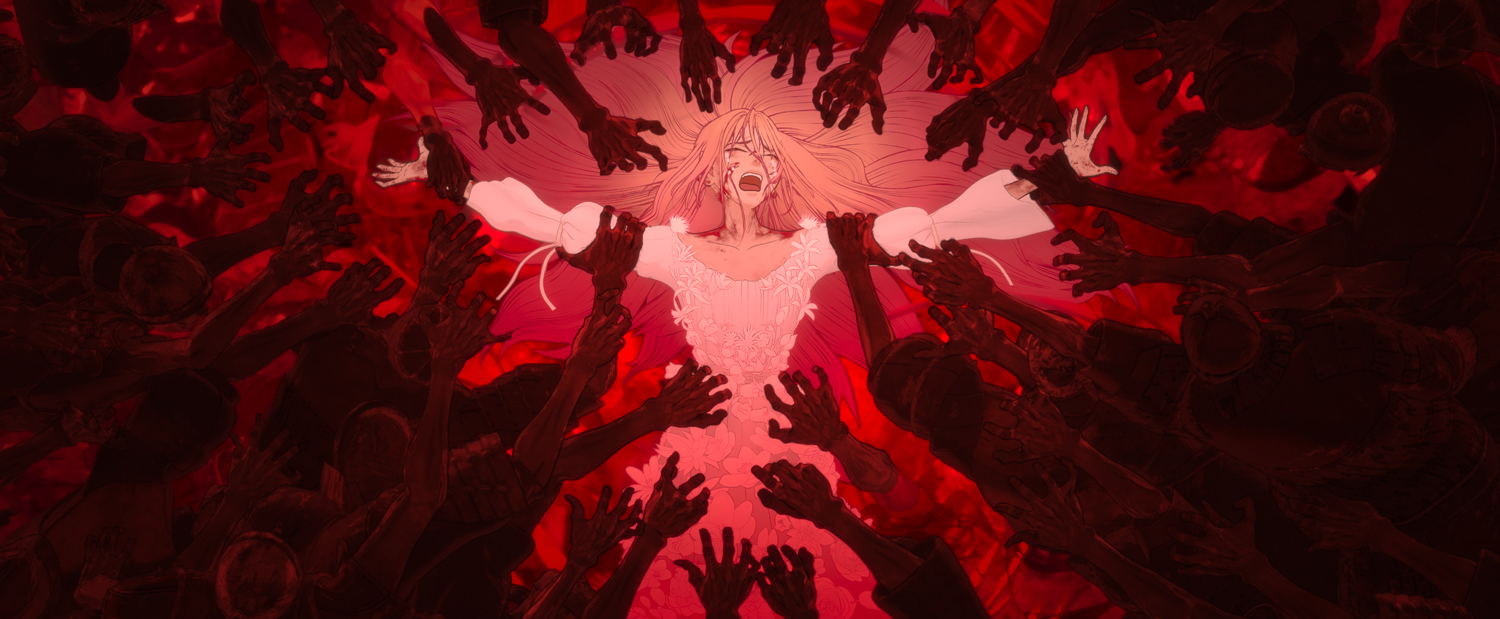
Scarlet, voiced by Mana Ashida, in a scene from "Scarlet." (Photo courtesy of Sony Pictures Classics. ©2025 STUDIO CHIZU)
Because if there's anything that sets “Scarlet” apart from most of what's currently out in theaters, is its boundless sense of awe and wonder. Despite the stylistic disparities on display, Hosoda is able to fuse the historical, fantastical, phantasmagorical and metaphysical elements into a whole that's not always cohesive, but consistently grand and transporting.
Hosoda, the Oscar-nominated filmmaker behind the magical “Mirai” and, more recently, an ornate “Beauty and the Beast” retelling called “Belle,” is not afraid to aim high. In “Scarlet,” his heroine embarks on her very own Jacob's ladder, sometimes quite literally, a visceral journey that tests her mettle, promotes her spiritual growth and indulges in the good kind of excess.
“Wuthering Heights” is now showing in wide release, including IMAX engagements at AMC Aventura, AMC Sunset Place, AMC Pembroke Lakes and the AutoNation IMAX at Fort Lauderdale's Museum of Discovery and Science. “Send Help” is also showing in wide release, including at CMX Brickell City Centre, Cinépolis Luxury Cinemas Coconut Grove, The Landmark at Merrick Park and Regal Dania Pointe. “Scarlet” has been held over at AMC Aventura, AMC Sunset Place, Regal Southland Mall, AMC Pompano Beach, Silverspot Cinema in Coconut Creek and Regal Magnolia Place in Coral Springs.