



They've been playing and singing together for forty years. One writer dubbed the soft rock duo Hit Supply and rightly so. Turn on any soft rock station and you're bound to hear an Air Supply song. In 1980, the song Lost in Love became the fastest selling single in the world; lead vocalist Russell Hitchcock and guitarist-songwriter Graham Russell sold more than 100 million albums and have toured regularly since 1975. On Saturday night, made-in-Australia Air Supply comes to South Florida to play Mardi Gras Casino in Hallandale.
miamiartzine.com editor Michelle Solomon spoke to one half of the dynamic duo, guitarist and songwriter Graham Russell, before the appearance.
MS: You've had so many hits. How do you write a hit song?
GR: I've been writing songs for such a long time it is second nature to me now and you know I still don't know how it works. I mean I sit down and I write very quickly. I know a lot of other songwriters and they say sometimes it take them weeks and weeks. In my particular instance, I think about a song for some time — maybe for two days in passing, but I won't sit down at the piano or the guitar until I know it's there — then it will all come quite quickly; a half hour at the max.
I never have any particular form or do anything in the traditional way. Sometimes I get the lyrics first, or a really strong line and I'll think about it and it will turn into a musical phrase. If I do have a line, say four or five words, and then a musical phrase comes along with that. It's very difficult for me to separate them — once they arrive it's almost like they are in stone. I don't try to go back and do any different lyrics or change the chords. It's like the song dictates itself.
MS: In 1980, your first Gold Record was All Out of Love. It's a catchy tune and song title. Where did it come from?
GR: That song was written in 1978. You know, that's not an English or an Australian phrase — English people or Australian people don't say, "I'm all out of something" — that's an American phrase. I really don't know where it came from but it did get ingrained in people's consciousness.
MS: There's a lot of love in your songs — Lost in Love (1979), All Out of Love (1980), The One That You Love (1981), Young Love (1983), Making Love Out of Nothing at All (1983), The Power of Love (1985), Faith in Love (2010) are a lot of loves in your titles.
GR: We've come under fire for that. That's just who I am and the person who I am. If people are going to have a go at my songs, then they are having a go at me. I like to think I'm a romantic person. I'm not a pushover, though. I'm 6-feet, 5-inches tall and 210 pounds. I'm kind of a big guy, so it must seem strange to people. . . those songs, but I guarantee no one has ever said that to my face. It wouldn't bother me because I don't care — because the songs have spoken for themselves. They've been out in the world for almost forty years now.
MS: How did you start songwriting?
GR: I grew up in The Midlands in England and it's very rural. It's just beautiful country side where a lot of the old English poets were from two or three hundred years ago — they lived in the same area. So I grew up knowing that and I'd go to the houses, they were museums and they would have all these old collections of poems and I would think about the people that wrote these beautiful words and I was in the middle of it. In my English literature class, I was the only boy with 35 girls; it wasn't considered a manly thing to pursue, but I loved poetry. So instead of playing rugby or cricked and getting myself beat up, I was following another path — writing poetry, writing songs, learning to play guitar. That was the path that I chose or should I say it was chosen for me. I really don't know how, it just happened and now I don't know any other path.
MS: Do you still write songs?
GR: Yes, I write every day. I'm very conscious that I need to do that. I do it every day at a certain time. Even if I'm on the road, I spend two or three hours around noon and I just play and I'll work on new songs. Like other people may take their dog for a walk or take a swim or go to the beach, it's a daily activity for me. It's something I love so dearly. I don't really know much about music. I've been given this gift and I use it. I know it's a gift. I'm so thankful for being able to do what I love to do. Because I see a lot of people working and they aren't into it. They are working for a living, but for me I love what I do. I love performing and writing songs more than anything in the world and everything that connected me to my career is connected to the songs. I sometimes will be on a plane when we are flying to another show and I look out and think, "What am I doing here? I should be in England in a factory or down a pit!" — but I'm not, I'm traveling the world meeting royalty and doing everything that I love. I'm so thankful. Sometimes I think somebody got the wrong guy here. I think it wasn't meant to be me; it was meant to be someone else.
MS: Do you hear Russell Hitchcock's voice in your head when you write a song?
GR: I do. The great thing about our musical partnership is I'm a baritone and I can cover a lot of the low stuff. And I have a high falsetto. Russell oddly enough has no falsetto and he can't get down below certain notes. He's a tenor, so we pretty much have that whole spectrum covered. He just happens to like my songs, which is cool.
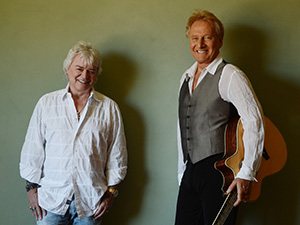
Photographer: Denise Truscello
MS: How did you two meet?
GR: I met Russell on the first day of rehearsals in Australia for the touring production of Jesus Christ Superstar in 1975. Neither of us knew anyone. I think that's why we gravitated to each other. We started to talk and he was from Melbourne and I was living in Melbourne. We were both named Russell, sort of; he's a year old than me, but we were born three days apart in June, so we're both Gemini. We both loved the Beatles and shared that we both saw them live in 1964.
I remember when the whole chorus began singing the numbers for Superstar and I was sitting next to Russell and I could hear him singing and I was amazed and then I realized straightaway that this guy's got the best voice in the show. The director didn't even know it. He made him a soldier in a vinyl suit, covered him from head to foot, he didn't even sing. I went up to the director and almost got fired. I said, "this is none of my business but the guy sitting next to me has the most incredible voice I've ever heard. You've got him as a soldier, you ought to listen to him." And the director took offense, but I didn't care. I knew as soon as I heard Russell's voice that I had to work with him because I knew I needed a great voice to sing my songs. And I had two years to do it because that's how long Superstar was going to be. We were both Apostles.
MS: So how did he start singing your songs?
GR: In the dressing room I had my guitar then and he kept saying. "what's this song, what's that song." Then he started to sing them. He was the missing link to my songs. I've always known my strengths and weaknesses — I'm a very good songwriter and I'm a good singer, Russell is a great singer and together we fill all the blanks in.
MS: Where did the name come from?
GR: We made a single; one record with an A side and a B side; it was a 45. We were still in Superstar and we didn't have a name (for the band). The record company said that we had to have a name by the next day in the morning, so we were under a time constriction. That night, and this is true, I went to sleep and I dreamed that I saw this big billboard. It was white and it had these flashing lights going on and off all around it like a strobe light. And in the middle it had black writing and it said Air Supply. I told Russell in the morning and he said, "I don't know what it means but we gotta go with it that's all we got."
MS: What was the first 45?
GR: It was called Love and Other Bruises and, it's like a said earlier, I couldn't separate the title from the melody. I tried all kinds of things, so in the end I said it's got to be Love and Other Bruises. Nobody knew who we were with our first record and one guy at a radio station heard it and started to play it and one-by-one, other stations in Sydney picked it up. And we were brand new and we had the number one record. It all kind of happened fast.
MS: What was your first tour like?
GR: As soon as we finished Superstar, we got the job of opening for Rod Stewart and he was the biggest act in the world. We felt like we were sent to school to learn to learn from the best that there was. We opened for Rod for six months in America and we were as green as grass; we were only a month old. We watched Rod every night; what he did, how he spoke to an audience, how he manufactured the song order, and we got to know him very well and his band. By the end of the Rod Stewart tour we had kind of made up for a lot of lost time. Because we were really late when we made it — when we went into superstar I was 24 and Russell was 25 and that's a little late to have this beginning in show business. But we had all that experience at an early age, compressed into that time frame, in 2 1/2 years we had toured with the biggest band in the world and been in the biggest musical in the world for 2 years.
MS: Why still tour?
GR: I live in Utah on a big ranch. I'm not a social person when I'm not working. I'm quite the opposite I have a studio here and I work every day. I started to write for Broadway two years ago -- I have one show opening in May. It's going to open very small on Broadway and it's called The Devil and the Deed and it's a reimagining of Robert Lewis Stevenson's Treasure Island.
The music is very different than Air Supply music. It's epic and it needs to be because the story is so epic. I've been working on it for about a year. We've had a couple of readings and we went into the studio and now we're opening in May. I'm excited about that and I'm looking forward to a lot more musicals.
But the reason I still tour is that I just love to play. I love to get up in front of an audience and play and play the songs that mean so much in their lives. And also play new things, and say, "hey, have a listen to this" and see their reaction. I think about what someone once told me: "You'll keep playing as long as people keep coming." So far, they come in droves to see us, we pretty much sell out every show and we may not be playing a huge stadium, but we do play big places. In Asia and South America, we play 20,000 to 25,000 seat arenas. And then we play Las Vegas to 700 people, so we just love to play and that's really the beginning and the end of it.
I could stop but I wouldn't know what do to with myself because I know the songs won't stop.
Air Supply performs Saturday, Nov. 22 at 8 p.m. at the Mardi Gras Casino,
831 N. Federal Highway, Hallandale.
For tickets and information,
http://www.ticketalternative.com/Events/28701.aspx or
www.mardigrascasinfl.com.