



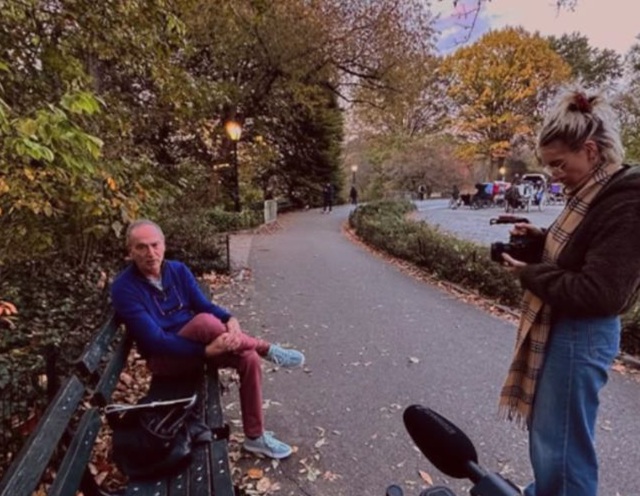
Filmmaker Oana Martisca works with a subject during filming of "New Without a Newsroom." (Photo courtesy of Oana Martisca)
What began as a master’s thesis project at the University of Miami and then a 12-minute short has grown into an 80-minute documentary about the decline of local journalism.
Directed by Romanian-born filmmaker Oana Martisca, “News Without a Newsroom” had its world premiere at the Miami Film Festival in April 2025 and has since made the festival rounds, including screenings at the Fort Lauderdale International Film Festival and the Julien Dubuque International Film Festival in Iowa. And, at the Hawaii International Fim Awards it won as Best Feature Documentary in May of 2025.
The film returns to Miami with a Q&A with the filmmaker following 1 p.m. Sunday, Aug. 16, screening at Coral Gables Art Cinema.
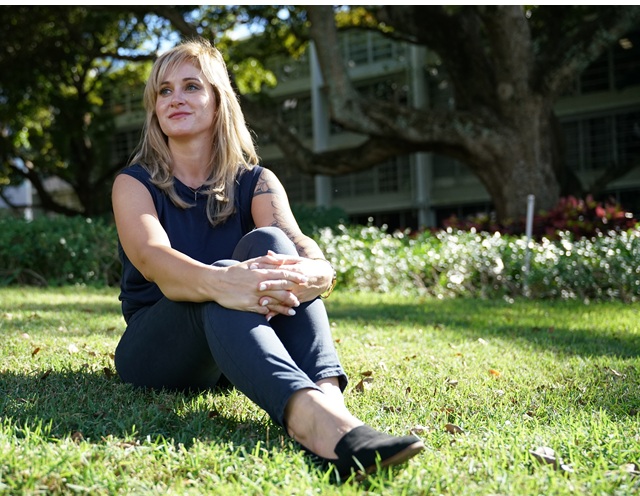
Filmmaker Oana Martisca began work on “News Without a Newsroom” while she was a graduate student at University of Miami. (Photo courtesy of Oana Martisca)
The documentary opens with archival footage of the 2014 demolition of the former Miami Herald headquarters on Biscayne Bay. Martisca’s interest in the building began while she was a master’s degree film student at UM, where a class introduced her to the history of One Herald Plaza. She initially envisioned a short documentary, but after receiving a $40,000 Knight Foundation grant, the project grew into the 80-minute “News Without a Newsroom.”
The Miami Herald figures prominently in the documentary. The Knight Foundation was established by brothers John S. and James L. Knight, who purchased the Herald in 1939 and went on to build one of the country’s largest newspaper companies. Its Miami-based foundation’s mission is to support journalism and fund projects aimed at strengthening local news.
Martisca brings together former Herald journalists to talk about what has changed. Photojournalist Maggie Steber visits the vacant lot where One Herald Plaza once stood and talks about the loss of physical newsrooms and local visual archives. Former Herald reporter and film critic Rene Rodriguez and former columnist Lizette Alvarez discuss the disappearance of neighborhood beats and what is lost when reporters no longer spend years covering the same community.
Also, “News Without a Newsroom” premiered at UM’s Bill Cosford Cinema in April of 2025. Named for the late Miami Herald film critic and UM professor, Rodriguez, who now manages the theater, is also an adjunct professor at UM’s School of Communication.
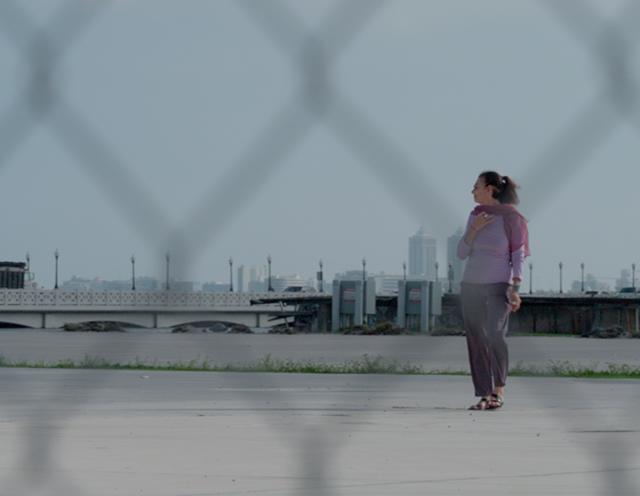
Maggie Steber, former assistant managing editor of photography and features at the Miami Herald, walks through the site where One Herald Plaza once stood during filming of the documentary “News Without a Newsroom.” (Photo courtesy of Oana Martisca)
Former Herald publisher Alberto Ibarguen, who later spent nearly two decades as president and CEO of the Knight Foundation, and former executive editor Marty Baron offer another perspective, looking at the financial and corporate pressures that have changed newspapers and local journalism.
But “News Without a Newsroom” doesn’t spend all of its time looking back. Martisca also examines what is happening now as newspapers have slashed staffs and communities no longer have a multitude of choices for local coverage. The film also addresses misinformation and media literacy and looks at nonprofit journalism as one possible way to help fill the gaps in local coverage.
She talks to Sarabeth Berman, president of the American Journalism Project, and Dale Anglin, director of Press Forward, two organizations working to strengthen and support local journalism. The film also includes Chalkbeat, a nonprofit news organization focused on education.
The documentary contrasts the days when reporters, editors and photographers worked together in a newsroom with a media landscape that is now mostly digital, complex, and fragmented.
It also raises questions about what happens when fewer reporters are covering city government, schools, neighborhoods and monitoring institutions that directly affect people's lives.
The filmmaker doesn’t offer any easy answers to what will replace the traditional newsroom and if it will even be replaced, for that matter.
Instead, “News Without a Newsroom” looks at what has been lost while introducing people who are trying to figure out how local journalism can continue and what that might look like.
WHAT: “News Without a Newsroom,” followed by a Q&A with director and producer Oana Martisca
WHEN: 1 p.m. Sunday, Aug. 16
WHERE: Coral Gables Art Cinema, 260 Aragon Ave., Coral Gables
TICKETS: $12.75 adults; $11 seniors, students and military; $8 cinema members and children 12 and under. A $1 service fee applies to online purchases.
INFORMATION: 786-472-2249; Coral Gables Art Cinema