



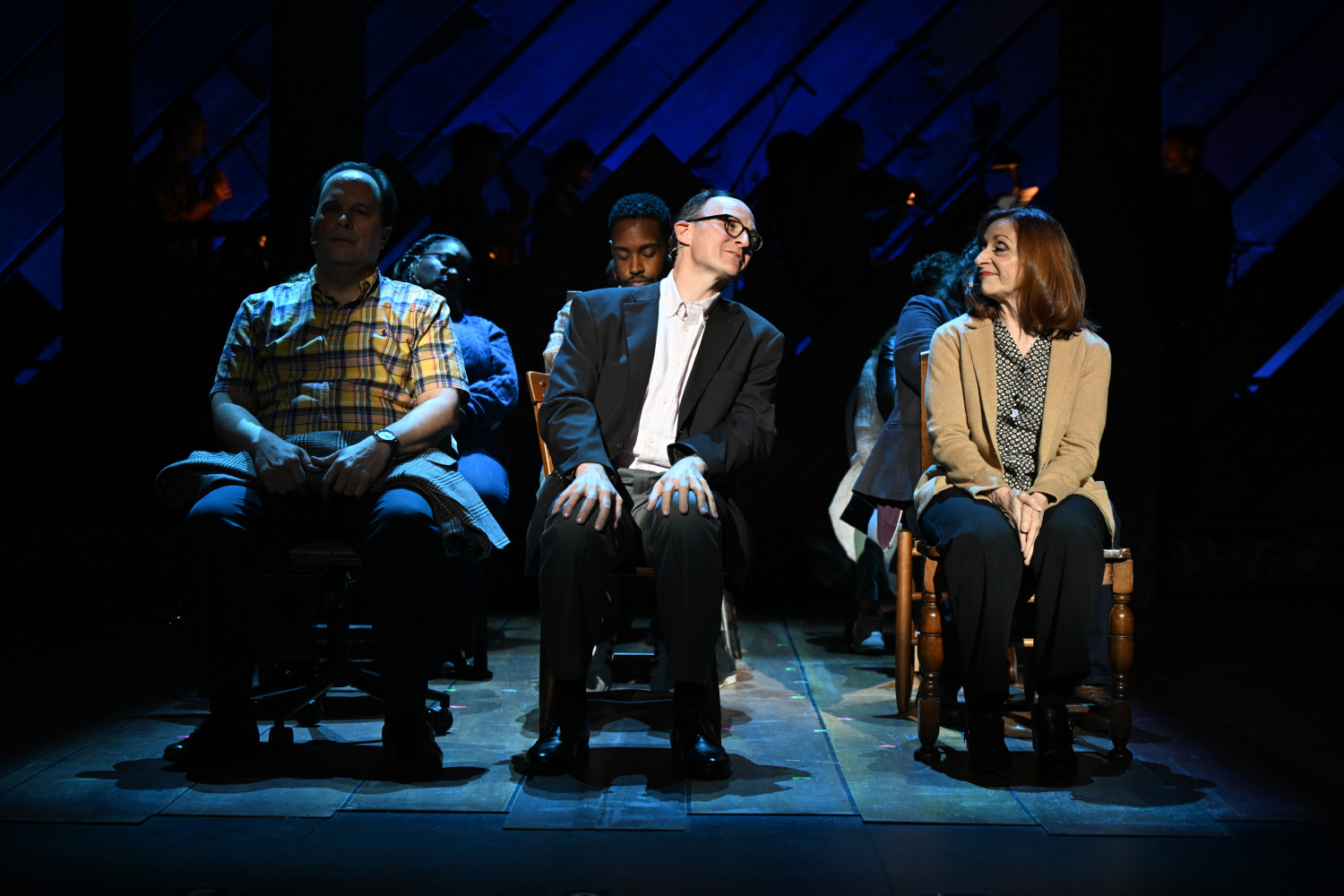
(Michael Dean Morgan, Irene Adjan and the company of Slow Burn Theatre's "Come From Away." (Photography by Larry Marano, courtesy of Slow Burn Theatre Co.)
The last thing we see in Slow Burn Theatre Company’s triumphant production of “Come From Away,” which leaves us with all the feels, is the cast jumping. It’s an apt and memorable stage picture because in the show, Gander residents jump into action almost immediately after 7,000 stranded airplane passengers land in the Canadian town on Sept. 11, 2001.
Slow Burn’s production runs through Sunday, Oct. 25, in the Amaturo Theater at the Broward Center for the Performing Arts in Fort Lauderdale. The running time is about 100 minutes without intermission.
“Come From Away,” with book, music, and lyrics by Irene Sankoff and David Hein, is an award-winning, often-performed musical based on actual events that occurred in the Canadian town of Gander during the week following the Sept. 11, 2001, terror attacks. After U.S. officials closed the country’s airspace, U.S.-bound flights had to land elsewhere. Nearly 40 planes, carrying about 7,000 people, landed at Gander International Airport, almost doubling the town’s population.
With passengers stranded in Gander for several days, the town’s generous residents opened their hearts, homes, and businesses to the travelers, while also transporting, feeding, and entertaining them. The show’s characters are based on actual Gander residents whom Sankoff and Hein interviewed during a trip to the town.
The original musical, which possesses heartbreak, humor, and heart, has earned widespread international acclaim, winning major theatrical honors on Broadway, in London’s West End, and across Canada. The script was translated into at least five languages for fully translated international professional productions.
The talented 12-member cast, under Patrick Fitzwater’s sensitive and precise direction, meets the tall challenges that the show presents. Altogether, the performers portray more than 80 characters, requiring the actors to play multiple parts.
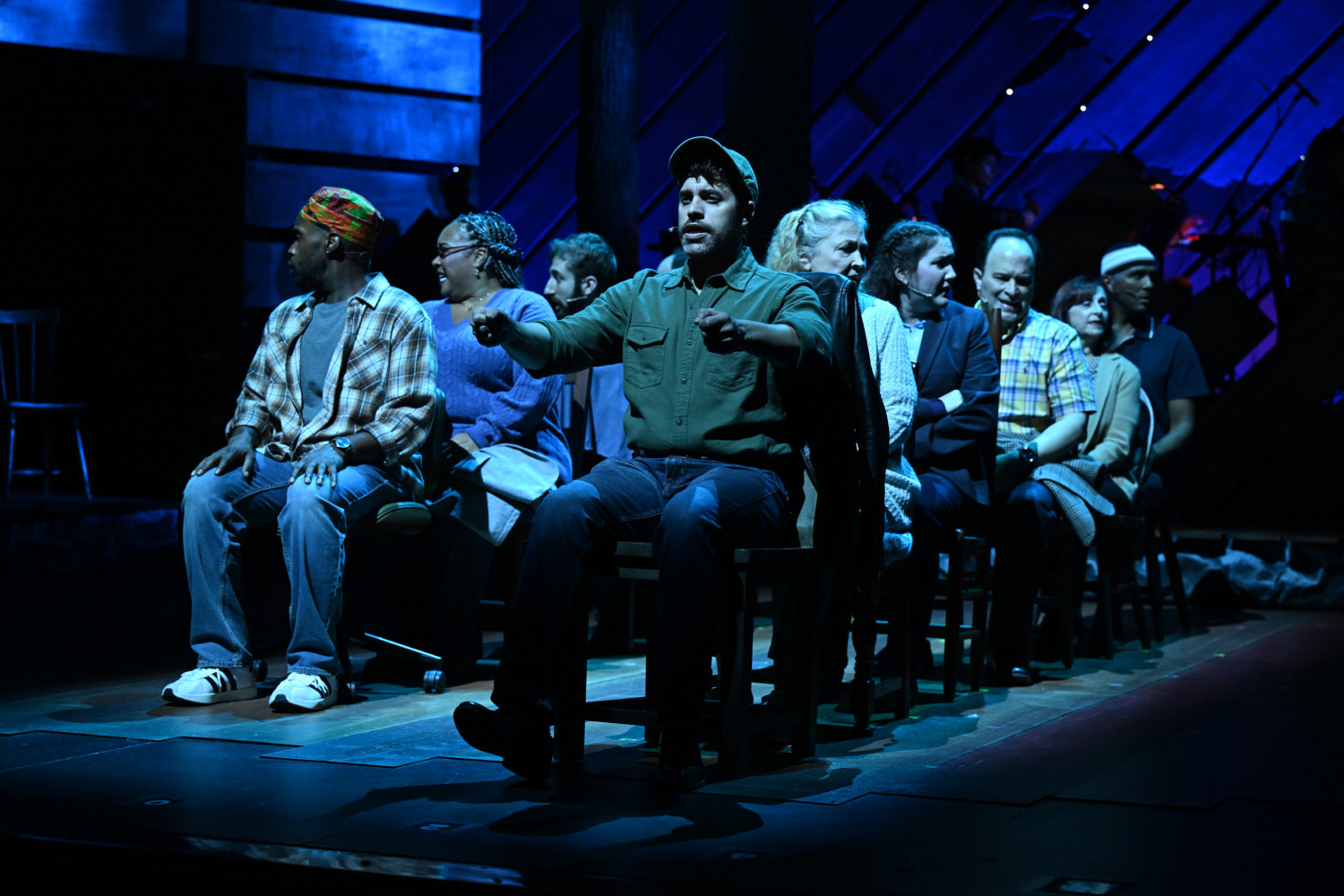
Justin Anthony Long and the company of Slow Burn Theatre's "Come From Away." (Photography by Larry Marano, courtesy of Slow Burn Theatre Co.)
To their credit, cast members move easily between characters with subtle shifts in voice, posture, and movement. They also switch naturally between dark and upbeat moments, demonstrating how life continues even in the aftermath of catastrophe.
With little fanfare, the Gander residents spring into action by preparing food, providing shelter, and entertaining the stranded travelers. During the number “Prayer,” the characters pause to pray. Their worship styles may be different, but a sense of unity suffuses the scene as the chants merge into one prayerful sound.
Following “Prayer,” the scene shifts to a tense, heated moment as national, racial, and ethnic tensions start to erupt among exhausted passengers and locals. The music is driving, chaotic, and heavy with dread. Then, to break the strife, the townspeople invite the “plane people” to a local bar. There, the show pivots to a high-energy celebration as people dance and sing an infectiously upbeat number.
At least one person stands on a table, and the scene may move you to sing and clap along. The celebration leads up to the “Screech-In” ceremony, when the outsiders become honorary Newfoundlanders.
Credit dialect coach Michael Dean Morgan, who is also a cast member, for helping the actors speak believably in a provincial accent (“Jesus” becomes “Jaysus,” for instance). As an ensemble, the cast convincingly portrays anxious, confused travelers as well as good-natured Gander residents.
While the cast succeeds as a whole, the performers also triumph with convincing individual performances. Some of the Gander residents can seem intense, but their warm-hearted ways shine through nonetheless.
Laura Turnbull injects Beulah Davis with a tireless, detail-oriented demeanor as she works diligently to lead the local relief effort. When a Gander resident asks whether the town will be ready to serve so many people, Turnbull’s Beulah sharply responds, “Well, we have to be, don’t we?” She moves with purpose and speaks with conviction, but her warmth comes across when, for instance, she supportively tells Hannah, a worried mother, that she’ll wait by the phone with her in case Hannah’s firefighter son calls from New York.
Lindsey Corey intensely yet believably portrays Bonnie, head of the local Gander SPCA (Society for the Prevention of Cruelty to Animals). Passion fills her voice as she hurries to save animals trapped on airplanes. Corey’s Bonnie can be impatient and emotional, but when she’s with those animals, she speaks compassionately while throwing in a wisecrack. “I’ve never met a rare bonobo chimpanzee before,” she tells the animal. “We don't get many of them here in Newfoundland. And since your partner there likes to throw his own feces, I'm going to say that you are the nicest rare bonobo chimpanzee I've ever met.”
At another point, with urgency, she announces, “We have two rare bonobo chimpanzees... and one of them is pregnant. The first chimp is about to be born!”
Kimberly Doreen Burns, speaking with a believable Southern accent, portrays American Airlines Capt. Beverly Bass with an air of authority while conveying her character’s pride at becoming the airline’s first female captain in 1986. You sense that Bass loves her job when Burns spreads her arms and sings “Me and the Sky” with conviction. Among other accomplishments, Bass captained the first all-female American Airlines crew from Washington, D.C., to Dallas.
“A pilot will fight to the ends of the earth to save his airplane. He just will,” Burns’ Bass says emphatically.

Justin Anthony Long and Lee Hollis Bussie in Slow Burn Theatre's "Come From Away." (Photography by Larry Marano, courtesy of Slow Burn Theatre Co.)
The line comes during a devastating sequence when the stranded passengers finally gain access to televisions in the Gander Academy cafeteria. As they watch news footage of the Sept. 11 attacks for the first time, Bass heartbreakingly realizes that one of the hijacked planes—American Airlines Flight 77, which was flown into the Pentagon—was piloted by her real-life friend and colleague, Charles “Chic” Burlingame.
As Gander Mayor Claude, Matthew W. Korinko initially portrays him with an air of formality and a sense of routine. You get the sense that he’s well aware of, and perhaps a bit tired of, the sameness, and he grows heated during negotiations with union representatives. But Korinko’s Claude gradually warms until he enthusiastically guides the Come From Aways (the stranded passengers) through the initiation steps required to become official honorary islanders.
Kareema Khouri sensitively conveys her character Hannah’s anguish as she deals with uncertainty about her son. We hear the pain in her powerful speaking and singing voice and her need to be with him in the aftermath of the Sept. 11 attacks. She sounds genuinely heartbroken when she learns that her son perished, and you want to comfort her.
In the beginning, Irene Adjan makes Diane’s anxiety about her situation palpable. You hear sincere concern in her strained voice. But gradually, Adjan’s Diane warms up to the locals and, in particular, fellow traveler Nick (an equally concerned Morgan, who grows affable over time). As time passes, the couple develop a bond, and by the end, they are fellow sightseers, standing on chairs to suggest a lookout as they visit the Dover Fault, a fracture in the Earth’s crust located on Newfoundland’s northeastern coast.
The musical includes many likable characters, including Kevin T. (a benevolent Justin Anthony Long), who, in the song “Something’s Missing,” reflects on the people of Gander’s overwhelming kindness. To give back and pay it forward, he eagerly announces that he’s starting a scholarship fund for Gander’s children. As of this year, continuous donations from the “plane people” and matching donors pushed the total to more than $2 million.
The performers shine alongside the production’s behind-the-scenes artists.
Scenic designer Nikolas Serrano created the striking, mostly unchanging set, which allows for seamless transitions between locales. Flowers and greenery hanging overhead immediately attract attention, evoking an outdoor community setting. For “Come From Away,” tree trunks, foliage, and flowers might seem like arbitrary choices. But when you consider that kindness and generosity blossom in Gander during the out-of-towners’ stay, set pieces that recall a garden seem appropriate.
Closer to the audience, on higher levels, we notice a sign proclaiming “Town of Gander” and a “Welcome” sign with an emblem of the Canadian flag nearby. Yet another sign indicates Tim Hortons, a Canadian staple. Serrano’s set relies on minor changes to indicate location changes. For instance, a row of chairs suggests both the cabin of an airplane and seats on a bus. Although the set remains basically unchanged, the human experience shifts from catastrophe to celebration.
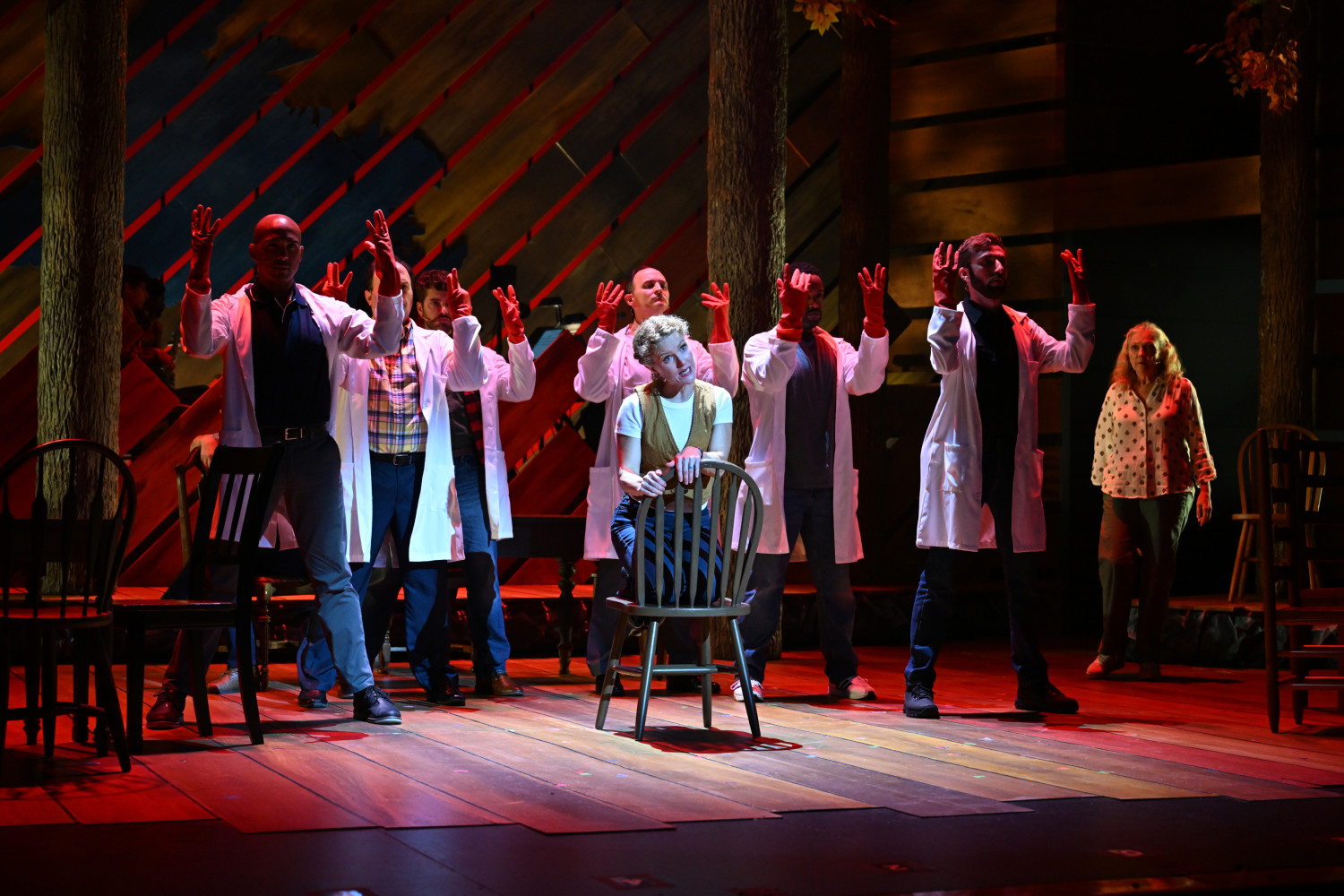
Kimberly Doreen Burns and the cast of "Come from Away" at Slow Burn Theatre. (Photography by Larry Marano, courtesy of Slow Burn Theatre Co.)
Eric Norbury’s lighting design effectively differentiates grim moments from upbeat scenes. When the locals become aware that something ominous has occurred, Norbury dims the lighting. The Gander residents are initially “in the dark” about what caused U.S.-bound aircraft to land in their town. The lighting remains dim as Bass solemnly makes an announcement pertaining to flights affected by the Sept. 11 terrorist attacks. By contrast, the lighting is bright during an upbeat bar scene in which stranded passengers become honorary Newfoundlanders by kissing a codfish. Norbury also uses hues such as red to suggest passion and potential danger.
Rick Peña’s costume design relies on fast-swapping parts to allow for quick changes. That’s significant because the 12-person cast portrays dozens of Gander townspeople and stranded airplane passengers without leaving the stage. Generally, Peña’s design uses practical, realistic early-2000s-era clothing. A skullcap helps identify a Jewish traveler.
The music of “Come From Away” features a distinctive, high-energy score by Sankoff and Hein. The writers and orchestrators describe the primary style as traditional Celtic meets contemporary folk-rock, with infusions of country, bluegrass, and punk. Much of the score draws on Newfoundland’s rich Celtic traditions. The show’s fast-paced, earthy, acoustic-driven rock foundation also reflects the creators’ admiration for Canadian folk-rock bands such as Great Big Sea.
Songs such as “Blankets and Bedding” transition into a “kicky bluegrass yarn-spinning” format, capturing the community-driven pace of the narrative. Songs focused on character development, including “Me and the Sky,” blend contemporary musical-theater power ballads with rock orchestration.
Slow Burn’s production uses a live band with instruments such as bass, guitar, mandolin, and drums. The musicians ably accompany the performers without overpowering them.
The music helps convey the community’s welcoming, lively personality, particularly in the infectiously upbeat opening number, “Welcome to the Rock.” During the song, cast members sing energetically and stomp their feet to a driving beat, making it easy to want to join them. Another cheery, memorable song is “Screech In,” which dubs travelers honorary Newfoundlanders. The cast complements its spirited singing with lively dance that further enlivens the production.
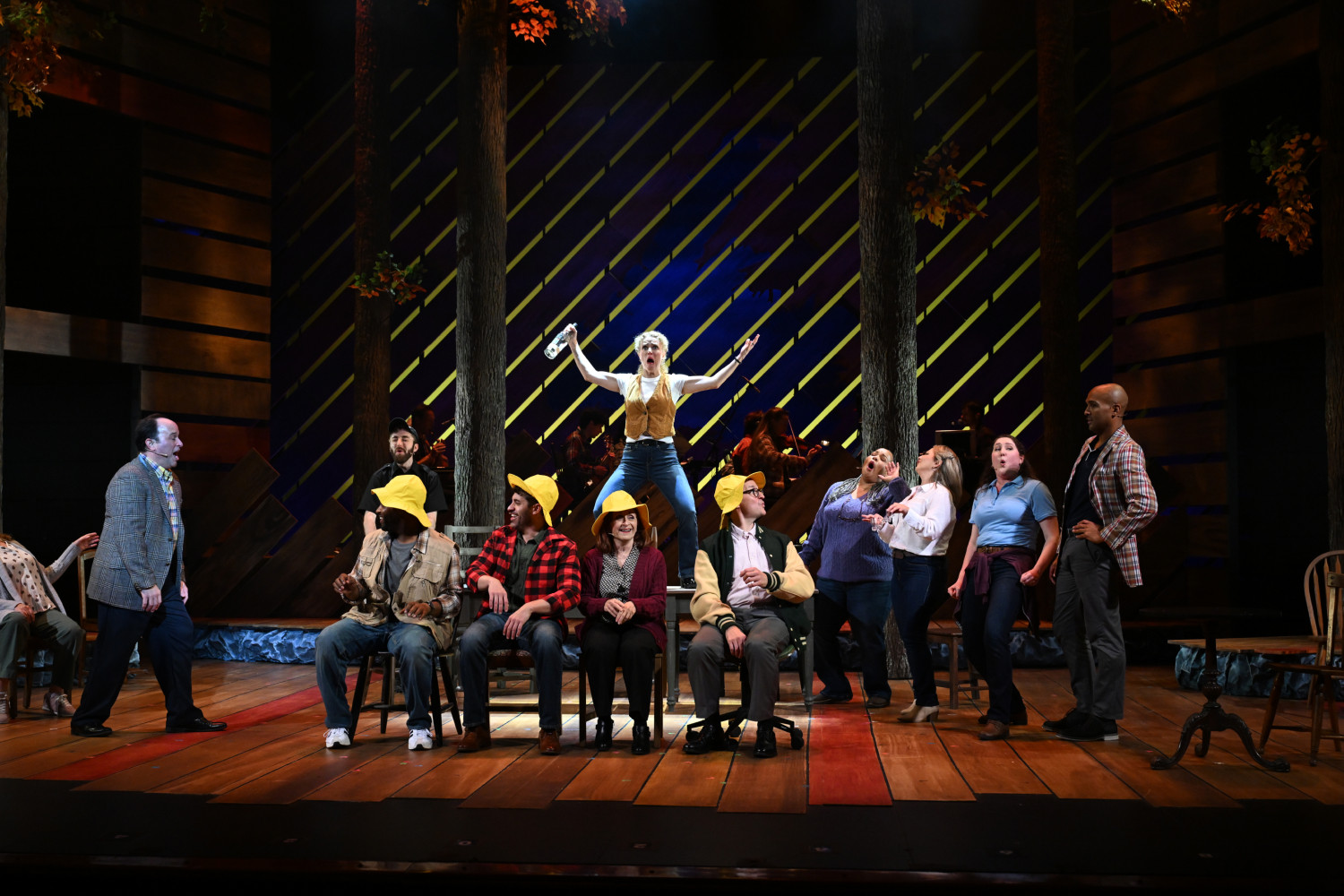
A scene from “Come From Away,” musical inspired by the true story of thousands of airline passengers stranded in a small Newfoundland town following the Sept. 11, 2001, terrorist attacks, now at Slow Burn Theatre. (Photography by Larry Marano, courtesy of Slow Burn Theatre Co.)
In addition to rousing songs, the musical includes quieter numbers that are no less powerful. For instance, “I Am Here” captures the paralyzing fear and isolation of a parent caught in a global crisis.
Meanwhile, “Me and the Sky” is a show-stopping solo anthem. The lyrics are adapted almost verbatim from a four-hour interview the show’s writers conducted with Bass.
The number begins with Bass as an 8-year-old girl watching planes at the airport. It goes on to detail her early career, when she flew corpses for a mortician for $5 an hour, coping with sexism from older pilots, and bringing male colleagues drinks. The song builds into a celebration of her achievements, then takes a chilling turn as Bass learns why she was grounded in Gander: the planes she loved, which had always represented freedom and progress, were used as weapons. Burns sings with earnest conviction, making Bass’s anguish palpable as she confronts the devastating betrayal of the aviation world she loves.
In the final analysis, “Come From Away” presents the best of humanity in the aftermath of an unimaginably tragic event that forever changed the world. Everyday, ordinary people opened their hearts and personal spaces to stranded travelers and, in the process, learned they shared more in common with the “plane people” than they realized. This true story, which renews our faith in humanity, illustrates people’s capacity for kindness at a moment’s notice, leaving us with the thought that our commonalities unite us more than our differences divide us.
Slow Burn’s fine “Come From Away” company comprises theater artists whose versatility and commitment to delivering moving theater unite them, leaving theatergoers with a memorable production that will likely linger long after the curtain has fallen.
IF YOU GO
WHAT: Slow Burn Theatre Company's production of “Come From Away.”
WHEN: Friday, Oct. 23, at 7:45 p.m.; Saturday, Oct. 24, at 1 and 7:45 p.m.; Sunday, Oct. 25, at 2 p.m.
WHERE: Amaturo Theater at the Broward Center for the Performing Arts, 201 S.W. Fifth Ave., Fort Lauderdale.
TICKETS: Prices vary by performance and seating. Visit slowburntheater.org or call 954-462-0222.